

Hemp basics · Label clarity · Evidence-first guidance
Two bottles can say “hemp” and contain very different products
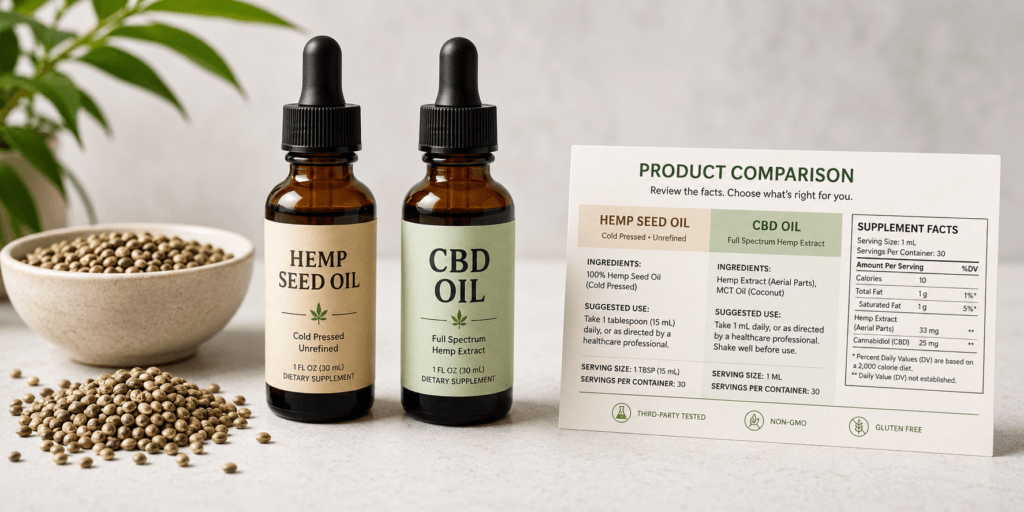
Hemp seed oil and CBD oil may sit beside each other online, in a wellness aisle, or inside a skincare display. Their labels may use similar green leaves, earthy colors, and phrases such as “natural hemp.” That visual similarity can hide a much more important fact: these oils come from different parts of the plant, contain different compounds, and should not be expected to produce the same effects.
Hemp seed oil is primarily a food or cosmetic oil. CBD oil contains cannabidiol, a biologically active compound that may cause side effects, interact with medications, and require closer attention to dosage and product testing.
By Kevin Meyer · Evidence reviewed July 26, 2026 · No product endorsements
The quick answer
Hemp seed oil is pressed from hemp seeds. It normally contains only trace or insignificant amounts of CBD and THC and is commonly used as a culinary oil, nutritional ingredient, or skin moisturizer.
CBD oil is made by combining a cannabidiol-rich hemp extract with a carrier oil. It contains a measured or claimed amount of CBD and may also contain other cannabinoids, including THC, depending on the formulation.
The simplest label test is this: if the bottle does not state how many milligrams of CBD it contains, do not assume that “hemp oil” provides CBD.
Hemp seed oil vs. CBD oil at a glance
| Question | Hemp seed oil | CBD oil |
|---|---|---|
| Where does it come from? | Pressed primarily from hemp seeds. | CBD is extracted mainly from cannabinoid-rich flowers and other aerial plant material, then placed in a carrier oil. |
| What does it contain? | Dietary fats and other seed-derived nutrients, with normally only trace or insignificant CBD and THC. | A stated amount of CBD, a carrier oil, and possibly other cannabinoids or plant compounds. |
| How is it commonly used? | Foods, dressings, smoothies, nutritional products, cosmetics, and moisturizers. | Oils, tinctures, capsules, gummies, topicals, and other products marketed for wellness purposes. |
| Is it biologically active like CBD? | It is primarily a food or cosmetic ingredient and should not be expected to produce CBD effects. | Yes. CBD can affect the body, cause side effects, and interact with certain medications. |
| Could THC be relevant? | Properly made seed oil contains, at most, trace contamination from contact with other plant material. | Full-spectrum products may contain measurable THC. Mislabeled or contaminated products may also create unexpected exposure. |
| What should the label show? | A clear ingredient name, intended culinary or cosmetic use, Nutrition Facts when sold as food, and storage directions. | CBD per serving and per package, spectrum type, THC information, complete ingredients, batch number, and a matching laboratory report. |
The difference begins with the part of the plant
Hemp seed oil
Hemp seed oil is produced by pressing the plant’s seeds. The seeds do not naturally contain meaningful concentrations of CBD or THC. Very small trace amounts may appear when seeds contact flowers, leaves, or resin during harvesting and processing.
The U.S. Food and Drug Administration has evaluated notices involving hulled hemp seed, hemp seed protein powder, and hemp seed oil for specified food uses. The agency explains that these seed-derived ingredients contain only trace cannabinoid amounts and are not capable of making consumers feel high.
CBD oil
CBD is concentrated mainly in resin-rich flowers and other above-ground portions of the hemp plant. Manufacturers extract the cannabidiol and then commonly dilute it in a carrier such as coconut-derived MCT oil, olive oil, or hemp seed oil.
This creates an easily missed nuance: a CBD product may list hemp seed oil as its carrier. The presence of hemp seed oil in the ingredient list does not tell you how much CBD the finished product contains. The label should state the CBD amount separately.
Do not let the phrase “hemp oil” make the decision for you. It may describe ordinary seed oil, a cannabinoid extract, a CBD product carried in hemp seed oil, or vague marketing language. Look for the exact ingredient and a clearly stated CBD amount.
What benefits can each oil reasonably offer?
A trustworthy comparison should not dismiss either product, but it should also avoid treating every potential benefit as proven. The quality of the evidence depends on which oil, dose, formulation, and intended use we are discussing.
Hemp seed oil: food and skin-care value
Hemp seed oil contains unsaturated fats and can be used in foods such as dressings, dips, and smoothies when the product is labeled for culinary use. Its exact nutrient content and serving size should be checked on the Nutrition Facts panel.
In cosmetics, hemp seed oil can act as an emollient that softens and moisturizes the skin. That is different from proving that the oil treats eczema, psoriasis, acne, arthritis, heart disease, or another medical condition.
For a broader evidence-based discussion, read
Hemp as a Natural Remedy: What the Evidence Really Says.
CBD oil: real activity, but use-specific evidence
CBD is not merely a nutritional oil. It is biologically active. The strongest established evidence applies to an FDA-approved prescription cannabidiol medicine used for seizures associated with specific medical conditions.
Research involving pain, anxiety, sleep, inflammation, and other concerns has produced some encouraging findings, but retail CBD products, doses, and formulations are not interchangeable with prescription CBD or controlled clinical research.
“Being studied for” does not mean “proven to treat.” A consumer CBD bottle should not replace professional evaluation or prescribed treatment.
Why CBD oil requires a different safety conversation
Hemp seed oil used as an ordinary food does not raise the same questions as a concentrated CBD extract. CBD may affect alertness, the liver, and the way certain medications are processed.
Before using CBD, involve a physician or pharmacist when you take prescriptions or over-the-counter medicines, have liver concerns, are preparing for surgery, are pregnant or breastfeeding, or are considering the product for a child.
-
Review possible interactions in
Can CBD Interact With Medications? -
Learn about alertness in
Can CBD Make You Drowsy? -
Understand liver concerns in
Can CBD Affect Your Liver? -
Disclose CBD before a procedure using
Should You Stop Taking CBD Before Surgery? -
Consider overlapping effects in
Can You Mix CBD and Alcohol?
Which oil fits the reason you are shopping?
-
For cooking or nutrition
Choose a food-grade hemp seed oil with Nutrition Facts, clear storage directions, and an ingredient list that does not rely on vague “hemp extract” language.
-
For moisturizing skin
Look for a cosmetic product that clearly identifies hemp seed oil and lists all added fragrances, preservatives, and other ingredients. Patch-test new cosmetics when appropriate.
-
For cannabidiol
Look for an exact CBD amount, spectrum type, THC information, batch number, and a matching Certificate of Analysis. Discuss health and medication concerns before purchasing.
How to read the label without being misled
On a hemp seed oil product, check for:
- “Hemp seed oil” or “Cannabis sativa seed oil” in the ingredients
- A clear statement that the product is culinary or cosmetic
- Nutrition Facts when it is sold as food
- Storage and refrigeration instructions
- A best-by date and intact packaging
- No implication that ordinary seed oil provides a meaningful CBD dose
On a CBD oil product, check for:
- CBD milligrams per serving and per bottle
- Full-spectrum, broad-spectrum, or isolate identification
- Clear THC information rather than a vague “hemp-derived” claim
- A lot or batch number that matches the laboratory report
- Testing for cannabinoid potency and relevant contaminants
- A complete ingredient list, serving guidance, and warnings
Learn how these CBD formulations differ in
Full-Spectrum vs. Broad-Spectrum vs. CBD Isolate.
Then use the site’s
CBD Certificate of Analysis guide
to inspect the actual laboratory report.
The Hemp Medical Benefits product recommendation promise
Hemp Medical Benefits may eventually recommend a limited number of carefully reviewed hemp or CBD products. Affiliate relationships will not determine the site’s medical, safety, or evidence conclusions.
Education comes first
A product will be introduced only when it supports information the reader already needs—not simply because a commission is available.
CBD partners must be vetted
Future CBD recommendations must provide transparent labels, accessible batch-specific reports, contaminant testing, realistic claims, and dependable customer support.
Sensitive articles stay commerce-free
Articles involving pregnancy, surgery, liver health, medication interactions, impairment, drug testing, children, and serious medical concerns will not be used as CBD sales pages.
Relationships remain reviewable
A partner may be removed if its labeling, laboratory access, claims, product line, or business practices no longer meet the site’s standards.
Our goal is simple: help readers separate credible hemp and CBD products from exaggerated promises, unclear labels, and avoidable risks.
Will hemp seed oil or CBD oil make you high?
Properly produced hemp seed oil is not intoxicating. The FDA explains that hemp seeds do not naturally contain THC or CBD and that the trace amounts sometimes acquired during harvesting or processing are not capable of making consumers feel high.
CBD itself is generally described as nonintoxicating, but that does not mean every CBD oil is free of THC or incapable of affecting alertness. Full-spectrum products may contain measurable THC, and inaccurate labeling or contamination can create additional uncertainty.
People subject to workplace, athletic, legal, or safety-sensitive testing should read
Can Hemp-Derived CBD Make You Fail a Drug Test?.
No retail CBD label can guarantee a negative result.
Four-question knowledge check
Open each question to check your answer.
1. Does ordinary hemp seed oil provide a meaningful CBD dose?
Answer: Usually no.
Hemp seeds do not naturally contain meaningful concentrations of CBD. A product contains a CBD dose only when cannabidiol extract has been deliberately added and clearly identified.
2. Can a CBD oil use hemp seed oil as its carrier?
Answer: Yes.
Hemp seed oil may appear in a CBD product as the carrier. Check the separate CBD amount rather than judging the product from the carrier oil alone.
3. Does “hemp-derived” guarantee that a CBD oil contains no THC?
Answer: No.
Full-spectrum products may contain THC, and labels are not always accurate. Review the spectrum type and a batch-matched laboratory report.
4. Should a CBD oil be treated like an ordinary cooking oil?
Answer: No.
CBD is biologically active and may cause side effects or medication interactions. Its dose, ingredients, THC content, and laboratory testing deserve closer review.
Frequently asked questions
Is hemp oil the same as hemp seed oil?
Sometimes sellers use “hemp oil” to mean hemp seed oil, but the phrase is not precise enough to rely on. Check whether the ingredient is seed oil, a cannabinoid-rich hemp extract, or CBD mixed into a carrier oil.
Does hemp seed oil contain CBD?
Hemp seeds do not naturally contain meaningful CBD. Properly produced hemp seed oil may contain only trace amounts acquired through contact with other plant material unless CBD extract has been intentionally added.
Can hemp seed oil be taken with medication?
Culinary hemp seed oil is primarily a food, not concentrated CBD. However, anyone with food allergies, dietary restrictions, swallowing concerns, or medically directed fat limits should review the exact product with an appropriate healthcare professional.
Is CBD oil better than hemp seed oil?
Neither is universally better. They serve different purposes. Hemp seed oil is primarily nutritional or cosmetic, while CBD oil contains an active cannabinoid and raises additional questions about dosage, effectiveness, interactions, THC, and product quality.
Can CBD oil be used for cooking?
Follow the product’s label and intended use. CBD products should not be treated as ordinary cooking oils, and heating may affect ingredients or dosing. CBD also remains subject to federal, state, and product-category rules that differ from those governing hemp seed food ingredients.
Does a Certificate of Analysis prove that CBD works?
No. A laboratory report can describe measured cannabinoids and contaminants in a tested sample. It cannot prove that the product is clinically effective, appropriate for your condition, free of side effects, or safe with your medications.
Which oil is more likely to affect a drug test?
CBD oil creates more concern, especially when it is full-spectrum, inaccurately labeled, or contaminated with THC. Ordinary hemp seed oil is not intended to contain meaningful cannabinoids, although no product should be used as a guaranteed drug-testing strategy.
The bottom line
Hemp seed oil and CBD oil may come from the same plant species, but they belong in different decision-making categories.
Choose hemp seed oil when you are looking for a clearly labeled culinary or cosmetic seed oil. Consider CBD only when you understand the exact amount, formulation, THC content, laboratory report, possible side effects, and medication concerns.
That distinction does not diminish CBD’s potential or hemp seed oil’s usefulness. It gives each product a fairer, more accurate place—and helps you avoid buying one while expecting the other.
Authoritative sources
-
U.S. Food and Drug Administration: Hemp seed-derived ingredients used in human food
-
U.S. Food and Drug Administration: Regulation of cannabis and CBD
-
Centers for Disease Control and Prevention: About CBD
Medical information is provided for general education and does not replace individualized advice from a physician, pharmacist, dietitian, or other qualified professional.