

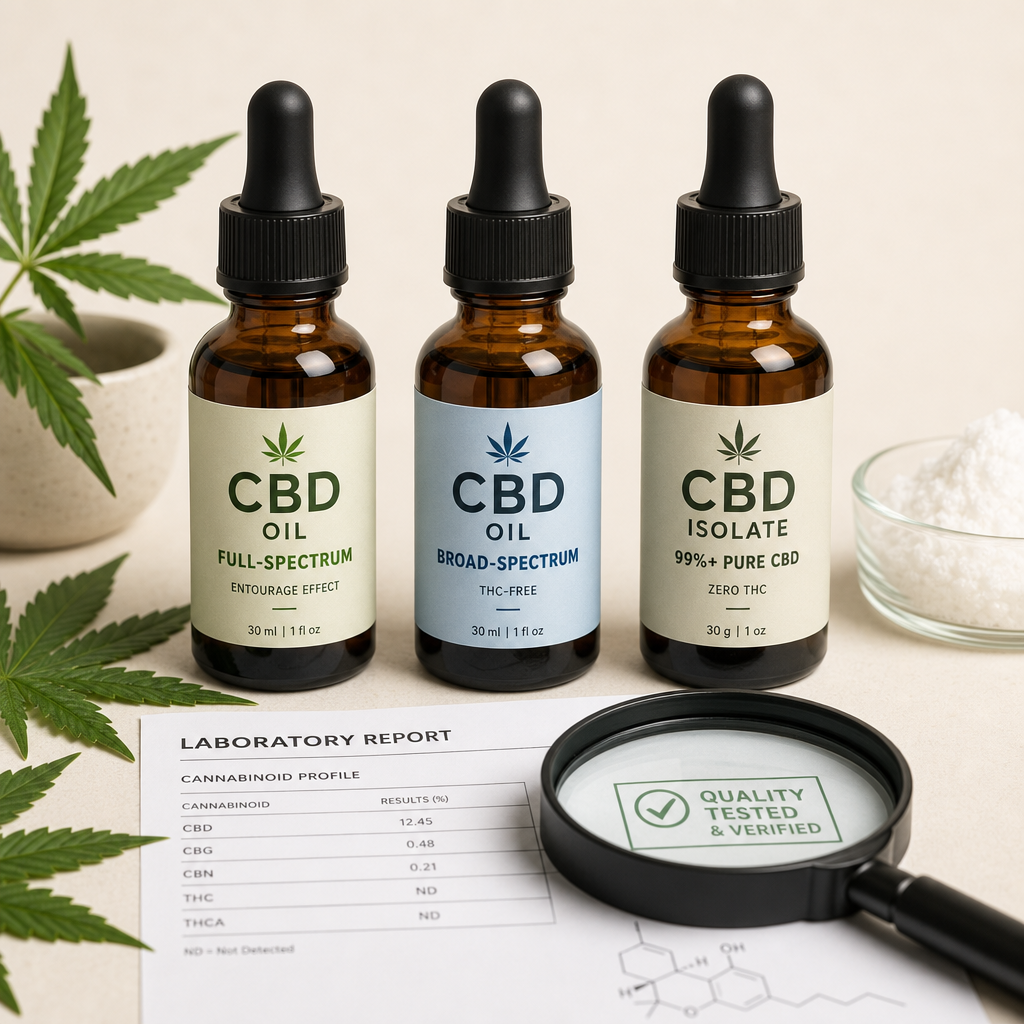
CBD label decoder
Three bottles can look nearly identical while containing very different combinations of CBD, THC, minor cannabinoids, plant compounds, and added ingredients. The right comparison begins with what is actually in the product—not which label sounds most impressive.
The quick answer
There is no universally “best” CBD spectrum. The better choice depends on whether you need to avoid THC, prefer a simpler ingredient profile, want a wider range of hemp compounds, take medications, undergo drug testing, or live somewhere with product restrictions.
Retains the widest range of naturally occurring hemp compounds and may contain measurable THC.
Contains CBD and other hemp compounds, with THC intentionally removed or reduced.
Uses highly purified CBD with other cannabinoids and plant compounds removed in theory.
The important catch: These are common industry descriptions—not FDA approval seals or guarantees of what a particular bottle contains. A batch-specific certificate of analysis is more informative than the words printed across the front.
Full-spectrum vs. broad-spectrum vs. CBD isolate at a glance
| Product type | What it generally contains | THC reality | Possible reason to consider it | Main concern |
|---|---|---|---|---|
| Full-spectrum CBD | CBD, additional cannabinoids, terpenes, and other extractable plant compounds | May intentionally contain THC within the product’s applicable legal limit | You want a less-refined extract and are comfortable with the disclosed cannabinoid profile | Greater THC exposure and drug-testing concern |
| Broad-spectrum CBD | CBD plus selected cannabinoids and plant compounds after THC-removal processing | Often marketed as THC-free, but residual THC, contamination, or inaccurate labeling may occur | You prefer multiple hemp compounds while attempting to limit THC exposure | “THC-free” and “non-detectable” are not absolute guarantees |
| CBD isolate | Purified CBD with most other cannabinoids, terpenes, and plant material removed | Should contain little or no measurable THC when accurately produced and tested | You want the simplest cannabinoid profile | Manufacturing errors, cross-contamination, and inaccurate reports remain possible |
That table describes what the labels are intended to mean. It does not prove that every manufacturer uses the terms consistently or that every batch matches the package.
What does full-spectrum CBD mean?
Full-spectrum products retain more of the original extract
A full-spectrum extract is generally processed to preserve CBD along with additional naturally occurring cannabinoids, terpenes, flavonoids, and other plant compounds. Its exact profile depends on the hemp material, extraction process, formulation, storage, and manufacturing controls.
Full-spectrum does not mean that the product contains every compound found in the original plant, nor does it establish a medically useful ratio. It simply indicates that the extract is intended to retain a broader range of components than isolate.
The defining practical concern is THC. A full-spectrum product may contain measurable THC even when it is described as hemp-derived and nonintoxicating. The amount in one serving can differ from the amount in the entire bottle or package.
Full-spectrum may deserve extra caution when:
- You undergo workplace, federal, military, school, or athletic drug testing.
- You must avoid impairment or THC exposure for legal, occupational, or personal reasons.
- You are sensitive to THC or have experienced unwanted effects from cannabis products.
- The label does not provide a batch-specific cannabinoid report.
- The product relies on a dry-weight percentage without clearly stating milligrams per serving and per container.
For a more detailed explanation of testing risk, read Can Hemp-Derived CBD Make You Fail a Drug Test?
What does broad-spectrum CBD mean?
Broad-spectrum products attempt to preserve variety while reducing THC
Broad-spectrum CBD typically begins as a hemp extract containing multiple cannabinoids and plant compounds. Additional processing is then used to remove or substantially reduce THC while preserving at least some of the remaining components.
This can sound like the obvious compromise: more plant compounds than isolate, but none of the THC associated with full-spectrum products. In practice, the label still needs verification.
Why “THC-free” may not mean absolute zero
A laboratory may report THC as ND, meaning “not detected.” That generally means the compound was not detected above the laboratory method’s stated limit. It does not necessarily prove that no THC molecule is present.
Residual THC can also remain after processing, be introduced through cross-contamination, or appear because the package and laboratory report do not accurately describe the same batch.
Broad-spectrum may reduce THC exposure compared with a full-spectrum formulation, but it should never be treated as a guaranteed way to pass a drug test.
What does CBD isolate mean?
CBD isolate removes most of the extract’s other components
CBD isolate is a highly purified form of cannabidiol. Manufacturers remove other cannabinoids, terpenes, waxes, pigments, and much of the remaining plant material to create an ingredient intended to consist primarily of CBD.
Isolate may appeal to someone who wants fewer cannabinoid variables, dislikes the flavor of less-refined extracts, or is trying to minimize THC exposure. It can be added to oils, capsules, gummies, powders, creams, and other formulations.
However, “isolate” does not automatically make the finished product simple. The formula may still include carrier oils, sweeteners, flavorings, preservatives, allergens, colorants, or other active ingredients. Always read the complete ingredient list.
Isolate is not a zero-risk promise
An isolate product can still be inaccurately labeled or contaminated during manufacturing. A reliable certificate of analysis should confirm both the cannabinoid profile and contaminant testing for the exact batch being purchased.
Is full-spectrum CBD stronger or better?
Not automatically. A full-spectrum label describes the product’s general composition—not its potency, effectiveness, safety, or suitability for a particular person.
The phrase “entourage effect” is often used to suggest that cannabinoids, terpenes, and other plant compounds work better together than CBD does alone. Researchers continue to investigate possible interactions among these compounds, but the term is frequently presented with more certainty in advertising than the clinical evidence supports.
A wider ingredient profile may produce different effects, but “more compounds” does not automatically mean “more effective.” It can also mean more variables, a greater chance of THC exposure, and additional opportunities for an unwanted reaction.
Which type best matches your priority?
You want the simplest cannabinoid profile
A verified CBD isolate may be the most direct match. Check the other ingredients, potency, and batch report rather than assuming the finished product contains only CBD.
You want multiple compounds but less THC exposure
A well-tested broad-spectrum product may fit that preference, but “THC-free” should be confirmed with a matching laboratory report and still cannot guarantee a negative drug test.
You accept disclosed THC and prefer a wider extract
Full-spectrum may fit that preference when it is lawful where you live and the complete cannabinoid profile is clearly reported.
A positive drug test could affect your livelihood
The lowest-risk decision is to avoid nonprescription CBD and hemp cannabinoid products. Even isolate and broad-spectrum labels cannot eliminate all product-related uncertainty.
You take prescription or over-the-counter medicine
Do not choose a spectrum based only on marketing. CBD itself can interact with medications, including products that contain no THC.
You are looking for treatment for a health condition
Speak with a qualified healthcare professional. A retail product’s spectrum does not establish that it is safe, effective, or appropriately dosed for a medical condition.
Learn more about medication precautions in Can CBD Interact With Medications? What Hemp Users Need to Know.
Why the label alone is not enough
A 2024 laboratory analysis examined 202 commercially available CBD tinctures, gummies, vape products, and topicals selected from the United States market. The researchers compared measured cannabinoid content with product labels and also tested for several types of contamination.
The study also detected heavy metals, residual solvents, or pesticides in some samples, although contamination levels and regulatory-threshold violations varied. Because the products were selected to represent a retail-market sample rather than every product sold, the results should not be interpreted as a failure rate for every brand.
They do, however, illustrate why front-label terms are insufficient. Product quality must be supported by transparent manufacturing practices and a report that matches the bottle or package in hand.
How to read a certificate of analysis before buying
A certificate of analysis, commonly shortened to COA, is a laboratory report describing what was detected in a product sample. A COA cannot make a product medically effective or guarantee that you will pass a drug test, but it can expose mismatches and missing information.
- Match the batch or lot number. The number on the report should match the package. A generic company report may describe an older or completely different batch.
- Check the product name and form. A report for an unflavored tincture does not verify a flavored gummy, topical cream, or newer formulation.
- Look for an independent laboratory. The report should identify the laboratory, location, test date, methods, and contact information. Laboratory accreditation can add confidence, although it does not make every result infallible.
- Compare measured CBD with the label. Determine whether the report uses milligrams per gram, milligrams per milliliter, milligrams per piece, or a percentage. These units are not interchangeable.
- Read the complete cannabinoid panel. Do not stop at the CBD result. Review delta-9 THC, THCA, total THC when reported, and any other cannabinoids that matter to your legal, testing, or sensitivity concerns.
- Understand “ND” and “LOQ.” “Not detected” refers to the laboratory’s detection capability. The limit of quantitation, or LOQ, shows the lowest amount the method could reliably measure.
- Check contaminant panels. Depending on the product, useful testing may include pesticides, heavy metals, residual solvents, microbes, mycotoxins, and other manufacturing-related contaminants.
- Watch for unexplained omissions. A potency-only report does not establish contaminant safety. A report without a batch number, test date, or laboratory identity provides little reassurance.
Do not confuse total CBD with CBD per serving
Large numbers on the front of a bottle usually describe the total CBD in the entire container. That number can look more impressive than the amount in one serving.
Also check the serving volume. A dropper may be marked at several levels, and “one dropper” does not always mean the dropper is filled to the top. Gummies and capsules should list the amount per piece as well as the number of pieces considered one serving.
A manufacturer’s suggested serving is not the same as a medically validated dose. The FDA has not established standard over-the-counter CBD doses for sleep, pain, anxiety, inflammation, or other common wellness claims.
A major federal hemp change is scheduled for November 2026
Legal update current as of July 2026
A federal law enacted in November 2025 narrowed the definition of hemp. The amended definition is scheduled to take effect on November 12, 2026, unless Congress changes the law before then.
Among its provisions, the new definition excludes final hemp-derived cannabinoid products containing more than 0.4 milligrams per container of combined total tetrahydrocannabinols and certain cannabinoids with similar effects.
This is a container-level limit—not simply the familiar 0.3% delta-9 THC dry-weight standard associated with the 2018 Farm Bill. Many existing full-spectrum products may need to be reformulated, relabeled, removed, or reassessed under the new definition.
Federal classification is only one layer. State and local rules can be stricter, and laws may continue changing. Verify the rules that apply where you live and where a product is being shipped.
This changing legal landscape gives shoppers another reason to inspect current batch reports instead of relying on an old product review, archived label image, or general statement that a brand is “Farm Bill compliant.”
For the foundational distinction between the plant and its legal categories, see The Difference Between Hemp and Cannabis: What You Need to Know.
CBD safety does not depend only on THC
Choosing isolate or broad-spectrum does not remove the effects associated with CBD itself. The Centers for Disease Control and Prevention and the FDA caution that CBD use is not risk-free.
Potential concerns include medication interactions, liver injury, drowsiness, diarrhea or appetite changes, and changes in mood or alertness. Important questions also remain about long-term use and how different routes of administration affect exposure.
- Medications: Ask a physician or pharmacist to review prescriptions, over-the-counter drugs, and supplements together.
- Pregnancy and breastfeeding: The FDA advises against CBD, THC, and marijuana use during pregnancy or breastfeeding.
- Driving and machinery: Drowsiness or unexpected THC exposure can make safety-sensitive activity dangerous.
- Children: Keep gummies, oils, drinks, and other cannabinoid products in child-resistant packaging and out of reach.
- Liver concerns: Seek professional guidance if you have liver disease, abnormal test results, or take medicines that affect the liver.
- Surgery or procedures: Tell the healthcare team about CBD, cannabis, supplements, and other products before a scheduled procedure.
The FDA has approved one prescription medicine containing purified CBD for seizures associated with specific conditions. That approval applies to the prescription product, its manufacturing standards, studied doses, and approved uses. It does not establish that ordinary retail CBD products are approved treatments.
A practical CBD buyer checklist
Before purchasing a full-spectrum, broad-spectrum, or isolate product, confirm as many of these points as possible:
- The label clearly states whether the CBD amount is per serving or per container.
- The extract type is identified without implying that the label itself guarantees purity.
- A batch or lot number appears on both the package and laboratory report.
- The COA includes CBD, THC-related compounds, and relevant contaminant testing.
- The product has a complete ingredient list, including carrier oils, flavors, sweeteners, and allergens.
- The company provides a physical location or dependable contact information.
- The packaging includes storage instructions, warnings, and an expiration or best-by date.
- The marketing avoids promises to diagnose, cure, prevent, or treat serious diseases.
- The product is lawful where you live and compatible with workplace, athletic, school, or professional rules.
- A healthcare professional has reviewed the decision when medicines or health conditions are involved.
Knowledge check: Can you decode the label?
Choose your answer, then open each question to check it.
1. Does “broad-spectrum” guarantee that a product contains absolutely no THC?
Answer: No. Broad-spectrum products are intended to have THC removed or substantially reduced, but residual THC, cross-contamination, inconsistent terminology, and inaccurate labeling can still occur.
2. Is a full-spectrum product automatically more potent than CBD isolate?
Answer: No. Spectrum describes the range of compounds. Potency depends on the measured amount of CBD and other cannabinoids per serving.
3. Does “ND” on a laboratory report always mean absolute zero?
Answer: No. It normally means the laboratory did not detect the compound above the method’s stated detection or quantitation limit.
4. Can CBD isolate still interact with medication?
Answer: Yes. Removing THC and other hemp compounds does not remove CBD’s potential to affect drug-processing pathways or contribute to side effects.
The bottom line
Full-spectrum generally provides the widest hemp-compound profile but carries the clearest THC concern. Broad-spectrum attempts to preserve several compounds while reducing THC, although the result must be verified. CBD isolate offers the simplest cannabinoid profile, but quality and label accuracy still matter.
The smartest decision is not based on which option sounds most natural, pure, advanced, or powerful. It is based on your medications, health considerations, drug-testing exposure, legal environment, ingredient preferences, and the evidence supplied for the exact batch.
Read beyond the front label. Match the COA. Check the units. Understand what “not detected” means. And when the decision involves health or prescribed medicine, bring the package and laboratory report to a qualified healthcare professional.
Frequently asked questions
Which CBD type is least likely to contain THC?
A properly manufactured and verified CBD isolate is generally intended to have the least THC, followed by broad-spectrum. However, no retail label can guarantee zero exposure. Manufacturing quality, cross-contamination, laboratory limits, and label accuracy still matter.
Can full-spectrum CBD make someone feel high?
CBD itself is not considered intoxicating, but full-spectrum products may contain THC. Whether someone notices psychoactive effects depends on the actual THC amount, serving size, frequency of use, individual sensitivity, and product accuracy. A “hemp-derived” label does not guarantee that effects are impossible.
Is broad-spectrum CBD safe for workplace drug testing?
It may present less THC exposure than full-spectrum, but it is not drug-test safe by definition. Residual THC, contamination, and incorrect labeling can still create risk. When a positive result could affect employment, licensing, military service, or competition, avoiding nonprescription cannabinoid products is the most dependable way to avoid product-related exposure.
Does CBD isolate work as well as full-spectrum CBD?
There is no universal answer. Results may vary by product, amount, intended use, individual response, and condition being studied. Marketing claims about the entourage effect do not prove that every full-spectrum product is more effective than isolate.
What is the difference between hemp seed oil and CBD oil?
Hemp seed oil is pressed from hemp seeds and is primarily a food or cosmetic oil. The seeds do not naturally contain meaningful amounts of CBD. CBD oil is formulated with cannabidiol extracted mainly from cannabinoid-rich flowers and other aerial plant material. A bottle labeled only “hemp oil” may contain little or no CBD.
Can a topical CBD product contain THC?
Yes. Topicals may be full-spectrum, broad-spectrum, or isolate-based. Some products also contain additional cannabinoids. Do not assume a cream or balm is THC-free simply because it is applied to the skin.
Should someone stop prescribed medicine before trying CBD?
No. Do not stop, reduce, or replace prescribed treatment without guidance from the prescriber. Ask a physician or pharmacist to evaluate the specific medicine, CBD product, amount, frequency, and health history.
How can I tell whether a CBD company is trustworthy?
Look for batch-specific independent testing, clear potency units, complete ingredients, realistic claims, dependable contact information, transparent warnings, and reports covering both cannabinoids and contaminants. These steps reduce uncertainty but do not establish medical effectiveness or eliminate every risk.
Sources and further reading
- Centers for Disease Control and Prevention: About CBD
- U.S. Food and Drug Administration: What to Know About Cannabis-Derived Products and CBD
- FDA Regulation of Cannabis and Cannabis-Derived Products
- Product Labeling Accuracy and Contamination Analysis of Commercial CBD Products
- U.S. Government Publishing Office: Agricultural Marketing Act, Including the Hemp Definition Effective November 12, 2026
- FDA Guidance on CBD During Pregnancy and Breastfeeding
Medical and legal disclaimer: This article provides general educational information and is not medical, legal, employment, or drug-testing advice. CBD can cause side effects and interact with medications. Product composition, laws, employer rules, testing policies, and scientific evidence can change. Consult qualified healthcare and legal professionals when a decision may affect your health, treatment, employment, license, or legal status.