

CBD safety · Alcohol awareness · Evidence-first guidance
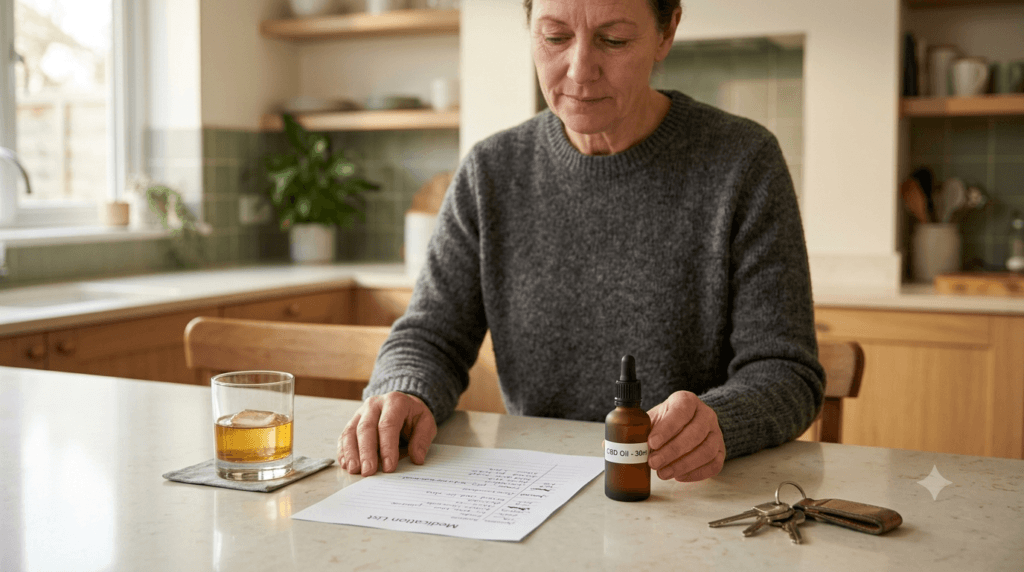
A CBD gummy and a glass of wine may look like an ordinary evening combination. The harder question is whether their effects on alertness, judgment, medication safety, and the liver can overlap in ways you did not expect.
If you came here hoping for a precise rule—one drink, one gummy, wait two hours—the evidence does not support that kind of universal formula. CBD products vary, alcoholic drinks vary, and people process both differently. A full-spectrum oil with measurable THC is not equivalent to purified CBD used in a laboratory study. A cocktail may contain more than one standard drink. A nighttime gummy may also contain melatonin or herbs that contribute to sleepiness.
Let’s separate what researchers know from what product marketing may lead you to assume.
Alcohol can reduce coordination and clear thinking. CBD can cause drowsiness or changes in alertness in some people.
Human studies of CBD and alcohol together remain small and do not cover every dose, product, health condition, or pattern of use.
Know the exact product, avoid safety-sensitive activity, and have a pharmacist review medications and other sedating substances.
Why CBD and alcohol deserve a closer look
CBD generally does not produce the classic high associated with THC. That distinction matters, but “nonintoxicating” is not the same as “incapable of affecting alertness.” The Centers for Disease Control and Prevention lists drowsiness or sleepiness among CBD’s possible effects and also notes concerns involving medication interactions and the liver.
Alcohol affects the brain differently, but its practical effects can travel through some of the same territory: attention, judgment, balance, coordination, and reaction. The National Institute on Alcohol Abuse and Alcoholism explains that alcohol can make it harder to think clearly and move with coordination.
That creates a sensible concern about overlapping effects—even when the CBD itself is not producing a THC-like high.
| Situation | What may happen | What the evidence cannot promise | Practical response |
|---|---|---|---|
| CBD alone | Some people report drowsiness, digestive effects, dizziness, or changes in alertness. | A label cannot predict your response or prove the product contains only the listed ingredients. | Do not test a new product before driving or hazardous work. |
| Alcohol alone | Judgment, coordination, attention, and reaction may decline as alcohol exposure rises. | Feeling “fine” does not establish safe driving ability or a low blood alcohol concentration. | Plan transportation and avoid safety-sensitive activity after drinking. |
| CBD and alcohol together | The FDA warns of increased sedation and drowsiness. Small controlled studies have not consistently found a large additional effect. | Existing studies cannot clear every retail product, medication combination, amount, or individual. | Do not treat the combination as predictable, and do not use CBD to counter alcohol. |
What the newest CBD-and-alcohol study found
A controlled study found no significant added effect—but its boundaries matter
A randomized, double-blind, placebo-controlled Phase I study examined CBD and alcohol co-use among healthy adults ages 21 to 65 who reported moderate alcohol use. During laboratory sessions, participants received placebo, 50 milligrams of CBD, or 100 milligrams of CBD with enough alcohol to target a peak blood alcohol concentration of 0.06%.
Researchers reported no significant differences in subjective effects, peak breath-alcohol levels, or the measured breath-alcohol time course between the CBD and placebo conditions. They also found no CBD-related impairment on the study’s performance measure four hours after dosing. During a four-week outpatient phase using 50 milligrams of CBD twice daily, researchers did not identify significant liver-enzyme changes.
Those results are useful and more current than the older studies often repeated online. They do not, however, prove that combining CBD and alcohol is universally safe. Only 19 people completed the trial. The researchers noted that the study was underpowered, the participant group was not representative of the wider U.S. population, and impairment was not measured repeatedly across the full period after dosing.
The findings also apply to the tested CBD, alcohol exposure, healthy-adult population, and controlled setting. They should not automatically be extended to heavy drinking, alcohol use disorder, pregnancy, liver disease, complicated medication regimens, higher CBD amounts, products containing THC, or inaccurately labeled retail products.
Read the full 2026 Phase I study in the Journal of Cannabis Research.
How does that fit with earlier research?
A 2023 placebo-controlled crossover study gave participants 30 or 200 milligrams of oral CBD before a standardized alcohol dose. Researchers found only small differences in breath-alcohol decline and subjective stimulation or sedation and concluded that CBD had minimal influence on alcohol’s measured effects. That study included 36 people who completed at least one session.
A much older 1979 study involving only ten healthy volunteers received attention because the CBD-and-alcohol condition produced lower measured blood alcohol levels than alcohol alone. However, alcohol and alcohol plus CBD both impaired motor and psychomotor performance compared with placebo, and later research has not established CBD as a dependable way to lower blood alcohol levels.
The honest interpretation: Controlled human research has not consistently shown that purified CBD dramatically worsens alcohol’s acute effects, but the evidence base remains too small and narrow to turn that finding into a personal safety guarantee. Official FDA guidance therefore still deserves attention, particularly when product contents, medications, health conditions, or real-world alcohol amounts are uncertain.
CBD will not sober you up or make driving safe
This is one of the most important misconceptions to remove. CBD should not be used as an antidote to alcohol, a shortcut to sobriety, or a way to lower a breathalyzer result. The recent 2023 and 2026 studies did not show a meaningful, dependable reduction in breath-alcohol exposure that readers could use as a safety strategy.
Even if a person feels calmer or notices no extra sleepiness, alcohol may still impair judgment, coordination, and reaction. Subjective confidence is not a driving test. Neither CBD nor coffee, food, water, a cold shower, or fresh air rapidly removes alcohol from the bloodstream.
Do not drive after combining CBD and alcohol. Do not ride a motorcycle, operate shop equipment, use power tools, climb a ladder, enter open water alone, or perform another task where slower reactions could harm you or someone else. Arrange a sober driver or another safe way home.
For a closer look at CBD-related alertness, read Can CBD Make You Drowsy?
Why the CBD product itself changes the answer
A clinical researcher knows the CBD dose and formulation being administered. A consumer may have a bottle whose front label provides only part of the story.
Full-spectrum products may contain THC
Full-spectrum CBD products may contain measurable THC. If THC is present, this is no longer a purified-CBD question. Alcohol and THC can create a different impairment picture, and the reassuring parts of a controlled purified-CBD study should not be borrowed to clear that combination.
“THC-free” is not an absolute guarantee
Broad-spectrum and isolate products are intended to reduce or remove THC, but inaccurate labeling, contamination, and laboratory detection limits still matter. Compare the package with a current, batch-specific certificate of analysis rather than trusting the front label alone.
Combination products can hide another sedating ingredient
A CBD gummy marketed for nighttime use may also contain melatonin, herbs, or another active ingredient. A tincture may use alcohol as part of its formulation. Read the complete ingredient list and serving directions—not only the number of CBD milligrams printed in large type.
Our guides to full-spectrum, broad-spectrum, and CBD isolate and reading a CBD Certificate of Analysis can help you examine those product details.
Medication can turn two substances into a three-way problem
The combination deserves extra caution when medication is involved. CBD may affect how the body processes some medicines. Alcohol can intensify drowsiness, dizziness, or other effects from a wide range of prescription and nonprescription products. The concern is not limited to medicine that carries a dramatic warning label.
Sleep aids, anxiety medicines, opioids, muscle relaxants, seizure medicines, sedating allergy or cold products, antidepressants, pain relievers, and other drugs may require individualized review. That is not a complete interaction list, and it should not be used to diagnose your own combination.
The National Institute on Alcohol Abuse and Alcoholism cautions that alcohol and medicines can interact harmfully even when they are not taken at the same time. Similarly, moving CBD and a prescription a few hours apart may not eliminate an interaction.
Bring the whole picture to the pharmacist: the CBD package, CBD amount per serving, spectrum type, laboratory report, expected alcohol use, every prescription, nonprescription medicine, vitamin, and herbal supplement. Do not stop or skip prescribed medicine to make room for CBD or alcohol.
Continue with Can CBD Interact With Medications? for a fuller medication-safety review.
What about the liver?
CBD and alcohol each raise legitimate liver questions, but responsible guidance must avoid claiming more than the evidence shows.
The 2026 Phase I study did not find significant changes in the liver enzymes ALT or AST during its four-week outpatient period. That is reassuring for the studied dose and group. It does not prove that the combination is harmless for people with liver disease, abnormal laboratory results, heavy alcohol use, higher CBD exposure, or medicines that affect the liver.
Higher oral CBD doses have been associated with liver-enzyme elevations in other research. Heavy or repeated alcohol use can also injure the liver. Researchers have not established a universal CBD-and-alcohol threshold below which every person’s liver is protected.
If you have liver disease, unexplained abnormal blood tests, a previous medication-related liver problem, or several medicines, ask a clinician before using oral CBD. Our evidence-focused guide, Can CBD Affect Your Liver?, explains ALT, AST, dose, warning signs, and the limitations of current research.
Who should be especially cautious?
No online checklist can determine that CBD and alcohol are safe for a particular person. Professional guidance becomes especially important when any of the following applies:
- You take prescription medicine, sleep aids, pain relievers, allergy products, or several supplements.
- You have liver disease, abnormal liver tests, or a history of substance-related liver problems.
- You are older, have a history of falls, or already experience dizziness, confusion, or balance problems.
- You are pregnant, breastfeeding, trying to become pregnant, or responsible for an infant during the period of possible impairment.
- You use prescription cannabidiol such as Epidiolex.
- You drink heavily, have alcohol use disorder, or experience withdrawal symptoms.
- Your CBD product contains THC, melatonin, sedating herbs, or unclear ingredients.
- You must drive, operate machinery, supervise children, work at height, or perform another safety-sensitive activity.
The 2026 study specifically called for more research in people with more severe alcohol use. Someone with alcohol dependence should not use CBD as a homemade withdrawal treatment. Alcohol withdrawal can become medically dangerous and deserves professional care.
A practical safety check before CBD and alcohol enter the same evening
-
Identify the exact CBD product.
Check the product form, CBD per serving, THC content, additional active ingredients, lot number, and matching laboratory report. -
Count the alcohol accurately.
A large pour, strong craft beer, or mixed drink may contain more alcohol than one standard drink. Do not judge the amount by the number of glasses alone. -
Review medications and health conditions.
Ask a pharmacist about the complete combination. Include occasional sleep, allergy, cold, anxiety, and pain products. -
Remove driving and hazardous activity from the plan.
Arrange transportation and avoid tasks requiring balance, coordination, fast reactions, or uninterrupted attention. -
Do not add more substances to correct how you feel.
More CBD will not sober you up, and another drink will not make an unexpected CBD effect easier to interpret.
What should you do if you already combined them?
Do not panic, but do not dismiss a change in alertness simply because both products were legally purchased. Stop drinking alcohol and do not take more CBD or another sedating product. Do not drive. Stay in a safe place and let a trusted sober adult know what you used if you feel impaired.
Seek urgent help for severe confusion, fainting, a seizure, trouble breathing, inability to stay awake, repeated vomiting, a serious fall, chest discomfort, or rapidly worsening symptoms. In the United States, call 911 for an emergency or contact Poison Control at 1-800-222-1222. Have the CBD package, alcohol information, medication list, amount used, and timing available.
Knowledge check: Can you spot the safer answer?
Choose your answer before opening each explanation.
1. A 2026 study found no significant added impairment from CBD under its test conditions. Does that prove every CBD-and-alcohol combination is safe?
Answer: No. Only 19 participants completed the study, and it involved controlled CBD doses, moderate alcohol users, and a laboratory setting. It did not clear higher-risk health conditions, heavy drinking, THC-containing products, complicated medication use, or every retail formulation.
2. Can CBD be used to lower your blood alcohol level or make you safe to drive?
Answer: No. Current research does not establish CBD as a dependable way to reduce blood alcohol exposure, reverse impairment, or make driving safe.
3. Does a “THC-free” label guarantee that a CBD product will not add to drowsiness?
Answer: No. CBD itself may cause drowsiness in some people, other ingredients may affect alertness, and retail labels are not infallible. A laboratory report can clarify measured contents but cannot predict your response.
4. If CBD and a medicine are taken several hours apart, is it automatically safe to drink alcohol later?
Answer: No. CBD, alcohol, and medicines may remain active or affect shared body systems beyond the moment they are taken. Ask a pharmacist about the entire combination rather than creating your own timing rule.
The bottom line
The best answer is more useful than either “never, under any circumstance” or “a small study says it is fine.” The FDA warns that CBD with alcohol can increase sedation and drowsiness. A small 2026 randomized study did not find significant added effects under controlled conditions, but its size, population, doses, and methods limit how far that reassurance can travel.
Your real-world product may contain a different CBD amount, THC, melatonin, herbs, or an inaccurately labeled ingredient. Your medications, liver health, age, alcohol amount, sleep, and individual sensitivity may also change the consequences.
Treat CBD as biologically active. Treat alcohol as impairing. Do not use one to counter the other, do not drive after combining them, and bring the exact product and medication list to a pharmacist when the decision is not straightforward.
Frequently asked questions
Can you drink alcohol after taking CBD?
There is no universal waiting period that makes the combination safe for every person and product. CBD amount, formulation, timing, alcohol exposure, medications, liver health, and individual response all matter. If the choice affects medication safety or a health condition, ask a physician or pharmacist.
Does CBD make alcohol feel stronger?
It may increase drowsiness or sedation for some people, which is why the FDA advises caution. Small controlled studies have not consistently found a large additional subjective effect, but they cannot predict how a particular retail product or individual will respond.
Can CBD lower your blood alcohol concentration?
An older ten-person study reported lower measured alcohol levels with CBD, but more recent research has not established a dependable reduction. CBD should never be used to lower a breathalyzer result, accelerate sobriety, or justify driving.
Can you drive after using CBD and alcohol?
No one should use CBD as evidence that driving after alcohol is safe. Alcohol can impair judgment, reaction, and coordination, while CBD may contribute to drowsiness or changes in alertness. Arrange a sober driver or another safe form of transportation.
Does full-spectrum CBD change the concern?
Yes. Full-spectrum products may contain measurable THC and additional cannabinoids. Research involving purified CBD should not automatically be applied to a THC-containing product, and alcohol plus THC may produce a different impairment profile.
Should you mix CBD and alcohol if you take medication?
Do not assume the combination is safe. CBD may interact with some medicines, and alcohol may intensify drowsiness, dizziness, bleeding, liver, or other medication-related concerns. Ask a pharmacist to review the exact CBD product, expected alcohol use, and complete medication list.
Continue learning about CBD safety
Trusted sources and further reading
- U.S. Food and Drug Administration: What to Know About Products Containing Cannabis and CBD
- Journal of Cannabis Research: Safety of Co-Administered CBD and Alcohol—A Phase I Study (2026)
- Psychopharmacology: Oral CBD Before a Standard Alcohol Dose (2023)
- Centers for Disease Control and Prevention: About CBD
- National Institute on Alcohol Abuse and Alcoholism: Mixing Alcohol With Medicines
- National Center for Complementary and Integrative Health: Cannabis and Cannabinoids
Medical and safety disclaimer: This article provides general educational information and is not medical, toxicology, substance-use, transportation, or legal advice. CBD products, alcohol exposure, medications, health conditions, and individual responses vary. Do not start, stop, skip, or change prescribed treatment based on this article. Consult a qualified healthcare professional for guidance that fits your situation, and seek emergency help for severe or rapidly worsening symptoms.