

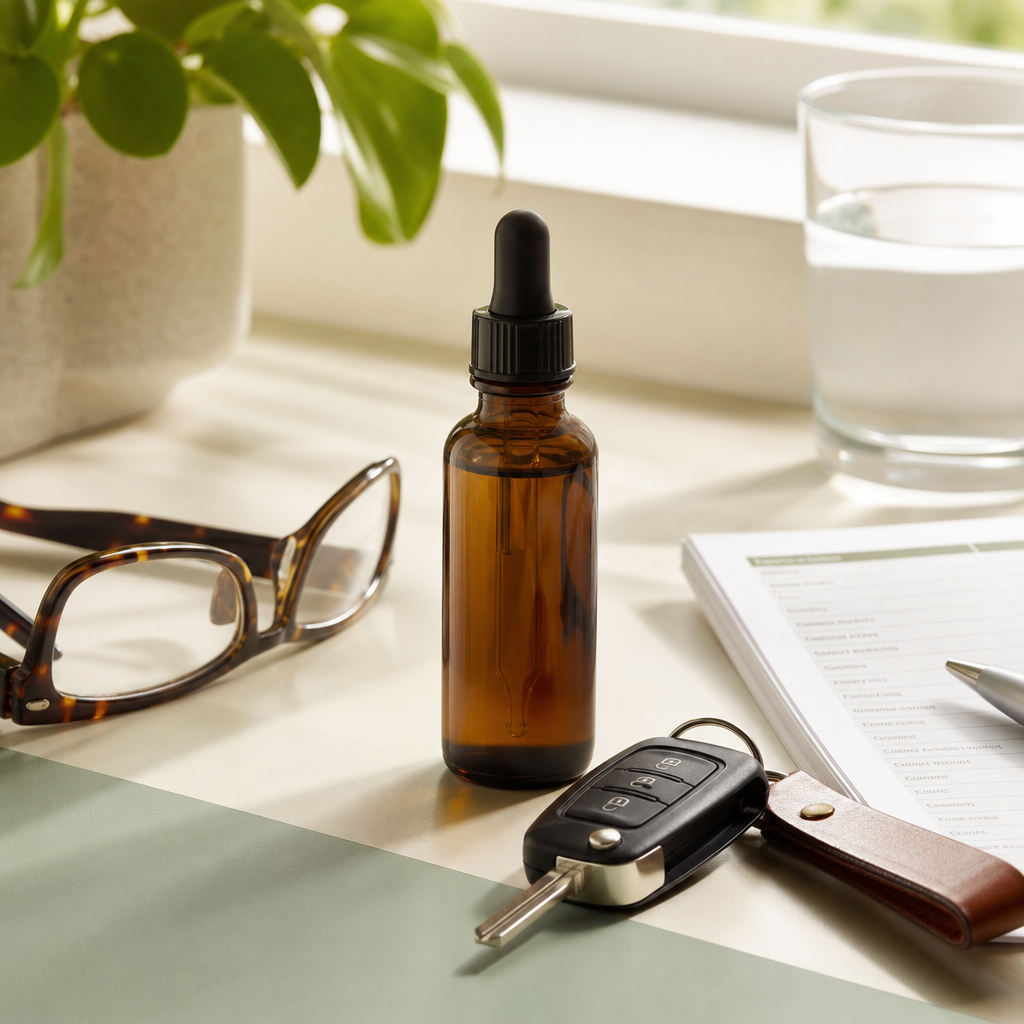
CBD side effects · Driving safety · Medication awareness
CBD does not usually produce the classic high associated with THC, but that does not mean it leaves every person fully alert. Drowsiness, sleepiness, dizziness, or changes in attention can matter when you need to drive, work around machinery, care for someone, or combine CBD with other substances.
Evidence reviewed July 2026 · Plain-English consumer guide · No product endorsements
Quick answer: Can CBD make you drowsy?
Yes. CBD may cause drowsiness or changes in alertness in some people. The effect is not predictable from the word “hemp,” the package design, or the fact that CBD is described as nonintoxicating.
Do not drive, operate machinery, climb, work at height, or perform another safety-sensitive task when you feel sleepy, dizzy, foggy, slowed down, or less coordinated after using a CBD product.
CBD is often promoted in oils, gummies, capsules, beverages, creams, and products marketed for nighttime relaxation or everyday wellness. Because it is commonly described as nonintoxicating, shoppers may assume it cannot affect reaction time, attention, or wakefulness.
That assumption is too broad. The Centers for Disease Control and Prevention lists drowsiness or sleepiness among the possible effects of CBD. The U.S. Food and Drug Administration also warns that CBD can cause changes in alertness and that combining it with alcohol or other substances that slow brain activity can increase sedation.
The important question is therefore not simply, “Does CBD get you high?” A more useful question is, “Could this particular product make me less able to drive, work, or respond safely?”
Why can CBD cause drowsiness?
Cannabidiol is biologically active. Although it acts differently from THC, the body still absorbs, processes, and responds to it. Sleepiness may reflect the CBD itself, another cannabinoid or ingredient in the product, an interaction with medication, or the combined effect of several substances.
People respond differently
The same product may make one person sleepy while another notices little immediate effect. Age, health, medications, food, timing, previous exposure, and individual sensitivity may all influence the experience.
Products are not identical
A purified prescription CBD medicine, a full-spectrum oil, a gummy, and an inaccurately labeled retail product should not be treated as interchangeable.
Combined effects can add up
CBD may be used alongside alcohol, sleep aids, allergy medicine, pain medicine, anxiety medicine, or supplements that also reduce alertness. The combined effect may be more important than any one item by itself.
Researchers have conducted controlled studies examining isolated CBD and driving-related performance. Some studies did not find meaningful impairment under the specific doses, formulations, participants, and testing conditions used. Those results are useful, but they do not prove that every retail CBD product is safe before driving.
A controlled study can verify the substance and dose provided to selected participants. A consumer may instead be using a product with a different amount of CBD, additional cannabinoids, undeclared THC, another active ingredient, or a label that does not accurately match the contents.
Can you drive after taking CBD?
There is no dependable universal waiting period that makes driving safe for every CBD product and every person. Product type, amount, route, timing, other substances, personal response, and labeling accuracy can all differ.
The FDA advises that products containing cannabis-derived compounds, including CBD, could make driving dangerous because CBD may cause sleepiness and changes in alertness. The practical response is to assess how you actually feel rather than relying on a marketing claim such as “THC-free,” “daytime,” “non-drowsy,” or “natural.”
This caution also applies to motorcycles, bicycles in traffic, boats, forklifts, tractors, power tools, shop equipment, ladders, and other tasks where a delayed response could injure you or someone else.
What about studies suggesting CBD does not impair driving?
Controlled research should be interpreted carefully. A finding that isolated CBD did not significantly impair average driving performance under one study protocol does not establish that:
- Every participant remained free of drowsiness or side effects.
- Every dose of CBD will produce the same result.
- A retail gummy or oil contains only what its label claims.
- CBD combined with alcohol or medication will behave the same way.
- A full-spectrum product with THC is equivalent to isolated CBD.
- A person with a medical condition will respond like a healthy study volunteer.
Evidence can inform a safety decision, but it should not be stretched into a blanket promise. If a CBD product changes your alertness, the appropriate decision is not to drive.
What may increase the risk of CBD-related drowsiness?
| Situation | Why it deserves caution | Practical response |
|---|---|---|
| First use or a newly changed product | You do not yet know how the formulation will affect your alertness. | Use only when you will not need to drive, operate machinery, or perform safety-sensitive work. |
| CBD with alcohol | Alcohol and CBD may contribute to greater sleepiness or reduced alertness. | Do not assume the combination is safe because the CBD product is hemp-derived. |
| CBD with a sedating medicine | Effects on alertness, balance, coordination, or reaction time may add together. | Ask a physician or pharmacist to review the exact combination. |
| Full-spectrum or uncertain cannabinoid content | THC or other cannabinoids may change the product’s effects and drug-testing risk. | Review a current, batch-matched laboratory report, while remembering that it cannot guarantee your response. |
| Older age, fall risk, or multiple medications | Drowsiness, dizziness, and medication complexity can increase the consequences of impairment. | Obtain professional review before experimenting with CBD. |
| Sleep deprivation or illness | Existing fatigue or poor concentration can make an additional sedating effect harder to recognize. | Avoid driving or hazardous work when alertness is already reduced. |
| Unclear serving size or inaccurate label | You may take more CBD, THC, or another ingredient than expected. | Pause and investigate rather than estimating from the front label. |
CBD, alcohol, and sedating medications
Combining CBD with another substance that causes sleepiness deserves more caution than considering CBD alone. The FDA specifically warns that using CBD with alcohol or drugs that slow brain activity may increase sedation and drowsiness, potentially leading to injury.
Examples that deserve a conversation with a pharmacist may include sleep aids, some anxiety medicines, opioids, muscle relaxants, certain antiseizure medicines, sedating antihistamines, nighttime cold products, and other medicines carrying warnings about driving or alcohol.
This is not a complete interaction list. The risk depends on the exact medication, dose, timing, health history, and CBD product. Review the broader guide, Can CBD Interact With Medications?, before combining CBD with prescriptions, nonprescription medicines, vitamins, or herbal products.
Why the type of CBD product matters
The words CBD oil do not describe one standardized product. A bottle may contain CBD isolate, a broad-spectrum extract, a full-spectrum extract, flavoring, melatonin, herbs, THC, or other ingredients that affect how you feel.
Before comparing possible effects, review Full-Spectrum vs. Broad-Spectrum vs. CBD Isolate. These product categories can involve different cannabinoid profiles and different levels of uncertainty.
CBD isolate
CBD isolate is intended to contain highly purified CBD without the broader range of cannabinoids found in full-spectrum extracts. That does not guarantee that the finished product is accurately labeled, free of contaminants, or incapable of causing drowsiness.
Broad-spectrum CBD
Broad-spectrum products generally contain CBD and other hemp compounds while attempting to remove THC. “THC-free” should not be accepted without examining the laboratory’s reporting limits and the exact batch result.
Full-spectrum CBD
Full-spectrum products may contain measurable THC and additional cannabinoids. Even a product that complies with a legal hemp definition may expose a user to THC, particularly with repeated servings or an inaccurately labeled product.
Combination products
A CBD product marketed for sleep may contain melatonin, herbs, or other ingredients associated with drowsiness. If you become sleepy, do not automatically credit or blame the CBD alone. Read the complete ingredient panel.
Topical products
A topical cream and an ingestible gummy do not create the same exposure conditions. However, the word “topical” is not enough to answer every safety question, especially when directions, ingredients, intended use, or product quality are unclear.
A laboratory report helps—but does not clear you to drive
A batch-specific Certificate of Analysis can help verify measured CBD, THC-related compounds, and selected contaminants. It can also reveal whether the report matches the product and lot number you purchased.
It cannot predict whether you will become sleepy, whether your medications will interact, or whether you will be safe to drive. Use the guide How to Read a CBD Certificate of Analysis to understand batch numbers, cannabinoid panels, detection limits, and common warning signs.
A six-step alertness and safety check
-
Read every ingredient.
Look beyond the CBD amount. Check for THC, melatonin, herbs, alcohol-containing tinctures, or other ingredients that may affect alertness. -
Review the exact product with a professional.
Bring the package, serving information, laboratory report, and your full medication and supplement list to a physician or pharmacist. -
Do not test a new product before driving.
First use should occur when you have no need to drive, supervise hazardous equipment, or complete a safety-sensitive shift. -
Avoid stacking sedating substances.
Do not assume CBD is harmless alongside alcohol, sleep aids, sedating allergy medicine, or another product that affects alertness. -
Pay attention to more than sleepiness.
Dizziness, slowed thinking, poor balance, confusion, or difficulty concentrating can also make an activity unsafe. -
Stop the activity, not just the product.
When impairment is possible, do not continue driving or operating equipment while waiting to see whether the feeling passes.
Signs that should not be ignored
Mild sleepiness still matters when you are driving or working in a hazardous setting. More concerning symptoms deserve prompt professional guidance.
- Extreme or unusual drowsiness
- Confusion, fainting, or inability to stay awake
- Severe dizziness, poor coordination, or a fall
- Breathing difficulty, chest discomfort, or rapidly worsening symptoms
- Persistent vomiting, severe diarrhea, or inability to keep fluids down
- Yellowing of the skin or eyes, very dark urine, or significant abdominal pain
- A serious change after combining CBD with medication, alcohol, or another substance
Call emergency services for a medical emergency. In the United States, Poison Control can be reached at 1-800-222-1222. Provide the exact product, ingredient list, amount used, timing, and any other substances involved.
Does feeling sleepy mean CBD is treating insomnia?
No. A side effect is not the same as proof that a product safely or effectively treats a sleep disorder. Sleep problems may be related to pain, medication effects, sleep apnea, anxiety, depression, shift work, alcohol, caffeine, or another underlying issue.
Retail CBD products have not all been evaluated for effectiveness, appropriate dose, long-term safety, or medication interactions. Becoming drowsy after a gummy does not establish that the product improves healthy sleep architecture, addresses the cause of insomnia, or remains safe with repeated use.
For a wider evidence-focused discussion, read Hemp as a Natural Remedy: What the Evidence Really Says.
Knowledge check: Would you make the safer choice?
Choose your answer before opening each explanation.
1. CBD does not normally cause a THC-like high. Does that guarantee it cannot affect driving?
Answer: No. CBD may still cause drowsiness or changes in alertness. Nonintoxicating does not mean that every user will remain fully alert or safe to drive.
2. A controlled study found no significant average driving impairment from a particular CBD dose. Does that clear every store-bought product?
Answer: No. Study findings apply to the tested formulation, dose, participants, and conditions. Retail products may contain different amounts, additional cannabinoids, THC, or inaccurately labeled ingredients.
3. A product’s laboratory report says THC was not detected. Can you assume you will remain alert and pass every drug test?
Answer: No. A report describes the tested sample and its detection limits. It cannot predict your alertness, confirm every unit is identical, or guarantee a workplace or athletic drug-testing outcome.
4. You become unusually sleepy after combining CBD with a nighttime allergy product. Should you drive because each item was sold without a prescription?
Answer: No. Nonprescription products can still cause sedation and interact. Do not drive while impaired, and ask a pharmacist to review the combination.
The bottom line
CBD may cause drowsiness, sleepiness, dizziness, or changes in alertness. The effect can become more concerning when CBD is combined with alcohol, sedating medication, THC, multiple supplements, sleep deprivation, or an inaccurately labeled product.
Do not rely on “hemp-derived,” “nonintoxicating,” or “THC-free” as automatic proof that driving is safe. Read the full ingredient list, examine a batch-matched laboratory report, discuss medications with a healthcare professional, and avoid hazardous activity whenever you feel less than fully alert.
Continue learning about CBD safety
Frequently asked questions
Can CBD make you tired the next morning?
It may, particularly when a product is taken late, contains additional sleep-related ingredients, is combined with alcohol or sedating medication, or affects the person longer than expected. Do not drive or operate machinery when you remain drowsy or foggy the next morning.
Is CBD a sedative?
CBD should not be reduced to a simple yes-or-no sedative label. Drowsiness and changes in alertness are recognized possible effects, but responses vary by person, product, amount, formulation, and other substances used.
Does CBD affect reaction time?
Controlled studies of isolated CBD have not always found significant driving impairment under the conditions tested. However, an individual who feels sleepy, dizzy, unfocused, or slowed should consider their reaction ability impaired and avoid driving.
How long should I wait to drive after taking CBD?
No single waiting period applies to every product or person. Do not drive until you are fully alert and unaffected. A healthcare professional may offer more specific guidance when prescription medication or a medical condition is involved.
Can I mix CBD with alcohol?
The FDA warns that CBD used with alcohol or other substances that slow brain activity may increase sedation and drowsiness. The combination should not be assumed safe for driving or hazardous work.
Can a THC-free CBD product still cause sleepiness?
Yes. CBD itself may cause drowsiness in some users, and the finished product may contain other ingredients that affect alertness. “THC-free” also depends on the accuracy of the label and the laboratory’s detection limits.
Does a CBD Certificate of Analysis prove the product is safe before driving?
No. A laboratory report can show what was measured in a sample. It cannot predict your individual response, medication interactions, or ability to drive safely.
Sources and further reading
- U.S. Food and Drug Administration: What to Know About Products Containing Cannabis and CBD
- U.S. Food and Drug Administration: Some Medicines and Driving Don’t Mix
- Centers for Disease Control and Prevention: About CBD
- JAMA: Effect of Cannabidiol and Delta-9-THC on Driving Performance
- Journal of Psychopharmacology: Effects of Cannabidiol on Simulated Driving and Cognitive Performance
Medical and consumer disclaimer: This article is for general educational purposes and is not medical, legal, employment, transportation, or purchasing advice. CBD can cause side effects and interact with prescription medicines, nonprescription drugs, alcohol, and supplements. Product quality, cannabinoid content, and applicable laws vary. Speak with a qualified healthcare professional before using CBD, especially if you take medication, have a medical condition, are pregnant or breastfeeding, are preparing for surgery, perform safety-sensitive work, or are subject to drug testing.