

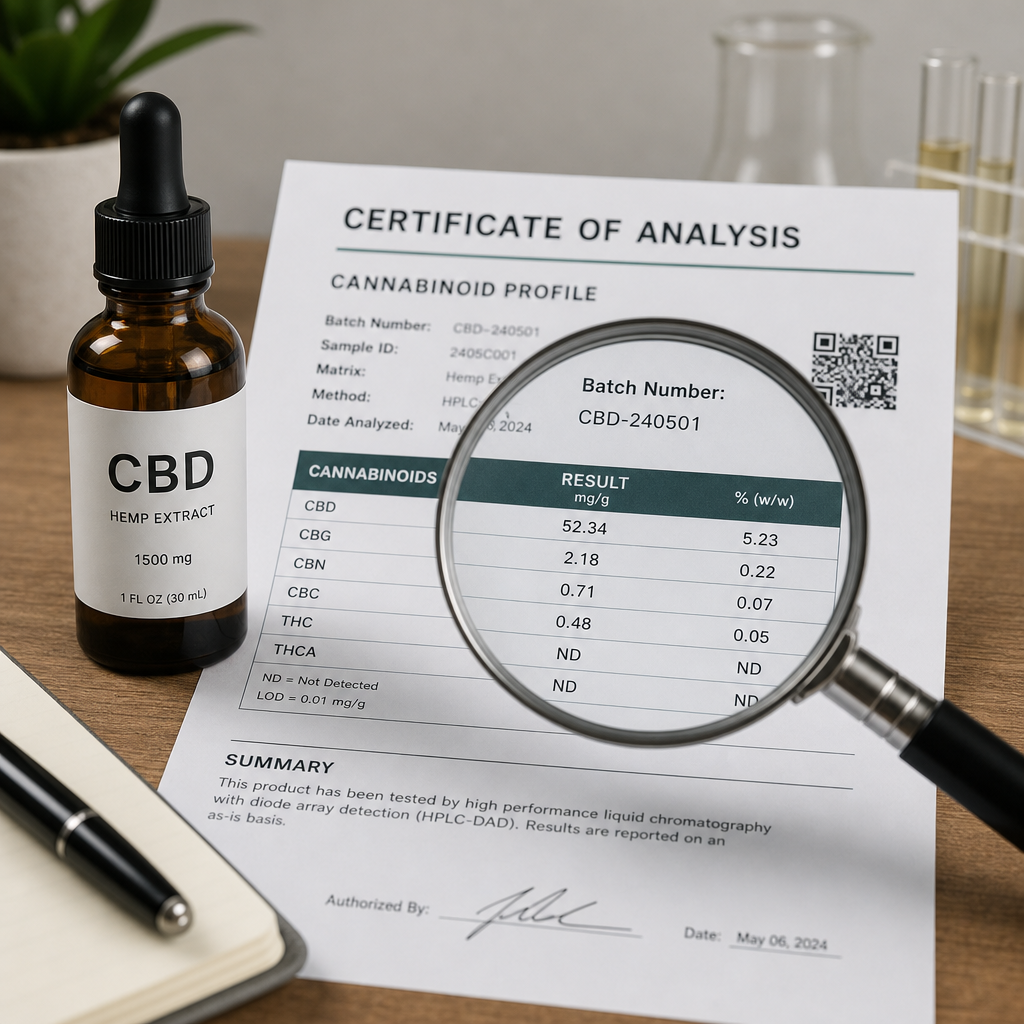
Do not stop at the front of the bottle
A polished label can tell you what a company wants you to believe. A batch-specific Certificate of Analysis can help you investigate what an independent laboratory actually measured.
Quick answer: What should a trustworthy CBD COA show?
A useful Certificate of Analysis should identify the exact product and batch, name the testing laboratory, show a recent test date, report measured CBD and THC-related compounds, explain detection limits, and include relevant contaminant results.
A COA is supporting evidence—not a guarantee. It cannot prove that a CBD product will work for you, prevent side effects, avoid medication interactions, or guarantee a negative drug test.
A CBD bottle may display phrases such as “premium hemp,” “THC-free,” “third-party tested,” or “maximum strength.” Those descriptions can sound reassuring, but they do not tell you whether the product in your hand matches the product that was tested.
The document that can help answer that question is a Certificate of Analysis, commonly shortened to COA. It is a laboratory report showing what was measured in a particular sample. Depending on the testing package, it may report cannabinoid potency and screening results for contaminants such as pesticides, heavy metals, residual solvents, microbes, or mycotoxins.
Learning to read the report matters because CBD products can look nearly identical while containing very different ingredients. Before comparing reports, it helps to understand the difference among full-spectrum CBD, broad-spectrum CBD, and CBD isolate.
Why the label alone may not be enough
The U.S. Food and Drug Administration has warned that many nonprescription CBD products are of unknown quality. The agency has reported concerns about unsupported medical claims, inaccurate cannabinoid amounts, medication interactions, liver injury, sedation, and possible contaminants.
Research also shows why shoppers should look beyond the package. In a study of 105 topical cannabinoid products, only 24% of the products that listed a CBD amount were within 10% of the amount stated on the label. THC was detected in 35% of all products tested, including some marketed as THC-free.
In one study of hemp-derived topical cannabinoid products, only about one-quarter of products listing a CBD amount were accurately labeled within the researchers’ defined 10% range. This does not describe every product on the market, but it shows why batch testing deserves attention.
A separate analysis of hundreds of edible and topical CBD products also reported substantial differences between labeled and measured CBD amounts. Researchers detected heavy metals in portions of the edible products they tested, reinforcing the value of reviewing more than potency alone.
Eight things to check before trusting a CBD COA
Match the batch or lot number
Find the batch, lot, or production number printed on the bottle, box, pouch, or jar. That identifier should match the number on the laboratory report.
A report for a different batch may describe a different extraction run, ingredient supply, concentration, or manufacturing date. A company-wide “sample report” is not a substitute for testing the product you purchased.
Confirm the exact product and formulation
The report should identify the product name, form, concentration, and sometimes flavor or package size. A COA for unflavored CBD oil should not be used to support a gummy, topical cream, pet product, or higher-strength tincture.
Also check whether the laboratory tested the finished retail product or only the bulk hemp extract used before additional ingredients were added.
Identify the laboratory
Look for the laboratory’s name, address, contact information, report number, and authorized signature or verification method. A report that hides the laboratory identity is difficult to verify.
Independent testing is generally more meaningful than an internal company spreadsheet. ISO/IEC 17025 accreditation is another useful quality signal because it involves third-party assessment of laboratory competence and testing systems.
Review the collection and testing dates
The test date should make sense for the product batch. A report from several years ago cannot establish the content of a newly manufactured bottle.
Some reports list a sample received date, testing date, report date, and expiration or retest date. Do not assume the newest-looking date is the date the sample was actually analyzed.
Compare CBD potency with the package
Locate the measured CBD result and determine whether the unit matches the label. A package might list milligrams per bottle, milligrams per milliliter, milligrams per gummy, or a percentage by weight.
Those figures are not interchangeable. Make sure the total amount and per-serving amount make mathematical sense for the bottle size and stated number of servings.
Examine the full cannabinoid panel
A strong potency report should show more than CBD alone. Depending on the product, the panel may include delta-9 THC, THCA, CBDA, CBG, CBN, CBC, and other cannabinoids.
This matters especially when a product is marketed as full-spectrum, broad-spectrum, isolate, or THC-free. The measured profile should be reasonably consistent with the product description.
Understand “ND,” LOD, and LOQ
ND usually means “not detected.” It does not necessarily mean absolute zero. It means the compound was not detected above the laboratory method’s stated threshold.
The limit of detection, or LOD, is the smallest amount the method can reliably notice. The limit of quantitation, or LOQ, is the smallest amount the laboratory can measure with acceptable confidence.
Look beyond potency to contaminants
A cannabinoid panel answers only part of the quality question. Depending on the product and manufacturing method, look for separate results covering pesticides, heavy metals, residual solvents, microbial contaminants, and mycotoxins.
A one-page potency report should not be described as “full-panel testing” unless the additional contaminant pages are also available.
Common COA terms in plain English
| COA term | What it generally means | What to check |
|---|---|---|
| Analyte | The specific compound or contaminant being measured. | Confirm the report includes CBD, relevant THC compounds, and the promised safety panels. |
| Result | The amount measured in the sample. | Check the unit before comparing it with the package. |
| ND | Not detected above the method’s detection threshold. | Find the LOD or LOQ before treating ND as meaningful. |
| LOD | Limit of detection. | A lower LOD can identify smaller amounts, but it still does not prove absolute zero. |
| LOQ | Limit of quantitation. | This indicates the lowest amount the laboratory can quantify reliably. |
| Pass | The result fell within the threshold used for that test. | Check which standard or jurisdiction supplied the limit. |
| Fail | The result exceeded the applicable threshold or did not meet the requirement. | Do not assume another passing page cancels a failed contaminant result. |
| mg/g or mg/mL | Milligrams per gram or milliliter. | Convert carefully before comparing with a total milligram claim. |
| Action limit | The threshold used to determine whether a result passes or fails. | Limits can vary by contaminant, product type, and jurisdiction. |
What each testing panel can—and cannot—tell you
| Testing panel | What it may reveal | What it does not prove |
|---|---|---|
| Cannabinoid potency | Measured CBD, THC, and other cannabinoid concentrations. | That the product is effective, appropriate, or free of contaminants. |
| Pesticides | Whether listed pesticide residues were detected above the reporting limits. | That every possible agricultural chemical was tested. |
| Heavy metals | Results for substances such as lead, arsenic, cadmium, or mercury. | That no other environmental contaminant is present. |
| Residual solvents | Solvents that may remain after certain extraction or manufacturing processes. | That the product was manufactured under ideal conditions. |
| Microbial screening | Specified bacteria, yeast, mold, or other microorganisms. | That the product cannot become contaminated after testing. |
| Mycotoxins | Certain toxins produced by molds. | That all mold-related risks have been eliminated. |
How to compare the label with the laboratory result
Start with the serving information rather than the largest number on the package. A bottle may advertise “1,500 mg” prominently while the serving panel lists a much smaller amount per dropper or per milliliter.
- Write down the total CBD claimed for the entire package.
- Note the container volume or number of pieces.
- Find the stated CBD amount per serving.
- Compare those figures with the laboratory’s unit of measurement.
- Check whether the report measured the finished product and matching batch.
A small difference does not automatically prove fraud. Laboratory methods, sampling, product uniformity, storage, and normal analytical variation can affect results. A large unexplained mismatch, however, deserves a clear answer from the manufacturer.
What a COA cannot tell you
Even a professional-looking laboratory report has limits. It cannot determine:
- Whether CBD is an appropriate choice for your symptoms or health condition.
- Whether the product will interact with a medication you take.
- Whether the suggested serving is safe for your individual circumstances.
- Whether repeated use will cause drowsiness, stomach upset, liver concerns, or another side effect.
- Whether a THC result below the laboratory threshold guarantees a negative workplace or athletic drug test.
- Whether every bottle in a production batch is perfectly identical to the tested sample.
CBD is biologically active. Anyone taking prescriptions, over-the-counter medicines, or other supplements should review how CBD may interact with medications and speak with a physician or pharmacist before use.
People subject to employment, licensing, military, school, or sports testing should also read whether hemp-derived CBD can contribute to a positive drug test. A COA can reduce uncertainty, but it cannot guarantee a testing outcome.
CBD COA red flags that deserve a pause
- No batch or lot number appears on the report.
- The package batch does not match the COA.
- The QR code leads only to the company homepage.
- Every product links to the same generic laboratory document.
- The report names no laboratory or provides no way to verify it.
- The company shows only the first page while hiding contaminant pages.
- A report is several years old but supports a newly produced batch.
- The product is labeled THC-free, but the THC result is omitted.
- “ND” appears without an LOD, LOQ, or reporting threshold.
- The measured CBD amount is substantially different from the label with no explanation.
- The company makes disease-treatment promises that go far beyond the evidence.
- Customer service refuses to provide the complete report.
A simple three-level buyer scorecard
Stronger evidence
Matching batch, identifiable independent lab, recent report, understandable potency results, detection limits, and complete contaminant panels.
More questions needed
Potency report is available, but the batch match, test date, product identity, accreditation, or contaminant testing is unclear.
Walk-away signs
No report, mismatched batch, hidden pages, unexplained failures, unverifiable laboratory, or aggressive promises to cure medical conditions.
A strong report does not require you to buy the product. It simply gives you better information for deciding whether the remaining uncertainty is acceptable.
Questions to ask a CBD company
When the report is unclear, contact the manufacturer and ask direct questions:
- Does this COA match the exact lot number on my product?
- Was the finished product tested, or only the original hemp extract?
- Is the laboratory independent from the brand?
- Is the laboratory accredited for the tests shown on this report?
- Where are the pesticide, heavy-metal, solvent, microbial, and mycotoxin results?
- What do ND, LOD, and LOQ mean on this particular report?
- Why does the measured potency differ from the package claim?
- Has the formulation changed since this batch was tested?
A trustworthy company should be able to answer without replacing the question with slogans about “clean hemp,” “premium extraction,” or “natural wellness.”
Knowledge check: Can you spot the stronger report?
Choose your answer before opening each explanation.
1. A QR code opens a COA, but the lot number does not match your bottle. Is that report enough?
Answer: No. The report may describe a different production batch. Look for a document that matches the lot or batch number printed on your product.
2. A THC result says “ND.” Does that prove the product contains absolutely no THC?
Answer: No. ND generally means the compound was not detected above the method’s stated threshold. Check the LOD or LOQ to understand what the result means.
3. A product passes its cannabinoid potency test. Does that mean it was also screened for heavy metals and pesticides?
Answer: Not necessarily. Potency and contaminant testing are separate panels. Look for the additional pages and individual results.
4. Can a batch-specific COA guarantee that a worker will pass a drug test?
Answer: No. The report can reduce uncertainty about the tested sample, but it cannot guarantee how every bottle, individual body, or testing program will respond.
The bottom line
A Certificate of Analysis is one of the most useful tools available to a CBD shopper—but only when the report is complete, readable, current, and matched to the product in hand.
Start with the lot number. Confirm the product identity. Identify the laboratory. Compare the CBD and THC results with the label. Read what ND actually means. Then look for contaminant panels rather than stopping at potency.
Most importantly, keep the report in perspective. A COA can help answer what the laboratory measured. It cannot answer whether CBD is medically appropriate, whether a product will deliver a promised benefit, or whether using it is worth the remaining risk.
Readers who are still learning the basics can begin with A Beginner’s Guide to Hemp Medicinal Benefits. For a broader evidence-focused view, continue with Hemp as a Natural Remedy: What the Evidence Really Says.
Continue learning about CBD safety
Frequently asked questions
What is a CBD Certificate of Analysis?
A CBD Certificate of Analysis is a laboratory report describing what was measured in a product sample. It may include cannabinoid potency, THC results, and contaminant screening.
Does every CBD product need a COA?
Requirements vary by product and jurisdiction. From a consumer standpoint, the absence of a complete batch-specific report makes it harder to verify the company’s potency and quality claims.
Is a third-party-tested CBD product automatically safe?
No. Third-party testing can provide useful independent evidence, but safety also depends on the tests performed, the reporting limits, product consistency, dose, medications, health conditions, and how the product is used.
What does “ND” mean on a CBD lab report?
ND usually means “not detected” above the laboratory method’s detection or reporting threshold. It should not be interpreted as proof that the amount is absolutely zero.
Should a CBD COA include pesticides and heavy metals?
A complete quality review should consider relevant contaminants, which may include pesticides, heavy metals, residual solvents, microbes, and mycotoxins. The appropriate panels can depend on the product and manufacturing process.
Can I trust a QR code on a CBD bottle?
A QR code is only a route to information. Open it and verify that the resulting report matches the product, batch, concentration, and testing date.
Can a COA guarantee that CBD will not affect a drug test?
No. A report can describe the tested sample and its detection limits, but it cannot guarantee that every product unit contains identical amounts or predict an individual testing result.
Does a good COA prove that CBD will work?
No. Laboratory testing can confirm measured ingredients and contaminants. It does not establish that the product is clinically effective for a symptom or medical condition.
Sources and further reading
- U.S. Food and Drug Administration: What to Know About Cannabis-Derived Products and CBD
- Product Labeling Accuracy and Contamination Analysis of Commercial CBD Products
- JAMA Network Open: Cannabinoid Content and Label Accuracy of Hemp-Derived Topical Products
- Heavy Metal and Phthalate Contamination and Labeling Integrity in Commercial CBD Products
- California Department of Cannabis Control: Testing Laboratories and Certificates of Analysis
- A2LA: Cannabis and Hemp Testing Laboratory Accreditation