

Hemp nutrition · Daily portions · Label-first guidance
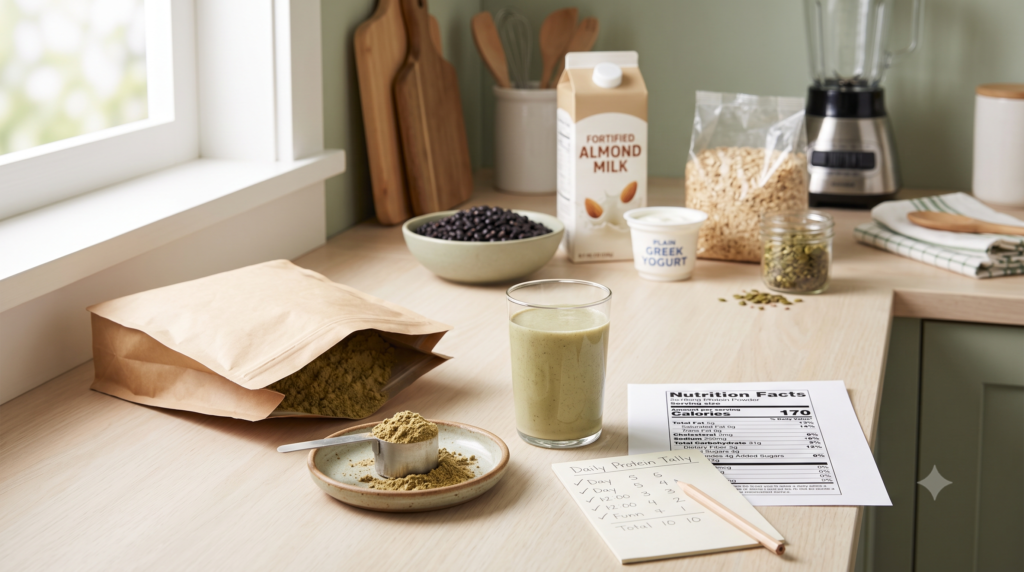
The scoop inside a bag of hemp protein looks like an answer. It is really just a measuring tool.
How much hemp protein powder you should use per day depends on what the powder provides, what you already eat, why you want it, and whether a health condition changes your protein needs. Before you add a second scoop, total the first one—and the rest of your food.
Quick answer: How much hemp protein powder per day?
There is no standard daily amount of hemp protein powder for everyone. For many healthy adults, a partial or full labeled serving may be enough to fill a genuine protein gap. Someone already meeting their needs through meals may not need any.
Start with your total daily protein target, subtract the protein you normally obtain from food, and use the powder’s Nutrition Facts panel to see what amount—if any—fills the remaining gap. Do not treat the included scoop or FDA’s 50-gram Daily Value as a personalized prescription.
The serving size is not your daily target
The FDA requires packaged foods to show a serving size, but that amount reflects what people typically consume. The agency explicitly says it is not a recommendation for how much you should eat. A manufacturer can also change scoop dimensions and serving weights from one product to another.
How many grams of powder the label uses for its nutrition calculations.
How many grams of actual protein that measured powder contributes.
A total from all food and drinks, shaped by your body and circumstances.
Those three numbers are not interchangeable. A 30-gram scoop of powder might provide 15 grams of protein, while another 30-gram powder portion might provide considerably more or less. Fiber, fat, processing, and added ingredients help explain the difference.
If you are comparing powder types, the site’s hemp protein vs. whey guide and hemp protein vs. pea protein guide show why equal scoops do not necessarily provide equal protein.
What number should you compare the label with?
The FDA’s protein Daily Value is 50 grams for label purposes, based on a 2,000-calorie diet. It is a useful reference for comparing foods, not a conclusion that every adult needs exactly 50 grams.
A widely used Recommended Dietary Allowance for generally healthy adults is 0.8 grams of protein per kilogram of body weight per day. It is intended as a population-level intake that meets the needs of nearly all healthy adults—not a promise that the same number suits every goal, life stage, or medical diet.
Quick unit conversion: body weight in pounds ÷ 2.205 = weight in kilograms. Then kilograms × 0.8 gives the general adult RDA reference in grams of protein per day.
This reference is not appropriate for setting a child’s intake or replacing individualized advice during pregnancy, breastfeeding, athletic training, illness, recovery, or treatment for kidney disease.
The USDA’s DRI calculator accounts for age, sex, height, weight, activity, and pregnancy or breastfeeding status. It also cautions that individual requirements may be higher or lower than its estimates.
Calculate the gap before measuring the powder
Start with a typical day—not your hungriest day and not the unusually perfect menu you eat once a month. List the protein from meals, snacks, beverages, and any other powders. Then compare that ordinary total with the target you are using.
A hypothetical example
Suppose a generally healthy adult weighs 165 pounds, or about 74.8 kilograms. Multiplying by the 0.8 g/kg adult reference produces roughly 60 grams of protein for the day.
If that person’s ordinary food log already contains 46 grams, the mathematical gap is about 14 grams. If a hemp powder label lists 15 grams of protein per 30 grams of powder, approximately one labeled serving would cover that arithmetic gap.
What the example proves: the label can be scaled to a known gap.
What it does not prove: that 60 grams is the ideal target for this particular person, that hemp is the best source, or that one full serving will feel comfortable.
The formula for scaling any label is:
Protein contributed = protein per labeled serving × (powder used ÷ labeled serving weight)
Use grams for both powder amounts. If your kitchen scale reads 20 grams and the label’s serving is 30 grams, you used two-thirds of a serving—not whatever fraction the scoop appears to hold.
Partial serving, full serving, or more? Compare the tradeoffs
The table below uses a fictional powder that lists 15 grams of protein and 7 grams of fiber per 30-gram serving. It demonstrates label math; it does not recommend a portion.
| Powder used | Protein contributed | Fiber contributed | Question to ask |
|---|---|---|---|
| 7.5 g (¼ serving) | 3.75 g | 1.75 g | Is this a small recipe addition rather than a meaningful protein gap-filler? |
| 15 g (½ serving) | 7.5 g | 3.5 g | Would a smaller portion fit your recipe or gradual fiber adjustment? |
| 30 g (1 serving) | 15 g | 7 g | Does this match an actual gap after you count the rest of the day? |
| 60 g (2 servings) | 30 g | 14 g | Did you intentionally double every listed nutrient, calorie, and potential digestive effect? |
Doubling the powder doubles more than protein. It also doubles the calories, fiber, fat, sodium, minerals, sweeteners, and other ingredients shown for one serving. If a large shake causes ordinary fullness or gas, work through the hemp protein gas and bloating checklist instead of assuming that more powder must be better.
Can you use hemp protein every day?
A food-grade hemp seed protein can be part of a recurring eating pattern when it fits the person, product, amount, and overall diet. FDA has evaluated a GRAS notice for hemp seed protein powder under specified intended conditions of use. That is not an endorsement of every product, an unlimited-intake finding, or proof that the powder is necessary.
Daily use creates a reason to inspect the routine more closely:
- Variety: Is the powder supplementing a varied diet, or quietly replacing beans, lentils, soy foods, dairy, eggs, fish, meat, nuts, or other foods you would otherwise eat?
- Comfort: Are you increasing fiber faster than your usual eating pattern tolerates?
- Label accuracy: Are you using a level measured amount and counting the complete recipe?
- Product quality: Does the lot have relevant, batch-matched testing rather than a generic “tested” badge?
- Purpose: Can you explain the actual gap it fills, or has the scoop become automatic?
If the powder is replacing breakfast, revisit Can Hemp Protein Replace a Meal? Protein alone does not establish that a shake supplies the energy, fats, carbohydrates, vitamins, minerals, and variety expected from a meal.
Your P.I.C.K. daily hemp protein planner
Use the site’s P.I.C.K. method: Pick the job, Inspect the label, Calculate the contribution, Keep useful notes. This calculator performs label arithmetic only. It does not determine your personal protein requirement or tell you that a planned amount is medically appropriate.
P — Pick the job
I — Inspect the numbers
C — Calculate the contribution
K — Keep useful notes
Entries stay in this page only and are not saved after you leave. A calculated “gap” is arithmetic, not a dose recommendation.
When not to choose the amount by yourself
General label math is not enough when protein, fiber, potassium, phosphorus, calories, or fluid needs are part of medical care. Get individualized guidance before adding a concentrated powder if you have kidney disease, are on dialysis, follow a prescribed diet, have difficulty eating, are recovering from illness or surgery, are pregnant or breastfeeding, or are choosing an amount for a child.
NIDDK notes that some people with chronic kidney disease may need moderate protein, while people receiving dialysis may need more. The right balance can change with treatment. “Plant-based” does not make an unrestricted amount appropriate for every kidney diet.
Possible allergy is not a serving-size experiment. Stop using the suspected product and seek medical advice for hives, mouth itching, swelling, wheezing, vomiting, faintness, or rapidly worsening symptoms. Trouble breathing or swelling of the tongue or throat needs emergency help. Do not retry a smaller scoop at home. See the full hemp protein allergy guide.
Inspect a frequently used product
Read the complete ingredient list, allergen and cross-contact statements, lot code, date, storage directions, and Nutrition Facts panel. If a company supplies contaminant testing, confirm that the report matches the finished product and the lot in your hand. The heavy-metals guide explains why a detected amount needs units and per-serving context.
Food-grade hemp seed protein is not the same as CBD oil. FDA states that hemp seeds do not naturally contain THC or CBD, although trace amounts may be picked up through harvesting and processing. Avoid products with added cannabinoid extracts if your goal is ordinary hemp-seed nutrition, and remember that no hemp product can promise a negative drug test.
Four-question interactive knowledge check
Choose your answer, then open the question to check it.
1. The scoop inside the bag tells you: A) your personal daily requirement, or B) a way to measure the manufacturer’s serving?
Answer: B. The scoop helps measure powder. The labeled serving is not an individualized intake recommendation.
2. A 30 g serving has 15 g protein. How much protein does 20 g of powder provide: A) 10 g, or B) 15 g?
Answer: A, 10 grams. Multiply 15 by 20 ÷ 30.
3. Should you count protein from meals before sizing a powder portion: A) yes, or B) no?
Answer: A. The useful comparison is total daily protein from all sources, not powder in isolation.
4. Does “plant-based” remove the need for individualized kidney-disease guidance: A) yes, or B) no?
Answer: B. Protein and mineral needs can change with kidney function and dialysis. Follow the plan from the clinician or renal dietitian managing the condition.
The bottom line
The best answer to “how much hemp protein powder per day?” is rarely printed on the scoop. First identify an appropriate total protein target. Then count what your ordinary food provides and use the label to size the powder’s contribution.
A partial serving may be enough. A full serving may fit. No powder may be necessary that day. The decision becomes clearer when you measure in grams, account for fiber and the whole recipe, and stop treating “more protein” as a goal without an endpoint.
Frequently asked questions
Is one scoop of hemp protein a day too much?
“One scoop” is not a consistent amount across products. Check its weight, protein, fiber, calories, and ingredients, then compare those numbers with your total diet and health needs. One labeled serving may fit some people and be unnecessary or uncomfortable for others.
Can I take hemp protein twice a day?
Two servings double everything on the panel. Before doing that routinely, total the protein already coming from food and ask why two servings are needed. Get individualized advice when your target relates to training, pregnancy, illness, weight change, kidney function, or another medical concern.
What is the best time to take hemp protein?
There is no universal clock time that makes hemp protein necessary or superior. Put it where it fills a real gap and fits your meals, appetite, training plan, and digestive comfort. Athletes with performance goals may benefit from advice that considers protein quality and distribution across the day.
Can hemp protein help with weight loss?
This article does not establish hemp protein as a weight-loss product. A shake may replace food or simply add calories to the day. The outcome depends on the complete eating pattern, portion, activity, and individual circumstances—not the word “hemp.”
Does hemp protein count as a complete protein?
Hemp provides all nine essential amino acids, but the amounts and digestibility still matter, and lysine is commonly limiting. “Complete” does not mean one scoop satisfies your daily protein needs or makes a nutritionally complete meal. See Is Hemp Protein a Complete Protein? for the full evidence review.
Is hemp protein powder the same as CBD powder?
No. Hemp protein is made from hemp seeds and used as food. CBD is a cannabinoid obtained mainly from other plant parts. Read the ingredient list because “hemp” on the front of a package does not identify the product clearly enough.
What does your scoop actually contribute?
Check your label and share the serving weight, protein grams, and fiber grams in the comments. Did measuring the powder change what you thought one scoop contained?
Keep personal diagnoses, medications, test results, and other private health information out of public comments.
Sources and evidence notes
- U.S. Food and Drug Administration: Serving Size on the Nutrition Facts Label — why serving size is not a personal recommendation.
- U.S. Food and Drug Administration: Daily Value on Nutrition and Supplement Facts Labels — protein Daily Value and interpretation of %DV.
- USDA National Agricultural Library: DRI Calculator for Healthcare Professionals — individualized DRI estimates and limitations.
- The Scientific Foundation for the Dietary Guidelines for Americans, 2025–2030 — current adult protein RDA context and the food-based dietary framework.
- U.S. Food and Drug Administration: Hemp Seed-Derived Ingredients for Use in Human Food — GRAS notice response and the distinction between hemp seed ingredients and cannabinoids.
- National Institute of Diabetes and Digestive and Kidney Diseases: Healthy Eating for Adults With Chronic Kidney Disease — individualized protein planning and dialysis considerations.
- NIH Office of Dietary Supplements: Exercise and Athletic Performance — protein food, timing, and athlete guidance.
Evidence and links checked September 6, 2026. This article provides general food and nutrition education. It does not diagnose a deficiency, prescribe a protein target, or replace advice from a physician or registered dietitian.