

Hemp nutrition · Lab-report guide · Evidence reviewed
A detectable number is not automatically a danger verdict—and a green “pass” box is not enough information to judge your scoop.
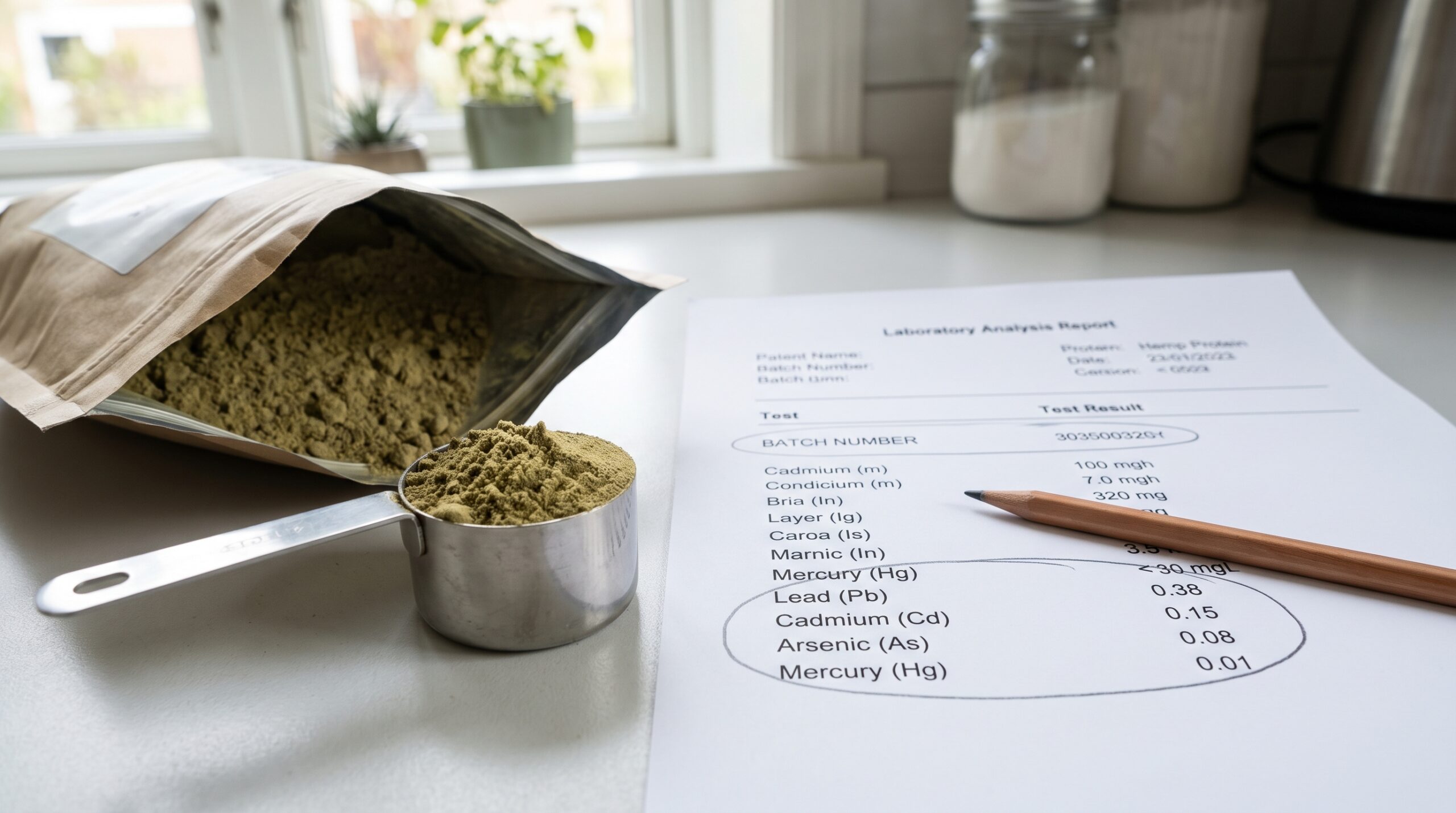
Heavy-metal questions begin with the exact bag, serving weight, batch number, and laboratory report—not the front-label promise.
You bought hemp protein because the ingredient list looked simple. Then a headline about lead in protein powders—or a tiny heavy-metals table on a laboratory report—made the bag feel much less straightforward.
The wrong response is either extreme: assuming every plant powder is contaminated beyond use, or accepting “third-party tested” without seeing what was tested. The useful response is slower and more specific. Match the report to the product, read the actual result and unit, convert it to your serving, and decide whether the company has answered the question you asked.
Quick answer: Does hemp protein powder contain heavy metals?
Hemp protein can contain detectable amounts of lead, cadmium, arsenic, or mercury. These elements can occur in soil, water, and air and enter foods as crops grow or products are processed. Detection alone does not prove that a particular serving creates a health hazard. “Not detected” also does not prove absolute zero.
The most useful evidence is a complete, batch-matched report for the finished product. It should name each element, show the measured result and unit, identify the laboratory and test date, and disclose the reporting limit. Then consider the serving weight, how often you use the powder, other dietary sources, and whether the user is in a more vulnerable group.
If a company provides only “pass,” a generic badge, or a report for a different lot, you do not have enough information to compare products responsibly. Choosing another product is a reasonable response to missing evidence.
Why can toxic elements show up in a plant protein?
“Heavy metals” is the familiar phrase, although the U.S. Food and Drug Administration often uses toxic elements when discussing arsenic, lead, cadmium, and mercury. The agency explains that environmental contaminants can be present in food because they occur in the soil, water, or air where food is grown, raised, or processed.
That background matters because a detected result does not automatically prove careless manufacturing. It also does not excuse a manufacturer from controlling hazards, testing appropriately, or explaining its specifications.
Soil chemistry, water, pollution history, geography, and crop variety can affect what a plant encounters and takes up.
Roots, stems, leaves, flowers, and seeds do not necessarily accumulate an element in the same way.
Removing oil, fiber, water, or other material can change a contaminant’s concentration in the finished ingredient.
Cocoa, other plant proteins, flavors, minerals, and additional ingredients can change a blend’s final result.
Hemp has been studied for its ability to grow in metal-contaminated soils, which is one reason alarming claims travel quickly online. But a phytoremediation experiment involving contaminated soil or vegetative tissue does not tell you the concentration in a retail bag of seed-derived protein. The crop source, plant part, soil, processing, batch, and laboratory result still matter.
“Natural,” “organic,” and “plant-based” are not test results
Those descriptions may answer other questions, but they do not show the lead, cadmium, arsenic, or mercury concentration in your lot. Organic production does not remove naturally occurring elements from soil, and a leaf graphic cannot replace a batch report.
What the evidence says specifically about hemp protein
In 2018, the FDA completed its evaluation of GRAS Notice 771 for hemp seed protein powder. The notifier described multiple formulations and supplied specifications for lead, cadmium, mercury, arsenic, aflatoxin, microorganisms, cannabinoids, and protein content. It also submitted results from multiple batches to show that its ingredient could meet those specifications.
That document is useful evidence that toxic-element control belongs in hemp-protein manufacturing. It is not an FDA approval of every hemp protein product, a public test of the bag in your kitchen, or a universal consumer shopping limit. The FDA’s response states that manufacturers remain responsible for ensuring marketed products are safe and comply with applicable requirements.
Broader protein-powder testing has produced results that attract understandable attention, but a market snapshot of selected plant, whey, or blended powders cannot establish the level in every hemp product. Likewise, a study that finds low estimated risk across its samples cannot clear a different brand or later batch. Product-level questions require product-level evidence.
This is the same reason the site’s guide to reading a Certificate of Analysis begins with the lot number. A professional-looking report is useful only when it describes the sample and test that actually matter to your decision.
Why one “safe limit” copied from the internet can mislead you
A threshold can describe an ingredient specification, a regulatory action level, a laboratory’s internal pass/fail limit, a state warning threshold, or a health agency’s exposure benchmark. Those are not interchangeable.
For example, the FDA’s interim reference levels for dietary lead are daily-exposure benchmarks, not hemp-protein product limits. The agency lists 2.2 micrograms per day for children and 8.8 micrograms per day for females of childbearing age, with a tenfold safety factor built into the calculation. The FDA also emphasizes that no safe level of lead exposure has been identified.
A concentration printed in milligrams per kilogram cannot be compared directly with a daily microgram benchmark until you account for the amount eaten. Even then, one food is only part of total dietary exposure.
Do not use an adult protein-powder article to plan a child’s serving
Children have smaller bodies and different nutrition needs, and the FDA identifies children as especially vulnerable to toxic-element exposure. A child’s use of a concentrated protein powder should be discussed with an appropriate pediatric clinician or registered dietitian rather than inferred from an adult label.
How to turn a laboratory concentration into a per-serving number
A report often lists toxic elements in milligrams per kilogram (mg/kg) or parts per million (ppm). For a solid food, these units line up conveniently:
The unit bridge for a solid powder
Per-serving estimate: result in mg/kg × serving grams = micrograms in that serving.
A clearly labeled example—not a product recommendation
Imagine a finished-product report lists lead at 0.08 mg/kg, and the label’s serving weighs 30 grams.
0.08 µg/g × 30 g = 2.4 µg of lead per serving.
That calculation translates the lab concentration into the amount associated with the labeled serving. It does not by itself declare the product acceptable for every person. You still need the report’s uncertainty and reporting limits, the frequency of use, other sources of exposure, the user’s age and circumstances, and the standard being used for comparison.
When the report uses ppb
For a solid food, 1 part per billion (ppb) is generally equivalent to 1 microgram per kilogram (µg/kg). Convert carefully before multiplying by a serving measured in grams. If the report does not state whether the result is based on the finished product, a dry-weight basis, or an ingredient sample, ask the laboratory or manufacturer instead of guessing.
What a useful hemp-protein COA shows—and what weak evidence hides
| Evidence shown | What it helps you answer | What remains uncertain | Practical response |
|---|---|---|---|
| “Third-party tested” on the front label | Only that the company makes a testing claim | Lab, lot, sample, analytes, results, limits, and date | Ask for the complete batch report. |
| A one-word “pass” for heavy metals | The sample met an unstated or separately stated threshold | Measured amount and whether the threshold fits your comparison | Request numeric results, units, and the standard used. |
| ND, with no LOD or LOQ | The lab did not report a detected amount | How low the method could detect or quantify | Find the reporting limit before treating ND as meaningful. |
| Ingredient-supplier report | What was measured in one incoming ingredient sample | The finished powder after blending and processing | Prefer finished-product testing when other ingredients are present. |
| Lot-matched finished-product report with numeric results | The strongest available view of the tested batch and sample | Perfect uniformity across every scoop and all future lots | Check units, reporting limits, lab identity, date, and serving math. |
Five report terms worth slowing down for
| Term | Plain-English meaning | Common mistake |
|---|---|---|
| Detected | The method found the element at a reportable level. | Assuming detection alone proves immediate harm. |
| ND | Not detected above the method’s stated detection or reporting threshold. | Reading it as absolute zero. |
| <LOQ | The element may have been detected, but below the level the method can quantify reliably. | Treating it as either a precise zero or a precise number. |
| Pass | The result met the criterion the report applied. | Failing to identify that criterion. |
| Action limit | The threshold used for a regulatory, contractual, or laboratory decision. | Assuming one jurisdiction’s limit applies everywhere and to every product type. |
If your concern began with the word hemp rather than a metal result, keep the questions separate. Plain hemp-seed protein and a cannabinoid extract are different products. The guide to hemp protein and drug-test risk explains why a THC panel cannot substitute for a toxic-elements panel—and vice versa.
Red flags that deserve a pause before the next scoop
- The QR code opens a company homepage instead of a report.
- The report’s product name, flavor, or lot number does not match the bag.
- The document tests only cannabinoid potency but is called “full panel.”
- Heavy metals are summarized as “pass” with no values, units, or limits.
- The company supplies an old example report for every current batch.
- The report names no laboratory or provides no verifiable report number.
- The sample is raw hemp, hemp extract, or an incoming ingredient rather than the finished protein blend.
- A measured result is shown, but customer service cannot explain the unit or serving calculation.
- The company answers a contaminant question with “organic,” “natural,” “clean,” or “premium.”
- The bag has a broken seal, moisture damage, unusual odor, pests, mold, or a matching recall—problems that a previous lab report cannot correct.
That last point connects testing with ordinary storage. A clean-looking COA cannot rescue a damaged package. If the concern is clumping, odor, age, or moisture, use the separate inspection in Does Hemp Protein Powder Go Bad?
The T.R.A.C.E. planner for one bag and one report
This planner is designed to prevent two common mistakes: comparing a report for the wrong product and comparing unlike units.
- T — Tie the report to the bag.
Match the exact product, flavor, serving size, lot or batch number, and manufacture or test date. Save the report because online files can change. - R — Read the complete result.
Find lead, cadmium, arsenic, and mercury individually. Record the numeric result, unit, LOD or LOQ, pass/fail criterion, laboratory, and whether the finished product was tested. - A — Adjust for the serving.
Use the serving weight you actually consume. When the result is in mg/kg for a solid powder, multiply it by serving grams to estimate micrograms per serving. - C — Consider frequency and context.
A scoop used occasionally and a scoop used every day do not create the same recurring exposure. Consider the rest of the diet and whether the user is a child, pregnant, or managing a condition that warrants individualized advice. - E — Email—or exit.
Ask the manufacturer to explain missing pages, mismatched lots, unclear units, or the standard behind “pass.” If it cannot provide a direct answer, you do not owe the product another purchase.
The planner does not need to end with a perfect verdict
Sometimes the honest result is “not enough information.” That is still useful. You can choose a different food or product without declaring the original bag toxic, and without letting a vague assurance decide for you.
What can reduce uncertainty without feeding fear?
- Use food variety. Do not make one powder the automatic source of a large share of your daily nutrition unless an appropriate professional has advised that plan.
- Prefer transparent batches. Look for a current, lot-matched finished-product report with numeric results and reporting limits.
- Measure the serving. A heaping household scoop may not match the label’s gram weight.
- Separate the ingredient from the blend. Cocoa, minerals, and other proteins can change the finished product’s contaminant profile.
- Keep the lot information. It helps with report matching, manufacturer questions, and recall checks.
- Skip “detox” responses. A concerning report or suspected exposure deserves qualified medical or public-health guidance, not an unverified cleanse or chelation product.
Hemp protein can still be a useful food ingredient. Its protein quality, fiber, and processing vary, as explained in Is Hemp Protein a Complete Protein? The goal is not to make one contaminant question erase the food’s entire nutritional context. It is to stop marketing language from erasing the contaminant question.
Four-question knowledge check
Choose your answer before opening each explanation.
1. Does “ND” prove that a hemp protein contains absolutely no lead?
Answer: No. ND generally means the laboratory did not detect the element above its method’s stated threshold. Find the LOD, LOQ, or reporting limit to understand how low the test could reliably see.
2. Can you compare a result in mg/kg directly with a daily benchmark in micrograms?
Answer: Not until you account for the serving. For a solid powder, 1 mg/kg equals 1 µg/g. Multiply the result in mg/kg by the serving weight in grams to estimate micrograms per serving.
3. Does an FDA GRAS notice approve every hemp protein powder on the market?
Answer: No. The FDA evaluated a notifier’s conclusion for the ingredient and uses described in that notice. The response does not test your retail bag or approve every company, formulation, or batch.
4. Is a finished-product, lot-matched report more useful than a generic ingredient report?
Answer: Usually, yes. A finished-product report can account for the complete formula and processing of the tested batch. It still cannot prove every scoop is identical, but it is more directly connected to the product in your hand.
Frequently asked questions
Does organic hemp protein have fewer heavy metals?
Organic certification does not establish the concentration of lead, cadmium, arsenic, or mercury in a finished lot. Growing practices, soil, water, geography, processing, added ingredients, and batch control all matter. Compare current laboratory results rather than assuming “organic” means metal-free.
Is any detectable lead in hemp protein automatically dangerous?
A detected amount deserves context, not dismissal or panic. Risk depends on the amount, serving, frequency, total exposure, and the person using the product. The FDA states that no safe level of lead exposure has been identified and works to reduce exposure, while also using exposure benchmarks and product-specific regulatory tools.
What should I ask a hemp protein company for?
Ask for a complete Certificate of Analysis for the exact lot. It should identify the finished product, laboratory, test date, method or reporting limits, and numeric results with units for lead, cadmium, arsenic, and mercury. Ask which standard or specification produced any “pass” result.
Is a California Proposition 65 warning the same as an FDA recall?
No. A state warning requirement and a federal product recall are different tools with different legal triggers and purposes. Read the exact warning, identify the product and exposure route, and ask the company for the underlying result. Do not translate the presence or absence of a warning into an automatic safety verdict.
Can I wash heavy metals out of hemp protein powder?
No practical home rinsing method can selectively remove a measured toxic element from a fine protein powder while preserving the product. Do not try to “clean” a concerning bag with water, sifting, blending, baking, or flavoring.
Does third-party certification guarantee zero heavy metals?
No. Certification can be a useful quality signal, but its value depends on the program, tests, limits, sample, and current product status. Verify what the certification covers and still review the lot-specific results when they are available.
Should I stop using hemp protein every day?
A general article cannot make that decision for a specific person or bag. Review the batch evidence, actual serving, frequency, total diet, and why you use the powder. If the report is concerning, missing, or difficult to interpret—or if the user is a child, pregnant, or has a relevant health condition—seek individualized guidance from a qualified clinician or registered dietitian.
Should I get a blood or urine test after using protein powder?
Do not order or interpret testing from a headline alone. If you have a confirmed high product result, a recall or public-health notice, a known exposure, concerning symptoms, or a clinician’s reason for testing, contact an appropriate healthcare professional or poison-control/public-health resource for guidance. Avoid unproven “heavy-metal detox” products.
The bottom line
Hemp protein can contain detectable toxic elements because food crops live in a real environment, not a contaminant-free laboratory. That fact supports better testing and transparency. It does not justify declaring every bag dangerous.
Begin with the exact lot. Prefer a finished-product report. Read the numeric result, unit, LOD or LOQ, and criterion behind “pass.” Convert the concentration to the serving you actually use, then consider frequency and the rest of the diet. If the company hides behind “natural,” “organic,” or “third-party tested,” treat the missing evidence as part of the decision.
The calm middle ground is the useful one: do not let a frightening headline replace the numbers, and do not let a reassuring badge hide them.
Authoritative sources
- U.S. Food and Drug Administration: Environmental Contaminants in Food
- U.S. Food and Drug Administration: Lead in Food and Foodwares
- U.S. Food and Drug Administration: GRAS Notice 771 Agency Response for Hemp Seed Protein Powder
- U.S. Food and Drug Administration: Is It Really “FDA Approved”?
- U.S. Food and Drug Administration: Elemental Analysis Manual for Food and Related Products
- Placido DF, Lee CC. Potential of Industrial Hemp for Phytoremediation of Heavy Metals. Plants. 2022.
- Bandara SB, et al. A Human Health Risk Assessment of Heavy Metal Ingestion Among Consumers of Protein Powder Supplements. Toxicology Reports. 2020.
Editorial and medical note: This article provides general food-safety and nutrition education. It cannot determine whether a specific product is safe from a label description, photograph, or partial laboratory report, and it does not replace advice from a physician, registered dietitian, toxicologist, poison-control center, or public-health authority. Do not use supplements, cleanses, or chelation products to treat suspected heavy-metal exposure without qualified medical guidance.
What did the report actually show?
Share the non-identifying details in the comments: Did the company provide a numeric result, only “pass,” or no heavy-metals page at all? Which unit or report term caused the confusion?
Your question may help another reader slow down and compare the right numbers. Do not post medical records, receipts, addresses, report verification codes, or a complete product lot number.