

Hemp nutrition · Storage troubleshooting · Evidence reviewed
The powder was always earthy—but was it always this earthy?
A darker color, a few small clumps, or a grassy smell can be normal for hemp protein. A broken seal, damp hard lumps, visible mold, insects, a distinctly rancid odor, or an active recall calls for a different decision.
By Kevin Meyer · Evidence reviewed August 24, 2026 · General food and nutrition education · No product endorsements
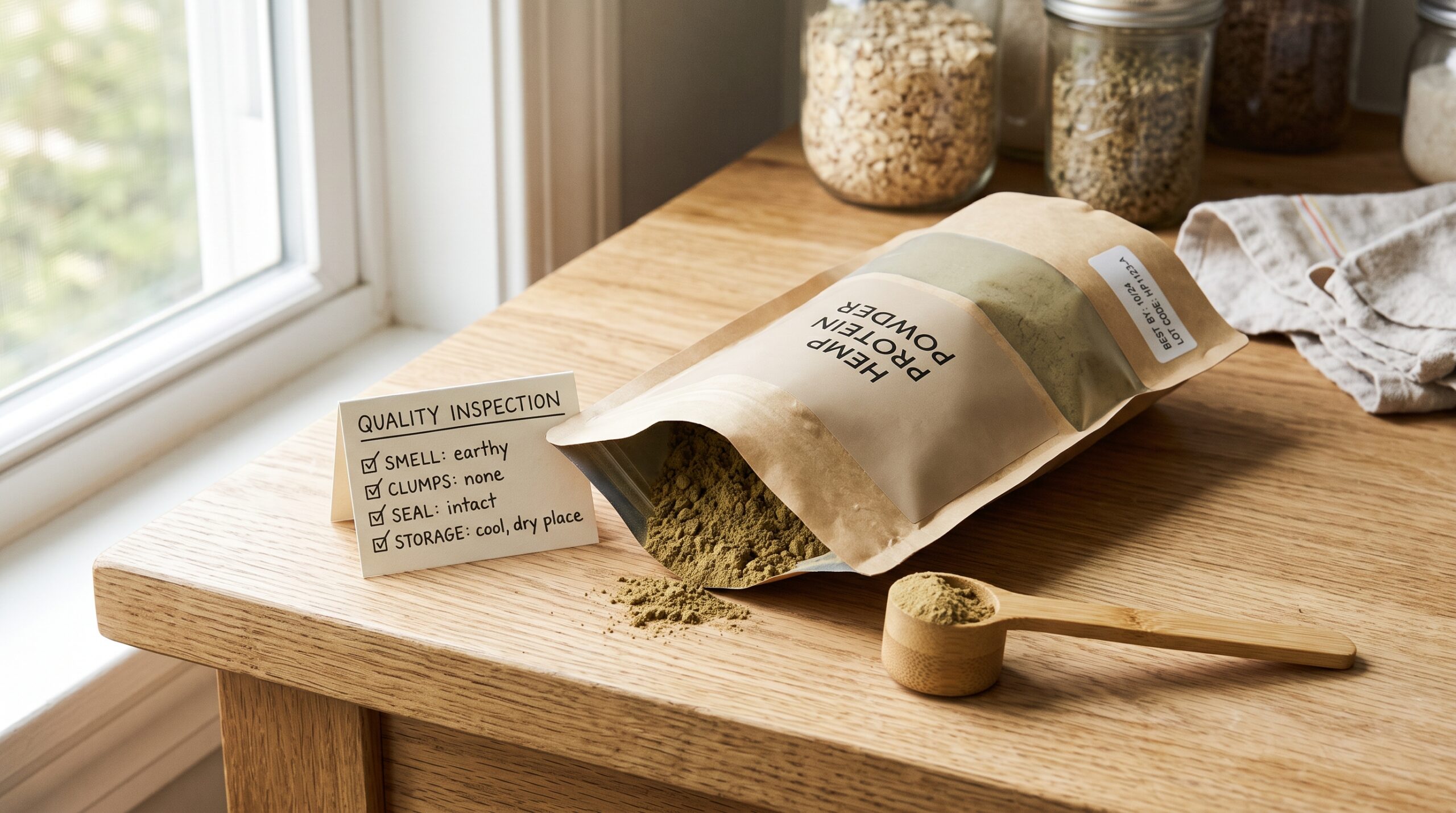
You pull a half-used bag of hemp protein from the back of the pantry. The best-by date is close—or already past. The powder looks a little clumpier than you remember, and its nutty smell now seems sharper.
That does not automatically mean the powder is unsafe, but it is not a reason to shrug and bury the change under banana and cocoa. The useful question is not simply, “Has the date passed?” It is whether the package, storage history, appearance, odor, texture, and recall status still support using this particular product.
Quick answer: Does hemp protein powder go bad?
Yes. Hemp protein powder can lose quality and may eventually become unsuitable to use. However, there is no evidence-based shelf-life number that applies to every bag. A single-ingredient powder, a flavored protein blend, and a product with different fat content, packaging, processing, or storage directions should not inherit the same countdown.
A “best if used by” date generally describes peak quality rather than acting as an automatic safety switch. The USDA’s food-dating guidance explains that, except for infant formula, food dates are not federal safety dates. That does not make every old or mishandled powder acceptable. It means the date belongs inside a broader inspection.
Discard the powder rather than tasting it if you find visible mold, insect activity, water damage, a torn or failed package, damp or sticky masses, an unmistakably rancid or otherwise abnormal odor, or a recall that matches the product and lot. When the storage history is unknown and the package raises concern, replacement is the more sensible choice.
Normal variation or a warning sign?
Hemp protein does not begin as a snowy, neutral powder. Its green, tan, or brown color and earthy flavor come from the seed material and the way the product is processed. A bag can also settle during shipping, and a small amount of humidity may create soft clumps that break apart easily.
The mistake is using one clue as a verdict. Color alone cannot prove freshness, a passed date cannot prove spoilage, and a normal smell cannot rule out every food-safety hazard. Compare several signals at once.
| What you notice | What it may mean | Practical response |
|---|---|---|
| Green, olive, tan, or brown powder | Normal color varies with seed fraction, processing, and formulation. | Compare it with the product’s original appearance and any label description; do not judge by greenness alone. |
| Earthy, grassy, or nutty aroma | Often normal for plain hemp protein. | Use your memory of the newly opened bag as the comparison, not the aroma of whey or pea protein. |
| Small, dry clumps that crush easily | Settling or limited humidity exposure may be involved; it is not proof of spoilage by itself. | Inspect the seal, odor, date, scoop habits, and storage area before deciding. |
| Stale, paint-like, soapy, sharply bitter, or distinctly rancid odor | The product’s fats or other ingredients may have oxidized, or quality may have deteriorated. | Do not hide the change in a recipe. Discard it and review where and how the bag was stored. |
| Damp, sticky, or hard masses; visible mold; insects; webbing | Moisture, contamination, or pest activity may have compromised the food. | Discard without tasting. Clean and inspect the storage area before replacing the product. |
| Torn bag, failed seal, water damage, or matching recall | The package can no longer provide the assurance expected from an intact product. | Do not use it. Follow the manufacturer’s or recall notice’s return and disposal instructions. |
If the powder has always tasted gritty or strongly earthy, storage may not be the main problem. Use the controlled comparisons in Why Does Hemp Protein Taste So Gritty? before assuming that a normal characteristic means the bag has spoiled.
What does the expiration or best-by date actually tell you?
Start by reading the phrase printed beside the date. “Best if used by,” “best before,” “use by,” and “sell by” are not interchangeable in everyday speech, and U.S. food dating is not governed by one universal phrase for all foods.
For a shelf-stable hemp protein product, the manufacturer’s date is still valuable. It reflects the company’s formulation, packaging, testing, and intended storage conditions better than a generic blog estimate. What it cannot do is reconstruct what happened after purchase.
Date
The maker’s quality window under the stated storage conditions.
Condition
The current package, seal, powder, odor, and storage history.
Recall
A lot-specific safety action that overrides a normal-looking bag.
Do not replace the printed date with “one year after opening” or another universal internet rule. Hemp protein powders vary in fat, fiber, protein concentration, particle size, added flavors, sweeteners, other proteins, antioxidants, and packaging. The FDA’s response to GRAS Notice 771 for hemp seed protein powder describes several formulations and processing routes, which helps explain why one bag should not set the shelf life for the entire category.
Processing also changes how much oil remains in the ingredient. A review of hemp seed food production reported that mechanically pressed hemp seed cake may retain substantially more oil than more thoroughly defatted meal. The same review notes that hemp seed quality and rancidity are influenced by storage and that the storage behavior of hemp protein fractions still needs more study. That uncertainty supports a product-specific answer, not a confident universal countdown.
Why a dry powder can still deserve caution
Dry food is often described as shelf-stable because low available moisture limits microbial growth. That does not mean dry food is sterile or that every contamination problem announces itself with a bad smell.
FDA guidance for manufacturers explains that low-moisture ready-to-eat foods generally do not support the growth of environmental pathogens, yet pathogens can survive in some dry foods. This distinction matters at home: keeping a scoop dry helps protect quality, but it cannot correct a manufacturing problem or clear a recalled lot.
Check the FDA recalls and safety alerts database when a company contacts you, a store posts a notice, the package seems unusual, or you hear about a protein-powder recall. Match the brand, product name, package size, lot code, and date—not merely the words “protein powder.”
A smell test has limits
Odor can reveal a quality change, but a normal odor cannot prove that a food is free of pathogens or undeclared allergens. A matching recall, visible mold, package breach, or known water damage is enough reason to stop—do not taste the powder to seek reassurance.
The 60-second check before you add a scoop
This inspection is designed for a bag that looks ordinary but leaves you uncertain. It is not a way to rescue a product with visible mold, pests, a failed package, water damage, or a matching recall.
- Read the exact date phrase. Record the best-by or use-by date, then find the lot code. If the bag has been open, note when you first opened it—or admit when that date is unknown.
- Inspect the package first. Check the heat seal, zipper, seams, pinholes, moisture marks, grease marks, and any evidence that pests reached the bag.
- Look without stirring. Check the surface for fuzzy growth, webbing, insects, unusual wet spots, or hard masses. Natural color variation is different from visible growth.
- Smell from a safe distance. Compare the aroma with the newly opened product you remember. A distinctly stale, paint-like, soapy, musty, or rancid change is a reason to discard it, not a challenge to mask it.
- Check recall status when doubt remains. Use the brand, product, package size, lot, and date. If they match a notice, follow the notice even when the powder looks normal.
- Make the decision before mixing. Once questionable powder disappears into a smoothie or batter, you lose the easiest visual and odor clues.
If you used the powder and then developed hives, mouth itching, swelling, wheezing, trouble breathing, repeated vomiting, dizziness, or another possible allergic reaction, storage troubleshooting is no longer the right tool. Stop using the product and seek appropriate medical care; breathing difficulty or throat swelling can be an emergency. For milder digestive symptoms without allergy signs, the separate guide Does Hemp Protein Powder Cause Gas or Bloating? helps separate the scoop from the rest of the smoothie.
Where you store the bag matters more than a clever container label
The best storage directions are the ones printed on the product you bought. In general, a dry powder benefits from protection against moisture, heat, light, pests, and repeated exposure to room air. The practical goal is consistency: a reliably cool, dry, clean storage spot and a seal that actually closes.
Choose the pantry zone, not merely the pantry
A cabinet above the stove, beside the dishwasher, under a leaking sink, or in direct window light can expose the bag to more heat or humidity than a central interior shelf. “Stored in the pantry” tells you very little unless you know which shelf.
Keep water out of the bag
Use a clean, completely dry scoop or spoon. Do not hold the open bag over a steaming blender, kettle, pot, or dishwasher. Do not return powder from a damp scoop, a smoothie-covered scoop, or a measuring cup that touched another ingredient.
Close the original seal—or improve it without losing the label
Press excess air out gently when the package allows, close the zipper across its full width, and confirm that powder is not blocking the track. If the original closure no longer works, place the entire labeled bag inside a clean airtight food-storage container, or transfer the powder only if you also preserve the product name, ingredients, allergen statement, best-by date, lot code, and directions.
Do not top a new powder onto an older batch. Mixing bags erases age, lot, allergen, and recall information and can transfer a quality or pest problem into the new product.
Should hemp protein powder go in the refrigerator or freezer?
Do not assume cold storage is automatically better. Follow the manufacturer’s directions or ask the company about that exact product. Refrigerators and freezers can introduce condensation when a cold container is repeatedly opened in warmer, humid air. Flavored blends may also have different storage requirements from plain hemp protein.
If the manufacturer specifically permits cold storage, keep the powder in a moisture-resistant airtight package and follow its thawing or handling directions. A generic freezer estimate should not replace the date and instructions established for the product.
Four storage situations that need different answers
| Product or situation | What changes | Best next step |
|---|---|---|
| Single-ingredient hemp protein | The shorter label makes odor and flavor comparisons easier, but fat and fiber still vary with processing. | Use the printed directions, keep the scoop dry, preserve the lot code, and record the open date. |
| Flavored or multi-protein blend | Cocoa, flavors, gums, sweeteners, dairy, or other proteins can change aroma, clumping, allergens, and shelf life. | Do not apply a plain-hemp rule. Read the complete label and follow the blend maker’s directions. |
| Powder moved to another container | You may lose the date, lot, ingredient, allergen, and recall trail. | Keep a clear photo or label with all identifying information and note when the container was cleaned and filled. |
| Prepared smoothie or batter | Once mixed with liquid or perishable ingredients, the dry-powder storage logic no longer applies. | Follow the storage limits for the complete prepared food and its most perishable ingredient; do not store it like dry powder. |
If you plan to use an older bag in muffins or pancakes, inspect it before it reaches the mixing bowl. Then use Can You Bake With Hemp Protein Powder? to manage flour replacement, hydration, color, and structure. Baking is not a way to restore rancid powder or clear a recalled product.
The O.P.E.N. bag-side storage planner
This four-step planner takes less than two minutes when you first open a bag. It preserves the details you will wish you had when the powder reaches the back of the shelf.
O
Observe the label and lot
Photograph the front, ingredients, allergen statement, date, lot code, and storage directions.
P
Pick a cool, dry shelf
Choose an interior cabinet away from stove heat, dishwasher steam, leaks, sunlight, and pests.
E
Exclude moisture
Use only a clean, dry scoop and close the full seal before the powder returns to the shelf.
N
Note the opened date
Write it on the bag or a removable label. Keep the product identity and lot information readable.
Planner rule: If you cannot identify the product, date, lot, or storage history and the powder has changed noticeably, do not force a certainty the evidence cannot provide. Replacing a questionable bag is cheaper than turning uncertainty into breakfast.
Four-question knowledge check
Choose your answer before opening each explanation.
1. Does a passed best-by date automatically prove that hemp protein powder is unsafe?
Answer: No. A best-by date generally addresses peak quality. The date still matters, but it should be considered with the product directions, storage history, seal, appearance, odor, lot, and recall status.
2. Do small clumps always mean the powder has spoiled?
Answer: No. Small, dry clumps that crush easily can reflect settling or limited humidity exposure. Damp, sticky, hard masses—especially with mold, pests, package damage, or an abnormal odor—are more concerning.
3. Can a normal smell prove that a dry protein powder is free of pathogens?
Answer: No. Smell can reveal some quality changes, but it cannot clear a recalled lot or prove the absence of contamination. Low-moisture food may not support pathogen growth while still allowing some pathogens to survive.
4. Is the cabinet above the stove automatically a good place for a sealed bag?
Answer: No. Heat and steam can make that cabinet a poor storage zone. Follow the product label and favor a reliably cool, dry, clean shelf away from heat, light, leaks, and pests.
Frequently asked questions
How long does hemp protein powder last after opening?
There is no defensible universal number for every product. Use the manufacturer’s date and after-opening directions, then account for when it was opened, whether the seal works, how it was stored, and whether its odor, appearance, or texture changed. Contact the manufacturer with the product and lot code when the label is unclear.
Can I use hemp protein powder after the best-by date?
A passed best-by date does not automatically prove the powder is unsafe, but it may no longer be at peak quality. Inspect the intact package, storage history, appearance, odor, and recall status. Discard it when there are signs of moisture, mold, pests, rancidity, package failure, or a matching recall.
Why does my hemp protein powder smell grassy?
Plain hemp protein commonly has an earthy, nutty, or grassy aroma. The better comparison is how this bag smelled when newly opened. A sudden musty, paint-like, soapy, stale, or distinctly rancid change deserves more caution than the normal hemp aroma itself.
Is clumpy hemp protein powder bad?
Not always. Dry, soft clumps that break easily can occur without spoilage, but they are a prompt to inspect the seal and storage area. Discard powder with damp, sticky, or hard masses, visible mold, insects, webbing, package damage, or an abnormal odor. Do not taste a suspicious clump.
Can I remove moldy powder from the top and use the rest?
No. Do not scoop around visible mold or mix the remaining powder into food. Discard the product and inspect the cabinet, nearby foods, and storage containers for moisture or contamination.
Will baking old hemp protein make it safe?
Do not use baking as a rescue method. Home baking cannot reverse rancid flavor, repair a compromised package, remove every possible hazard, or override a recall. Begin a recipe only with powder you have already decided is suitable to use.
Should I keep the scoop inside the bag?
Follow the package directions. If the scoop remains inside, keep it clean and completely dry, and avoid touching its bowl with wet hands or ingredients. A separate clean, dry measuring spoon can be easier to control, but do not return it to the bag after it touches liquid or another food.
Does rancid hemp protein powder make you sick?
Rancidity is primarily a sign of deteriorated fat quality, and smell alone cannot diagnose a food-safety hazard. Do not consume a powder with a distinctly rancid or otherwise abnormal odor or taste. If you feel ill after using a product, stop using it and contact an appropriate healthcare professional; report suspected product problems to the manufacturer and the relevant food-safety authority.
The bottom line
Hemp protein powder can lose quality, but the printed date is not the only clue and “two years unopened” is not a rule you should paste onto every bag. Product formulation, residual fat, packaging, processing, and storage directions vary.
Use a layered decision: read the date phrase, preserve the lot code, inspect the package before the powder, compare its odor with the freshly opened product, keep moisture out, and check recalls when there is a reason for concern. Natural green-brown color, an earthy aroma, or a few soft dry clumps can be normal. Visible mold, insects, damp masses, a broken package, a distinctly rancid odor, or a matching recall means the powder should not reach your blender.
That evidence-first habit protects both sides of the decision: it keeps a normal hemp characteristic from causing needless waste, and it keeps a questionable bag from being disguised as a smoothie.
Authoritative sources
- USDA Food Safety and Inspection Service: Food Product Dating
- U.S. Food and Drug Administration: Draft Guidance on Low-Moisture Ready-to-Eat Human Foods
- U.S. Food and Drug Administration: Three GRAS Notices for Hemp Seed-Derived Ingredients
- Burton RA, et al. Industrial hemp seed: from the field to value-added food ingredients. Journal of Cannabis Research. 2022.
- U.S. Food and Drug Administration: Recalls, Market Withdrawals, and Safety Alerts
Editorial note: This article provides general food-storage and nutrition education. It cannot determine the safety of a specific product from a description or photograph. Follow the label, manufacturer instructions, and any applicable recall notice.
What changed in your bag?
Share the non-identifying details in the comment section: Was the question caused by the date, the smell, the clumps, or where the bag had been stored? Did the manufacturer’s directions settle the decision?
Your observation may help another reader notice the difference between hemp protein’s naturally earthy character and a storage clue that deserves action. Do not post medical information, receipts, addresses, or a full product lot code.