

Hemp nutrition · Protein quality · Evidence reviewed
A bag can list 15 grams of protein and still leave an important question unanswered: how much do amino-acid balance and digestibility change what those grams mean?
You may have read that hemp protein is a “complete protein” because it contains all nine essential amino acids. Then another source warns that hemp is low in lysine. Both statements can appear to be true, yet they do not answer the same question.
The first statement asks whether the amino acids are present. The second asks whether they occur in the proportions used to judge protein quality. A third issue—how well the protein is digested—often disappears from the conversation altogether.
That distinction matters when you are choosing a daily smoothie powder, comparing hemp with another plant protein, or relying on a limited group of foods to meet most of your protein needs. It matters much less when hemp is one useful ingredient in a varied, adequate diet.
Quick answer: Is hemp protein a complete protein?
Hemp protein contains all nine essential amino acids, but “complete” is an incomplete answer. In a direct protein-quality study of whole hemp seed, dehulled seed, and hemp seed meal, lysine was the first limiting amino acid in every product. Digestibility and protein-quality scores also varied with processing.
Hemp protein can make a useful contribution to a meal or day. Do not treat the word complete as proof that every scoop has an ideal amino-acid balance, is fully digested, or meets your personal protein needs by itself. Read the actual label, count the whole meal, and include a variety of protein foods.
Why “Does it contain all nine?” is not the best first question
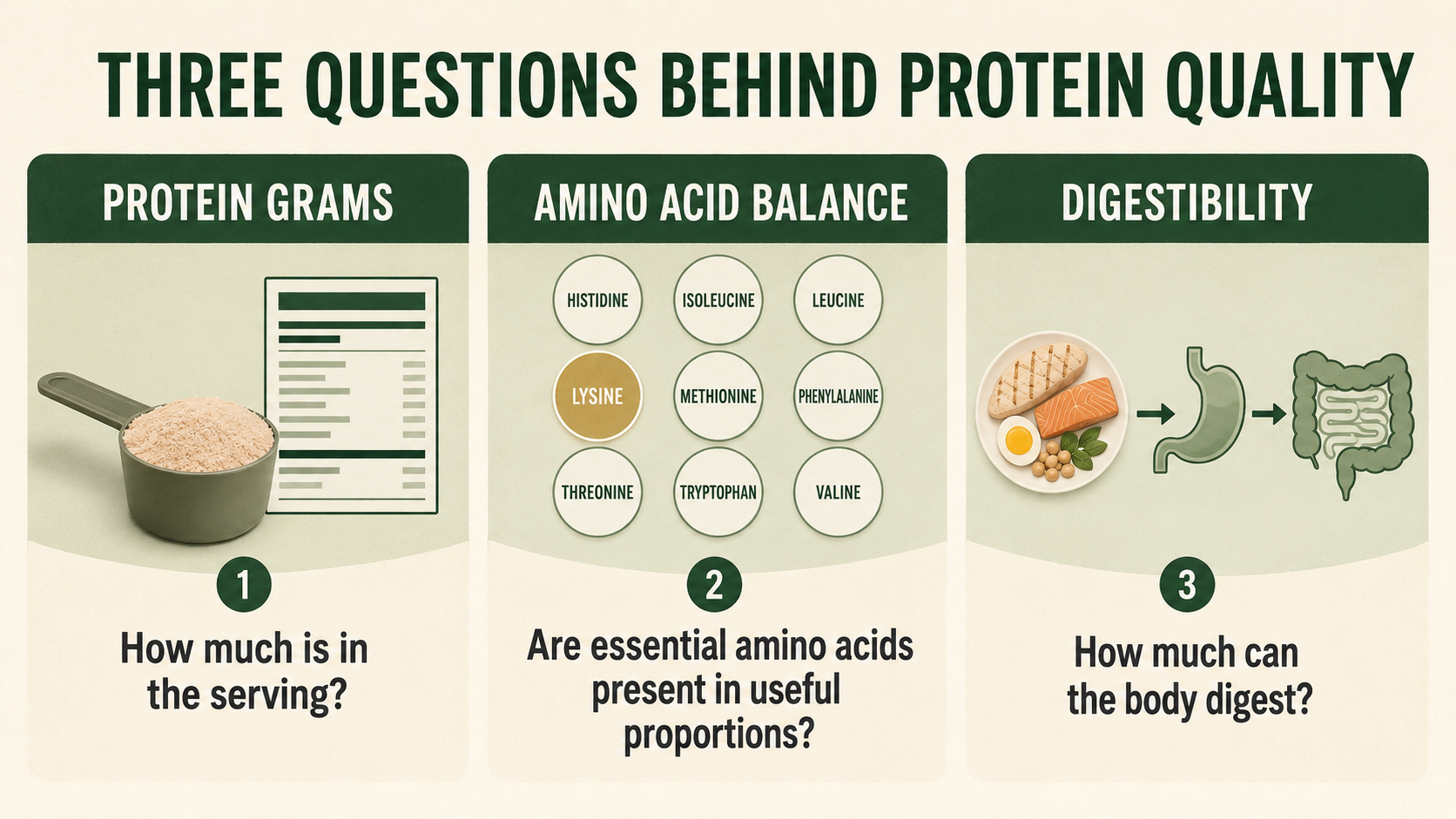
Adults must obtain nine amino acids from food because the body cannot make enough of them on its own: histidine, isoleucine, leucine, lysine, methionine, phenylalanine, threonine, tryptophan, and valine.
Finding all nine in a laboratory analysis does not mean they are present in equally useful proportions. Protein-quality methods compare each indispensable amino acid with a reference pattern. The amino acid with the lowest score becomes the limiting amino acid. Digestibility then changes the final quality estimate again.
1. Protein amount
How many grams does the labeled serving provide? This is the easiest number to find, but it does not describe amino-acid proportions or digestibility.
2. Amino-acid balance
Does the protein provide indispensable amino acids in the proportions used by a recognized reference pattern? “All nine are present” does not answer this fully.
3. Digestibility
What portion of the protein can be digested? The food form and processing can change this result.
4. Dietary context
What other protein foods appear in the meal and throughout the day? One scoop does not need to carry the entire diet.
The lysine catch in hemp protein
The most directly relevant published study analyzed 30 commercial samples of whole hemp seed, hemp seed meal, dehulled seed, and hulls. The researchers measured amino-acid profiles and used the protein digestibility-corrected amino acid score, or PDCAAS, on selected samples.
Lysine was the first limiting amino acid in every hemp product tested. That does not mean hemp contains no lysine. It means lysine was present in the lowest proportion relative to the study’s amino-acid reference pattern and therefore limited the score.
The same study reported digestibility ranges of 83.5% to 97.5%, depending on the hemp product, while PDCAAS ranges were lower: 0.46 to 0.66. That gap illustrates why a food can be reasonably digestible while its amino-acid pattern still limits the quality score.
Read the hemp protein-quality study on PubMed.
What the words and numbers actually tell you
On a phone, swipe the table sideways to see every column.
| What you see | What it can tell you | What it does not prove | Best reader action |
|---|---|---|---|
| “Contains all nine essential amino acids” | All nine were detected or are known to occur in the protein. | That each occurs in the ideal proportion, that the serving is large enough, or that digestion is complete. | Treat it as a starting fact, not the final quality verdict. |
| Protein grams | The amount of protein declared in one labeled serving. | The amino-acid pattern, protein quality, or your full meal total. | Confirm the serving weight and count the other foods in the meal. |
| % Daily Value for protein | A quality-adjusted contribution when it is required and calculated under U.S. labeling rules. | A personalized target for every age, activity level, or health condition. | Use it as label context; ask a clinician or dietitian about individual needs. |
| PDCAAS | A protein-quality estimate combining the limiting amino-acid score with digestibility. | How your whole diet performs, every effect of processing, or an individual clinical outcome. | Use it to understand a protein source, not to rank an entire food or diet by one decimal. |
| “Complete protein” | A consumer-friendly summary that often means all indispensable amino acids are present. | A standardized front-label promise that replaces the Nutrition Facts panel and total-diet context. | Look past the badge to the serving, ingredients, meal, and variety across the day. |
The FDA requires protein grams on the Nutrition Facts label, but protein % Daily Value is required only in specific situations, including when a protein claim is made. The agency’s label guidance also distinguishes the method used to declare grams from the quality-adjusted calculation used for protein % Daily Value. That is another reason not to assume that the largest gram number answers every quality question.
See the FDA’s guide to the Nutrition Facts label.
How processing changed the study results
Hemp hearts, whole seeds, and protein powder do not represent the same physical food. Removing the hull, pressing out oil, milling the remaining seed material, and sifting it into different grades redistribute protein, fat, and fiber. They can also change digestibility.
If that production sequence is unfamiliar, begin with Hemp Protein Powder vs. Hemp Hearts. It explains why the greener powder is not simply hemp hearts ground more finely.
The ranges below come from the 2010 hemp study—not from every product on the market.
| Studied hemp form | Protein digestibility | PDCAAS | What stands out |
|---|---|---|---|
| Whole hemp seed | 84.1%–86.2% | 0.49–0.53 | The hull reduced digestibility compared with some processed forms. |
| Dehulled hemp seed | 83.5%–92.1% | 0.63–0.66 | Removing the hull produced the highest PDCAAS range in this comparison. |
| Hemp seed meal | 90.8%–97.5% | 0.46–0.51 | High digestibility did not overcome the limiting amino-acid score. |
This is the part a “complete protein” label cannot show. More digestible did not automatically mean a higher PDCAAS. The amino-acid pattern—especially lysine—still mattered.
The Food and Agriculture Organization continues to refine how protein requirements and quality should be evaluated, including work on digestible indispensable amino acids and better global data. That broader scientific context is useful: protein-quality methods are tools with assumptions and data limitations, not permanent rankings carved into a package.
Review the FAO’s 2024 protein-quality database report.
Does this make hemp protein a poor choice?
No. A limiting amino acid does not make a food useless, and a lower score does not erase its protein, fiber, minerals, flavor, or practical value. It means the source should be interpreted accurately.
Hemp protein may fit well when you want:
- A plant-based protein contribution from a seed-derived food.
- A plain powder with a short ingredient list.
- Protein plus the fiber retained by a particular product.
- An earthy flavor that works in smoothies, oatmeal, baking, or energy bites.
- One protein source among several used across the day.
It may fit poorly when you dislike its texture, a high-fiber serving upsets your stomach, the blend contains ingredients you avoid, or you need a medically supervised protein plan. If digestive comfort is the immediate problem, use Does Hemp Protein Powder Cause Gas or Bloating? to separate the powder, serving, full smoothie, and possible warning signs.
Do you need to combine hemp protein with another food at the same meal?
Most readers do not need to engineer a perfect amino-acid pairing in every glass. A varied diet supplies amino acids from different foods over the course of the day. The current Dietary Guidelines for Americans, 2025–2030 recommend a variety of protein foods, including plant sources such as beans, peas, lentils, legumes, nuts, seeds, and soy.
The practical move is to look at your pattern rather than rescue one scoop with a complicated recipe. If hemp is your main protein powder, rotate or combine it with foods that broaden the day’s protein sources. Depending on your preferences and medical needs, that might include beans, lentils, soy foods, peas, dairy, eggs, seafood, or other proteins.
Do not add five ingredients simply to chase the word complete. A crowded smoothie may bring more calories, fiber, sweeteners, or digestive variables than you intended. Start with the meal’s job: breakfast, snack, post-exercise food, or a convenient way to fill a verified gap.
The Hemp Protein Quality Planner
This four-step planner turns a vague front-label claim into a decision you can check. Use the product in your kitchen and your normal meals—not a generic nutrition chart copied from a different powder.
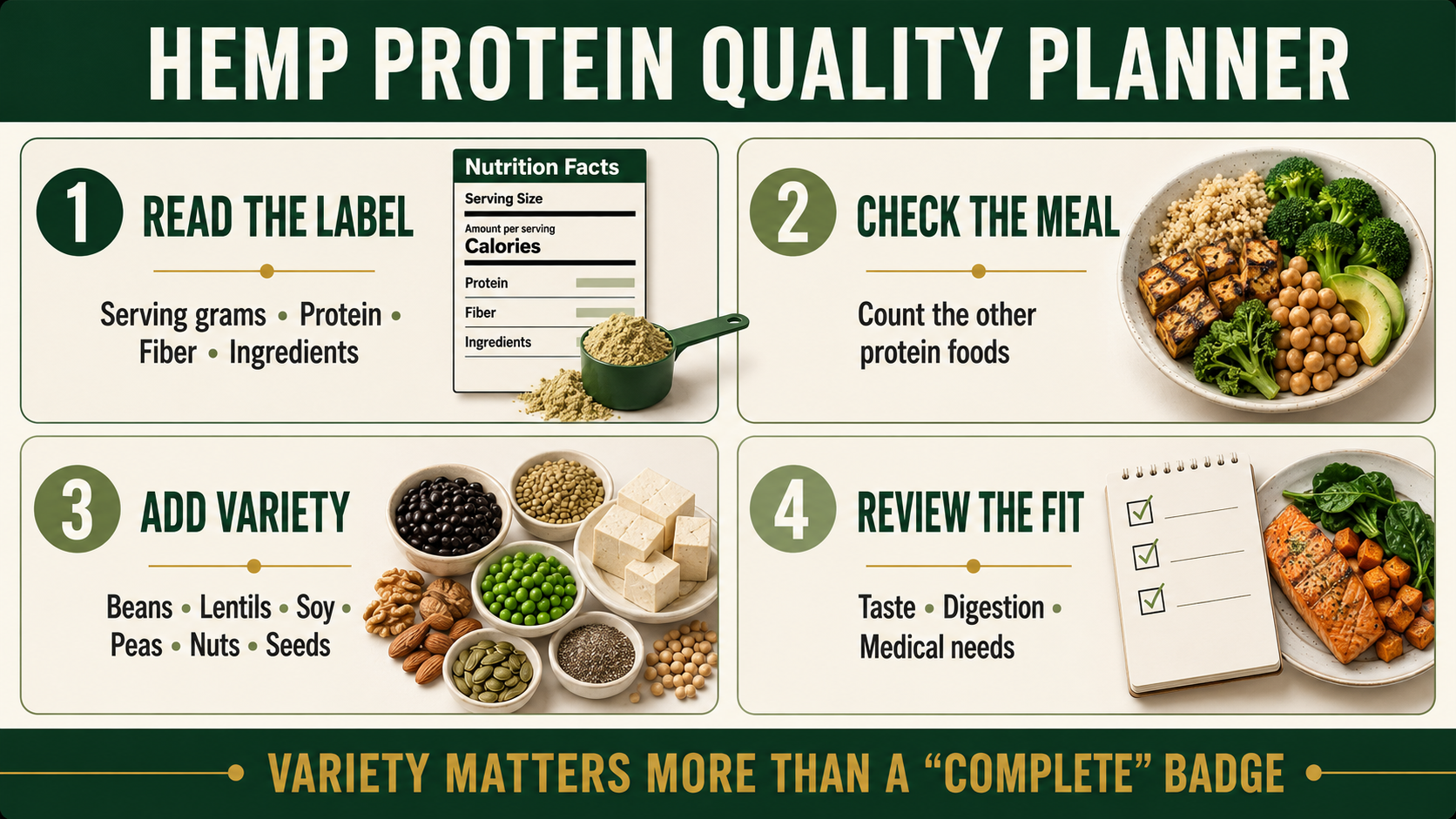
Read the exact label
Record the serving weight, protein grams, fiber, calories, ingredients, and any protein % Daily Value. Confirm whether it is plain hemp protein or a blend.
Count the whole meal
Add the protein from the liquid, yogurt, oats, nut or seed butter, and any food eaten alongside the shake. Do not credit the powder for the entire meal.
Review the day’s variety
Note the other protein sources you normally eat. Variety across meals matters more than forcing a perfect pairing into one smoothie.
Check personal fit
Consider taste, texture, fullness, digestive comfort, cost, convenience, allergy history, and any medically directed limits. A food you cannot use comfortably is not a practical solution.
Planner result: Keep hemp protein when it contributes a useful amount to meals you enjoy and the rest of your diet supplies adequate protein variety. Reconsider the product, serving, or professional guidance when you rely on it heavily, repeatedly fall short of a verified need, develop symptoms, or manage a condition that changes protein or mineral recommendations.
Who should get individualized protein advice?
Generic label guidance is not enough for everyone. A physician or registered dietitian can help if you:
- Have kidney disease or have been told to limit or monitor protein, phosphorus, potassium, fiber, or another nutrient.
- Are pregnant, breastfeeding, feeding a child, supporting an older adult with poor intake, or planning around high athletic demands.
- Follow a highly restrictive vegan or vegetarian diet or routinely replace meals with powders.
- Have persistent digestive symptoms, unexplained weight change, difficulty eating enough, or a history of an eating disorder.
- Develop hives, mouth itching, facial or lip swelling, wheezing, throat symptoms, dizziness, vomiting, or another possible food-allergy symptom.
Hemp is not one of the nine major allergens that receive special emphasis under U.S. federal labeling law, but reactions to hemp seed-derived ingredients have been reported. Stop using a suspected food and seek appropriate medical care. Trouble breathing, throat swelling, fainting, or another severe reaction is an emergency.
The FDA’s response to hemp seed ingredient notices distinguishes seed-derived foods from cannabinoid products and notes reported allergic reactions. Read the FDA hemp seed ingredient update.
One more label check: hemp protein is not CBD
Hemp seed protein powder is made from seed material. It should not be purchased with the expectation that it delivers cannabidiol effects. The FDA reports that the hulled hemp seed, hemp seed protein powder, and hemp seed oil evaluated in its GRAS responses contained only trace amounts of CBD and THC and were not capable of making consumers high.
If a package combines hemp protein with a hemp extract, cannabinoids, or a dose stated in milligrams, you are no longer evaluating a simple seed food. Use Hemp Seed Oil vs. CBD Oil to separate seed nutrition from cannabinoid questions involving medication interactions, THC exposure, and product testing.
Four-question knowledge check
Choose your answer before opening each explanation.
1. Does finding all nine essential amino acids prove that a hemp protein serving has an ideal amino-acid balance?
2. Which studied hemp form had the highest PDCAAS range: whole seed, dehulled seed, or hemp seed meal?
3. Did the hemp form with the highest digestibility also have the highest PDCAAS?
4. Must every hemp smoothie be perfectly paired with another protein at the same meal?
Frequently asked questions
Does hemp protein have all nine essential amino acids?
Is hemp protein good for building muscle?
Is hemp protein better than pea protein?
What food adds lysine to a hemp-based day?
Why does my hemp protein label show grams but no % Daily Value for protein?
Are hemp hearts a better-quality protein than hemp powder?
The bottom line
Hemp protein contains all nine essential amino acids. That is true—but it is not the whole answer.
Lysine was the first limiting amino acid in the published hemp protein-quality study. Digestibility changed with the form of the seed, and the most digestible studied form did not earn the highest PDCAAS. Those findings make a simple “complete protein” badge less useful than four practical checks: read the label, count the meal, include variety, and review personal fit.
You do not need to reject hemp protein, and you do not need to treat one scoop as nutritionally perfect. Give it a clear job inside a varied diet.
Authoritative sources and further reading
- House, Neufeld, and Leson: Evaluating the quality of protein from hemp seed products using PDCAAS
- U.S. FDA: How to Understand and Use the Nutrition Facts Label
- U.S. FDA: Daily Value on the Nutrition and Supplement Facts Labels
- U.S. FDA: Hemp seed-derived ingredients for use in human food
- FAO: Development of a protein database and the way forward for reviewing protein requirements
- Dietary Guidelines for Americans, 2025–2030
Nutrition and safety note: This article provides general education and does not diagnose, treat, or replace advice from a physician, registered dietitian, allergist, or other qualified professional. Individual guidance matters for allergies, kidney disease, digestive disorders, medically directed diets, pregnancy, breastfeeding, childhood nutrition, older-adult nutrition, athletic performance, restrictive diets, and persistent symptoms.
What does your hemp protein label actually show?
Share the serving weight, protein grams, fiber grams, ingredient count, and whether the package uses the words complete protein in the comment section. Please keep personal medical details private. Comparing real labels can help other readers see how much products differ without turning the discussion into individual diagnosis.
Join the comment discussion