

Hemp nutrition · Protein comparison · Evidence reviewed
You want more protein, but the two bags solve different problems. Whey looks efficient on the Nutrition Facts panel. Hemp looks appealing if you avoid dairy, want a plant-based option, or prefer a powder that may retain more of the seed’s fiber.
The useful question is not which powder wins every category. It is which product fits your diet, symptoms, training goal, recipe, and label—and whether you need a powder at all.
Quick answer: Is hemp protein better than whey?
Neither is automatically better. Whey generally supplies more protein and leucine per gram and has much more direct research behind its use with resistance training. Hemp protein is dairy-free and plant-based, and less-refined versions may provide substantially more fiber.
If maximum protein density is the priority and milk is suitable for you, whey often has the practical edge. If vegan eating, complete dairy avoidance, or a seed-based powder matters more, hemp may fit better. Compare the actual labels because a coarse hemp meal, a concentrated hemp powder, whey concentrate, and whey isolate are not equivalent products.
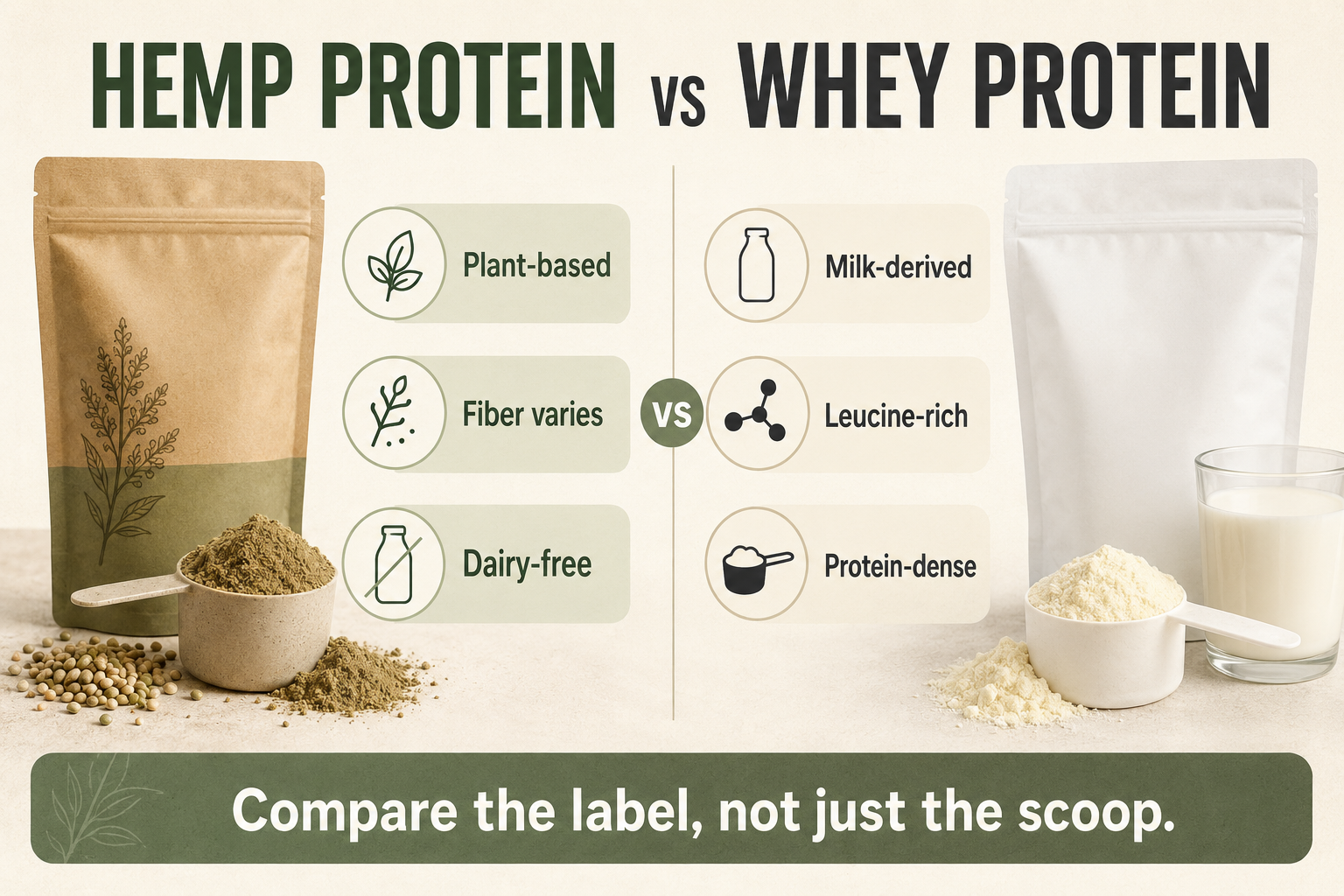
Hemp protein vs. whey protein at a glance
Hemp protein comes from hemp seeds, commonly after some oil has been removed and the remaining material has been milled or further processed. Whey is a group of milk proteins separated during dairy processing and sold in forms such as concentrate, isolate, and hydrolysate.
Those processing choices change what reaches the scoop. Treat the table below as a category comparison—not a substitute for the package in your hand.
| Decision factor | Hemp protein | Whey protein | What to check |
|---|---|---|---|
| Source | Hemp seed-derived; plant-based | Milk-derived | Ingredient list and allergen statement |
| Protein density | Often lower per gram because fiber, fat, and other seed material may remain; concentration varies widely | Usually higher, especially in isolates; concentrates retain more nonprotein material | Protein grams ÷ serving grams |
| Amino-acid pattern | Contains all nine essential amino acids, but lysine is commonly limiting and leucine density is generally lower | Rich in essential amino acids and leucine | Amino-acid panel when supplied; total diet matters too |
| Fiber | Can be a meaningful source, but processing changes the amount | Usually little or none | Dietary fiber per labeled serving |
| Dairy fit | Naturally dairy-free when it is a single-ingredient product without dairy cross-contact | Not dairy-free; whey is milk protein | “Contains: Milk,” ingredients, and cross-contact statement |
| Texture and flavor | Often earthy, green-brown, and grittier | Often milder and smoother, but formula and flavorings matter | Unflavored vs. flavored; gums, sweeteners, and serving size |
| Best practical fit | Vegan or dairy-free eating; recipes where fiber and earthy flavor are acceptable | Protein-dense shakes; people who tolerate milk protein and prioritize leucine efficiency | Your diet, symptoms, goal, and the complete day of food |
A seed-derived food ingredient
Some powders resemble a finely milled, partially defatted seed meal. Others are more concentrated. That is why protein and fiber can differ substantially from one bag to another.
A milk-derived protein ingredient
Concentrate, isolate, and hydrolyzed whey differ in processing and composition. “Isolate” may signal a higher protein percentage, but it does not turn milk protein into a non-dairy ingredient.
Which is better for muscle and recovery?
Whey has the stronger evidence-based advantage for delivering a concentrated dose of essential amino acids and leucine. A laboratory comparison of commercial protein isolates found that plant proteins varied widely and that hemp was lower in lysine and leucine than several animal proteins. Broader research also shows that whey produces a rapid rise in circulating essential amino acids and has been studied extensively around resistance exercise.
That does not mean hemp protein is useless for muscle. It means the same number of grams of powder should not be assumed to provide the same amount of protein, leucine, or digestible essential amino acids. Direct long-term trials comparing retail hemp protein with whey are limited, so a confident “hemp builds exactly the same muscle scoop for scoop” claim goes beyond the evidence.
The three factors that matter more than the front label
- Total daily protein: A powder contributes to the day; it does not replace the day. The NIH Office of Dietary Supplements notes that exercising people may need more protein than less-active adults, but food can still supply it.
- Training stimulus: Protein supplements do not create resistance-training adaptations by themselves. Systematic reviews find the benefit in the context of consistent training and sufficient intake.
- Protein quality and distribution: Essential amino acids, leucine, digestibility, meal size, age, and the rest of the diet influence the response. The exact target is individual—not a universal scoop printed on every bag.
If you rely mostly on plant proteins, variety across the day can help cover amino-acid needs. Hemp can be combined with foods or other plant proteins that contribute more lysine. For a deeper look at the word “complete,” read Is Hemp Protein a Complete Protein?
Which is easier on your stomach?
There is no universal winner because “digestive comfort” can refer to several different problems. Hemp’s fiber may support fullness, yet a sudden large serving can contribute to gas, bloating, or bowel changes. Whey may feel smoother to one person and cause symptoms for another because of lactose, milk-protein allergy, sweeteners, gums, or a large serving.
Lactose intolerance and milk allergy are not the same
Lactose intolerance involves difficulty digesting lactose, the sugar in milk. People tolerate different amounts. Whey isolate often contains less lactose than whey concentrate, but a category name does not reveal the amount in every product.
A milk allergy is an immune reaction to milk proteins. Whey is milk protein, so “low lactose” does not make whey appropriate for someone with a milk allergy. The FDA’s allergen-label guidance specifically uses “whey (milk)” as an example, while the NIDDK’s lactose-intolerance guidance explains why individual tolerance varies.
Hemp can create its own questions
A seed-based powder is not automatically nonallergenic. Allergic reactions to hemp seed have been documented, even though hemp is not one of the nine major allergens that receives special U.S. label treatment. Hives, mouth itching, swelling, wheezing, throat symptoms, faintness, or rapidly worsening symptoms need a different response from ordinary fullness.
Use the site’s hemp-protein allergy guide for warning signs and emergency guidance. For gradual gas or fullness without allergy signs, work through the hemp protein gas and bloating checklist.
| What happens | Possible clue | Safer next step |
|---|---|---|
| Gradual gas or fullness after a large hemp shake | Fiber amount, serving size, liquid, sweeteners, or the complete meal may matter | Stop if uncomfortable; review the label and change only one variable later if symptoms are mild and no allergy signs occurred |
| Bloating or diarrhea after whey | Lactose may be involved, but gums, sweeteners, milk protein, dose, or another ingredient could also contribute | Do not diagnose from the tub name; review the exact formula and seek guidance for persistent or concerning symptoms |
| Hives, swelling, wheezing, throat symptoms, faintness, or rapid worsening | Possible allergic reaction or emergency | Stop the product and follow appropriate emergency guidance; do not conduct a home retest |
| No symptoms, but a restrictive medical diet | Protein, potassium, phosphorus, fluid, or another nutrient may require individualized planning | Ask the clinician or registered dietitian managing the condition before adding a concentrated powder |
Choose by goal, not by “health halo”
The better first comparison
If the real choice is between two plant powders, use the separate hemp protein vs. pea protein comparison. Pea and hemp should not be grouped together merely because both are plant-based.
Do the label math before comparing price or protein
The front panel may advertise “20 g protein,” but that number is incomplete without the serving weight. A powder providing 20 grams of protein in 25 grams of powder is more protein-dense than one providing 20 grams in 45 grams of powder—even though both print the same protein claim.
A hypothetical comparison
| Label item | Powder A | Powder B | What it means |
|---|---|---|---|
| Serving weight | 30 g | 30 g | The powder amount is equal for this example |
| Protein | 15 g | 24 g | Powder B supplies more protein in the same powder weight |
| Protein density | 50% | 80% | 15 ÷ 30 and 24 ÷ 30 |
| Fiber | 8 g | 0 g | Powder A may serve a different purpose; higher protein density is not every shopper’s only goal |
These numbers are deliberately hypothetical. Use the formula on the products you are considering. Then compare added sugar, saturated fat, sodium, fiber, ingredients, allergens, serving size, and price per gram of protein.
Check quality evidence too
“Plant-based,” “grass-fed,” “natural,” and “third-party tested” are not full test reports. For hemp, ask whether contaminant testing matches the finished product and lot. The site’s heavy-metals guide shows how to read units and per-serving results without turning every detection into a panic—or every green “pass” badge into proof.
For any powder, check the seal, lot, date, storage directions, and recall status. An odd odor or damaged bag deserves inspection before the powder disappears into a flavored shake. Use the hemp protein storage guide when an older bag raises questions.
The P.I.C.K. label-side planner
This four-step planner keeps the decision attached to a purpose. Take a photo of both labels so you can compare them without relying on front-panel claims.
Pick the job
Is this for a convenient snack, a protein target, a dairy-free recipe, more fiber, or post-training nutrition?
Inspect the full label
Read ingredients, allergens, serving grams, protein, fiber, sugars, sodium, lot, date, and preparation directions.
Calculate the tradeoff
Compare protein density and cost per gram of protein. Then decide whether fiber, dairy status, flavor, or convenience changes the answer.
Keep one-variable notes
Record the product, amount, recipe, timing, taste, comfort, and training context. Do not home-test a product after a possible allergic reaction.
Planner rule: A powder is successful when it consistently fits the job without creating a new problem. If half the bag expires because you dislike the taste, the “best” amino-acid profile did not make it the best practical purchase.
When neither powder is the automatic answer
A protein powder is convenient, not mandatory. Eggs, dairy foods, soy foods, beans, lentils, fish, poultry, meat, nuts, seeds, and mixed meals can all contribute protein according to a person’s dietary pattern.
- You already meet your needs: More powder is not automatically more benefit.
- You have kidney disease or a prescribed nutrition plan: Protein and minerals may need individualized limits or targets.
- You are choosing for a child: Do not borrow an adult bodybuilding serving; ask an appropriate pediatric professional.
- You are pregnant, breastfeeding, recovering from illness, or managing unintentional weight loss: A clinician or registered dietitian can help match the product and amount to the situation.
- You had a possible allergic reaction: Stop the suspected product and seek qualified guidance rather than switching flavors or trying a smaller scoop at home.
Four-question interactive knowledge check
Choose your answer before opening each explanation.
1. Does a 30-gram scoop of hemp automatically provide the same protein as a 30-gram scoop of whey?
No. Equal powder weight does not guarantee equal protein. Divide protein grams by serving grams to compare protein density, then review fiber and other nutrients that may explain part of the difference.
2. Is whey isolate safe for a milk allergy because it may contain little lactose?
No. Lactose is milk sugar; whey is milk protein. Lower lactose does not remove the milk-allergy concern. Follow the allergen label and individualized medical guidance.
3. Does hemp contain all nine essential amino acids?
Yes, but that is not the complete quality comparison. The amounts, digestibility, limiting amino acids, protein dose, and full-day diet matter. Hemp is commonly lower in lysine and leucine density than whey.
4. Does more fiber automatically make hemp the better powder?
No. Fiber may be useful, but the amount varies and can be uncomfortable when increased abruptly. The better product matches the goal, the rest of the diet, and the user’s tolerance.
Frequently asked questions
Can hemp protein build muscle?
Hemp protein can contribute protein and essential amino acids to a diet that supports muscle maintenance or growth. However, it usually supplies less protein and leucine per gram than whey, and direct long-term hemp-versus-whey training trials are limited. Total intake, energy intake, resistance training, age, and the rest of the diet all matter.
Is hemp protein healthier than whey?
“Healthier” is too broad to answer from the ingredient name. Hemp may offer fiber and plant-based compatibility; whey may provide greater protein and leucine density. Added sugar, sodium, allergens, contaminants, serving size, and the rest of the diet can reverse a front-label impression.
Is whey protein dairy-free?
No. Whey comes from milk. A whey isolate may contain less lactose than a concentrate, but it remains a milk-derived protein and should not be presented as dairy-free.
Which is better for weight loss?
Neither powder causes weight loss on its own. Protein and fiber can influence fullness, but the complete diet, energy intake, activity, sleep, health conditions, and whether the shake adds or replaces calories determine the practical result. A large “healthy” smoothie can contain much more energy than expected.
Can I mix hemp and whey protein?
A person who tolerates both ingredients can combine foods or powders, but a blend does not erase milk allergens, suspected hemp allergy, lactose, or other formula ingredients. Compare the final serving rather than assuming half a scoop of each is nutritionally balanced.
Why is hemp protein grittier than whey?
Hemp powders can retain fiber and other seed particles, and milling and processing differ. More liquid, longer blending, a smaller serving, or a different recipe may improve texture. Use the site’s hemp protein texture guide for a controlled test.
Which powder is better for lactose intolerance?
Hemp is naturally lactose-free when it contains only hemp-derived ingredients. Some people with lactose intolerance tolerate certain whey isolates, but lactose amounts and individual tolerance vary. Read the exact label; do not confuse lactose intolerance with milk allergy.
Does hemp protein contain THC or make you high?
Properly produced hemp-seed foods are not intoxicating. Trace cannabinoid contamination can occur during harvesting or processing, so people subject to high-consequence drug testing should not treat a generic “hemp” claim as a guarantee. Use the site’s hemp protein and drug-testing guide for that separate decision.
Authoritative sources and further reading
- Gorissen SHM, et al. Protein content and amino acid composition of commercially available plant-based protein isolates. Amino Acids. 2018.
- Tang JE, et al. Ingestion of whey hydrolysate, casein, or soy protein isolate: effects on mixed muscle protein synthesis at rest and following resistance exercise. Journal of Applied Physiology. 2009.
- Morton RW, et al. Protein supplementation and resistance-training adaptations: systematic review, meta-analysis, and meta-regression. British Journal of Sports Medicine. 2018.
- NIH Office of Dietary Supplements: Dietary Supplements for Exercise and Athletic Performance.
- U.S. Food and Drug Administration: Have Food Allergies? Read the Label.
- National Institute of Diabetes and Digestive and Kidney Diseases: Eating, Diet, and Nutrition for Lactose Intolerance.
Medical and editorial note: This article provides general food and nutrition education. It does not diagnose lactose intolerance or food allergy, prescribe a protein target, or replace individualized advice from a physician, allergist, registered dietitian, or other qualified professional. Seek emergency help for breathing difficulty, throat or tongue swelling, fainting, loss of consciousness, or rapidly worsening symptoms.
The bottom line
Choose whey when protein and leucine density are the main job and milk is appropriate for you. Choose hemp when plant-based, dairy-free eating and a potentially higher-fiber powder fit the job better.
Then make the decision smaller: compare two real labels, calculate protein density, read every allergen and ingredient line, and test taste and comfort without changing the entire smoothie at once. The better powder is the one that fits your diet and gets used consistently—not the one with the loudest front panel.
What mattered most on your label?
In the comments, share the non-identifying detail that changed your decision: protein per serving, serving weight, fiber, “Contains: Milk,” sweeteners, texture, or another ingredient. Please do not post medical records, full lot numbers, addresses, receipts, or personal treatment details.