
Hemp nutrition · Everyday meals · Label-first guidance
You blend hemp protein with water, call it breakfast, and find yourself looking for food again before the morning is over. The first thing to check is the whole meal you packed into the glass.
A protein number can look reassuring while telling you very little about the rest of breakfast. Before adding another scoop, ask a more useful question: what did this drink replace, and what is it actually providing?
Quick answer: Can hemp protein replace a meal?
Hemp protein can be an ingredient in a meal, but plain powder mixed with water should not automatically be treated as a complete meal replacement. Review the drink’s energy, protein, other ingredients, and the foods it displaces. A smoothie can fit breakfast when its composition and portion suit your needs.
“Complete protein” describes amino acids. It does not establish that a scoop supplies everything a meal needs. Start with the actual label and your usual eating pattern, then use the P.I.C.K. breakfast planner below.
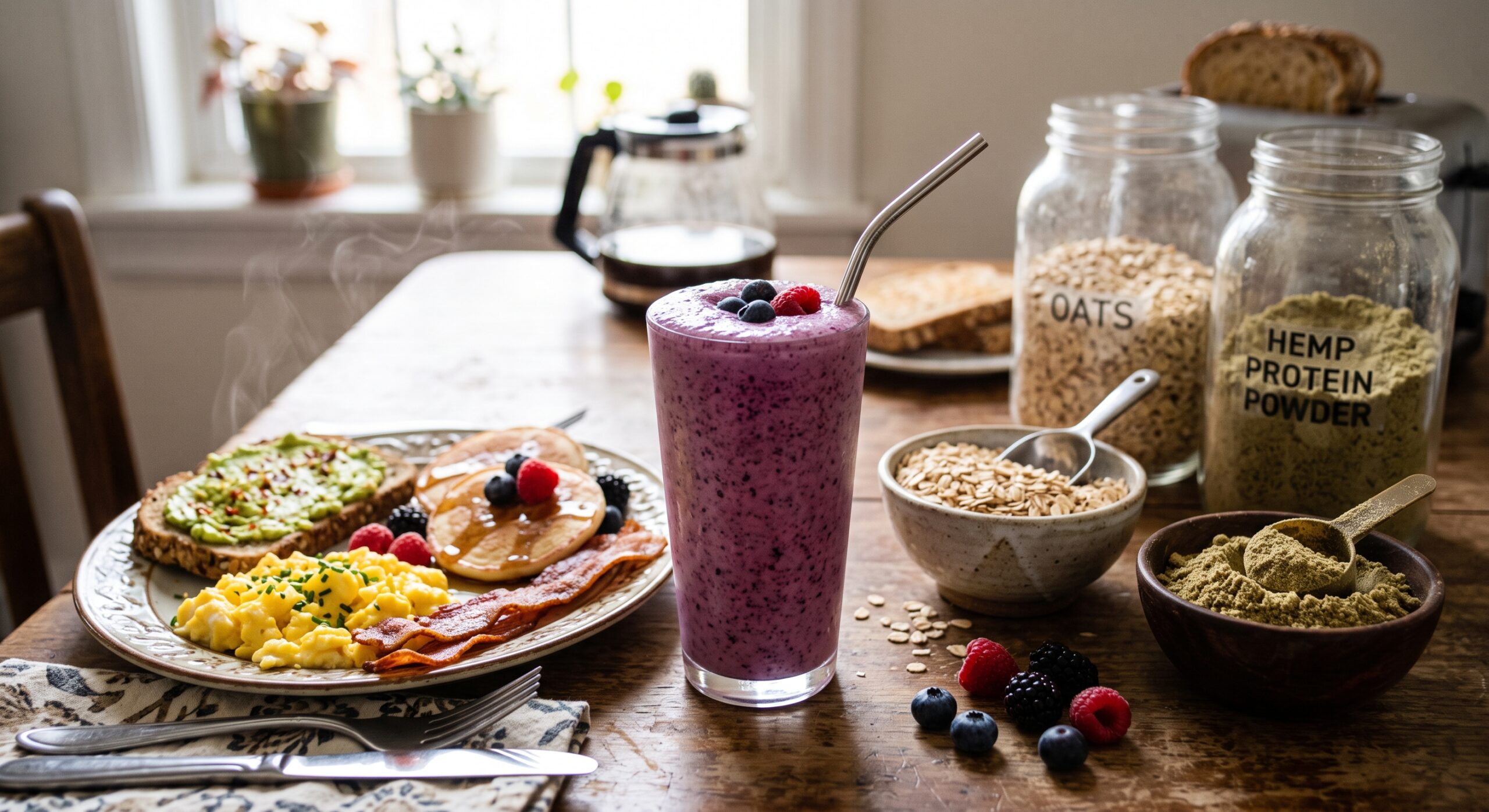
Protein powder, a smoothie, and a meal replacement do different jobs
Choosing between hemp and whey protein helps you select an ingredient. Deciding whether that ingredient can stand in for breakfast takes another step.
Here, “replace a meal” means using a drink in place of an ordinary meal. This guide is not a plan for replacing every meal or changing prescribed medical nutrition.
On a phone, swipe the comparison sideways if needed.
| Option | Practical role | Question to answer |
|---|---|---|
| Plain hemp powder + water | Adds the nutrients shown on the powder’s label; water does not fill nutritional gaps. | Would this replace a much more varied or substantial breakfast? |
| A homemade hemp smoothie | Lets you combine the powder with foods you enjoy and tolerate. | Have you counted the entire recipe and checked what the day still needs? |
| A product marketed as a meal replacement | May include added carbohydrate, fat, vitamins, and minerals as part of its formulation. | What does the prepared serving actually provide, and what use do its directions describe? |
| A smoothie alongside food | Lets a smaller drink accompany toast, a bowl, or another familiar breakfast. | Would eating part of the meal be simpler or more satisfying for you? |
A marketing name is a starting point for inspection. Read the ingredients, preparation directions, and nutrition panel. Products sold as supplements use a Supplement Facts panel; NIH notes that supplements cannot take the place of dietary variety. [1]
What your hemp protein smoothie may be missing
1. Enough food for the job you gave it
Compare your drink with the meal it replaced. A powder-and-water breakfast might remove the oats, fruit, milk or fortified beverage, and other foods you previously ate. That is a change in the whole meal, even if the protein number stays similar.
The FDA explains that a Nutrition Facts serving size reflects a typical amount consumed; it is not a personal eating recommendation. Multiply the panel values by the fraction or number of servings you actually use. A scoop is a measuring aid, not a breakfast prescription. [2]
2. Variety beyond the protein number
A healthy eating pattern involves adequate energy, a balance of macronutrients, and diverse foods. WHO’s guidance emphasizes those principles across the diet. No single breakfast has to supply every nutrient, but repeatedly removing several foods without replacing their contributions deserves attention. [3]
For the amino-acid question, see Is Hemp Protein a Complete Protein? For this meal decision, look beyond the amino-acid claim.
The breakfast check
Look at the whole glass
Four questions to ask before adding another scoop.
Write down the powder and every other ingredient you actually use.
Compare it with your usual breakfast, including foods now missing.
Check more than protein: energy, fiber, fats, and relevant vitamins and minerals.
Consider appetite, comfort, preparation time, and when you next eat.
3. Nutrients you assumed the liquid supplied
Read the carton as carefully as the powder bag. Plant-based beverages differ in protein and fortification. Compare protein, calcium, and vitamin D rather than assuming almond, oat, soy, and other drinks provide equivalent amounts. The FDA’s milk and plant-based beverage guide explains that label check. [4]
For a fully plant-based diet, vitamin B12 needs deliberate attention. Unfortified plant foods are not a reliable source; NIH identifies fortified foods and supplements as relevant sources. Do not assume ordinary hemp powder or a green smoothie provides B12. Check the product and the rest of your diet. [5]
4. A portion your stomach handles comfortably
Adding more powder, oats, fruit, and seeds together can change the fiber load considerably. NIDDK notes that too much fiber can increase gas for some people; certain carbohydrates and sweeteners can also contribute. A bigger smoothie is not automatically a more comfortable one. [6]
Keep the first version simple and record the recipe. If ordinary gas or fullness is the issue, use the hemp protein bloating checklist. Do not use a smaller serving as a home test after a possible allergic reaction.
Build a breakfast you would actually want again
Start with foods you already enjoy and tolerate. The following is a practical assembly idea, not a tested recipe, prescribed portion, or claim that every combination meets everyone’s needs.
- Choose a familiar liquid. Milk or a fortified plant beverage can be an option when it fits your diet. Inspect its label and allergens.
- Measure your hemp powder. Use the label to translate the amount into nutrients. Avoid guessing from a heaped scoop.
- Add a familiar fruit. A portion of berries or banana gives the drink a different flavor and texture. Write down the amount.
- Decide where the rest of breakfast belongs. Oats, yogurt, or a suitable nut or seed butter might fit your recipe. Toast or another food alongside the drink may be easier.
- Review before enlarging. Check the whole breakfast and how it fits your day before doubling the powder.
For an initial flavor combination, consider hemp powder, a beverage you tolerate, and berries, with oats in a separate bowl if preferred. Change one ingredient or portion at a time so you can tell which adjustment helped. The hemp protein texture guide addresses grit and mixing in more detail.
You do not have to drink the entire meal. If a large shake feels like a chore, keep the smoothie smaller and eat something alongside it. The practical goal is a breakfast that fits your needs and routine.
One label calculation worth doing
Suppose a hypothetical powder lists 120 calories, 15 grams of protein, and 7 grams of fiber per 30-gram serving. Using 15 grams of powder contributes half of each listed value: 60 calories, 7.5 grams of protein, and 3.5 grams of fiber.
Now add the other ingredients using their labels or a reliable food-composition reference. Keep the units consistent. The example below shows why the powder’s number is only part of the calculation.
Illustrative label math
The powder is only one entry
Invented values for a full recipe, shown to explain addition.
| Entry | Calories | Protein | Fiber |
|---|---|---|---|
| Powder portion | 120 | 15 g | 7 g |
| Beverage portion | 90 | 7 g | 1 g |
| Fruit portion | 80 | 1 g | 3 g |
| Oats portion | 80 | 3 g | 2 g |
| Whole recipe | 370 | 26 g | 13 g |
This calculation does not prove the drink is enough for you. It does show what to review: the whole portion, the fiber load, ingredients that are missing, and how the meal fits the day. Hunger and comfort are useful observations, but they cannot diagnose a nutrient deficiency.
Put the label to work
Your P.I.C.K. breakfast planner
Use the same P.I.C.K. approach as the site’s protein comparisons: Pick the job, Inspect the labels, Calculate the serving, Keep useful notes.
Fields are not saved by this planner after you leave. Copy your notes or print the page to keep them. The calculator adds label values; it does not judge whether your meal is nutritionally adequate.
Keep convenience from creating another problem
Check the food, not just the nutrition. A matching batch report can help assess the tested powder, but it cannot certify your breakfast as balanced. Use the hemp protein heavy-metals guide if you need help interpreting a report.
Keep prepared smoothies cold. Refrigerate perishable ingredients and prepared drinks promptly, at 40°F (4°C) or below. FDA’s general rule is no more than two hours unrefrigerated, or one hour above 90°F (32°C). A dry powder’s shelf life does not become the smoothie’s shelf life. [7]
Get individual guidance for medical nutrition. If you follow a prescribed diet, have unintentional weight loss or difficulty eating, or are replacing meals during pregnancy or for a child, discuss the plan with a clinician or registered dietitian. Keep prescribed nutritional products within that care plan.
Possible allergy needs a different response. Stop the suspected product and seek medical advice for allergy symptoms. Breathing trouble, throat or tongue swelling, faintness, or rapidly worsening symptoms need emergency help. Use prescribed epinephrine as directed and call emergency services. Do not retry the smoothie at home. Read the hemp protein allergy guide. [8]
Check what you learned
Four-question interactive knowledge check
Choose A or B in your head, then tap each question to reveal the answer.
1. “Complete protein” means: A) the whole meal is nutritionally complete, or B) a claim about essential amino acids?
Answer: B. Protein quality and meal adequacy are separate questions. The rest of the recipe and day still need consideration.
2. A 30 g serving lists 15 g protein. Using 15 g of powder gives: A) 7.5 g protein, or B) 15 g protein?
Answer: A, 7.5 g. You used half the labeled serving, so the listed protein contribution is halved. Add the other ingredients separately.
3. Two plant beverages are interchangeable because both say “milk”: A) true, or B) false?
Answer: B, false. Their protein and fortification can differ. Compare the cartons before counting either as an equivalent ingredient.
4. The calculator totals your calories, protein, and fiber. Does that prove breakfast is adequate? A) yes, or B) no?
Answer: B, no. The arithmetic describes those entries. It does not assess every nutrient, your individual needs, or the rest of your diet.
Frequently asked questions
Can I have a hemp protein smoothie for breakfast every day?
A recurring smoothie can be part of a varied eating pattern. Review the whole recipe, foods it regularly replaces, and the rest of your day. If the same nutritional gaps recur, change the meal or ask a registered dietitian to help assess it.
How many scoops make a meal?
There is no universal scoop count. Scoop sizes and powder composition vary, and people have different needs. Measure the actual portion and consider food alongside the drink before adding more powder.
Is a hemp smoothie better for weight loss?
This article does not establish a weight-loss benefit for hemp smoothies. A drink can add to your usual intake or replace part of it. Its role depends on the whole eating pattern, portion, and individual circumstances; the word “hemp” does not decide the outcome.
Do I need a multivitamin to make the smoothie complete?
Adding a multivitamin does not establish that a meal is adequate. It does not replace food energy, dietary variety, or a review of what you are eating. Supplements may address specific needs, but that decision should follow an actual assessment. [1]
Is plain hemp protein powder the same as a CBD product?
No. This guide concerns food-grade hemp seed protein. FDA distinguishes hemp seed ingredients from CBD: seeds do not naturally contain THC or CBD, although trace amounts can occur through contact with other plant material. Read the ingredients for added extracts. [9]
Sources and evidence notes
This is an application of general nutrition and labeling guidance. It does not report a clinical trial of the suggested smoothie or claim that a particular hemp recipe is a validated meal replacement.
- NIH Office of Dietary Supplements: Dietary Supplements—What You Need to Know. Supplement labels and the limits of replacing dietary variety.
- FDA: How to Understand and Use the Nutrition Facts Label. Serving sizes and proportional calculations.
- WHO: Healthy diet. Adequacy, balance, and dietary diversity.
- FDA: Using the Nutrition Facts Label to Choose Milk and Plant-Based Beverages. Comparing protein and fortification.
- NIH Office of Dietary Supplements: Vitamin B12. Food sources and fortification.
- NIDDK: Eating, Diet, & Nutrition for Gas in the Digestive Tract. Dietary contributors to gas symptoms.
- FDA: Are You Storing Food Safely? Refrigeration and time limits for perishable foods.
- FDA: Have Food Allergies? Read the Label. Allergy symptoms and urgent response.
- FDA: Hemp Seed-Derived Ingredients for Use in Human Food. Seed ingredients and trace cannabinoids.
Evidence and links checked September 2, 2026. This article provides general education and does not replace individual nutrition or medical advice. No product endorsements or affiliate links appear in this guide.
What would make your smoothie a better breakfast?
Do you prefer it as a snack, a full breakfast, or a smaller drink with food alongside? Share one ingredient or routine change that made it more useful for you in the comments.
A recipe idea or label detail is welcome. Keep private health information out of public comments.