

A green scoop can look like a complete muscle-building plan. It is not.
Hemp protein can add useful protein to a meal or post-workout shake, especially if you prefer a plant-based powder. Whether it helps you gain muscle, however, depends on the resistance training you do, the protein and energy you get across the entire day, the amount supplied by the serving, and the powder’s amino-acid profile.
By Kevin Meyer · Evidence checked September 16, 2026 · General nutrition education · No product endorsements
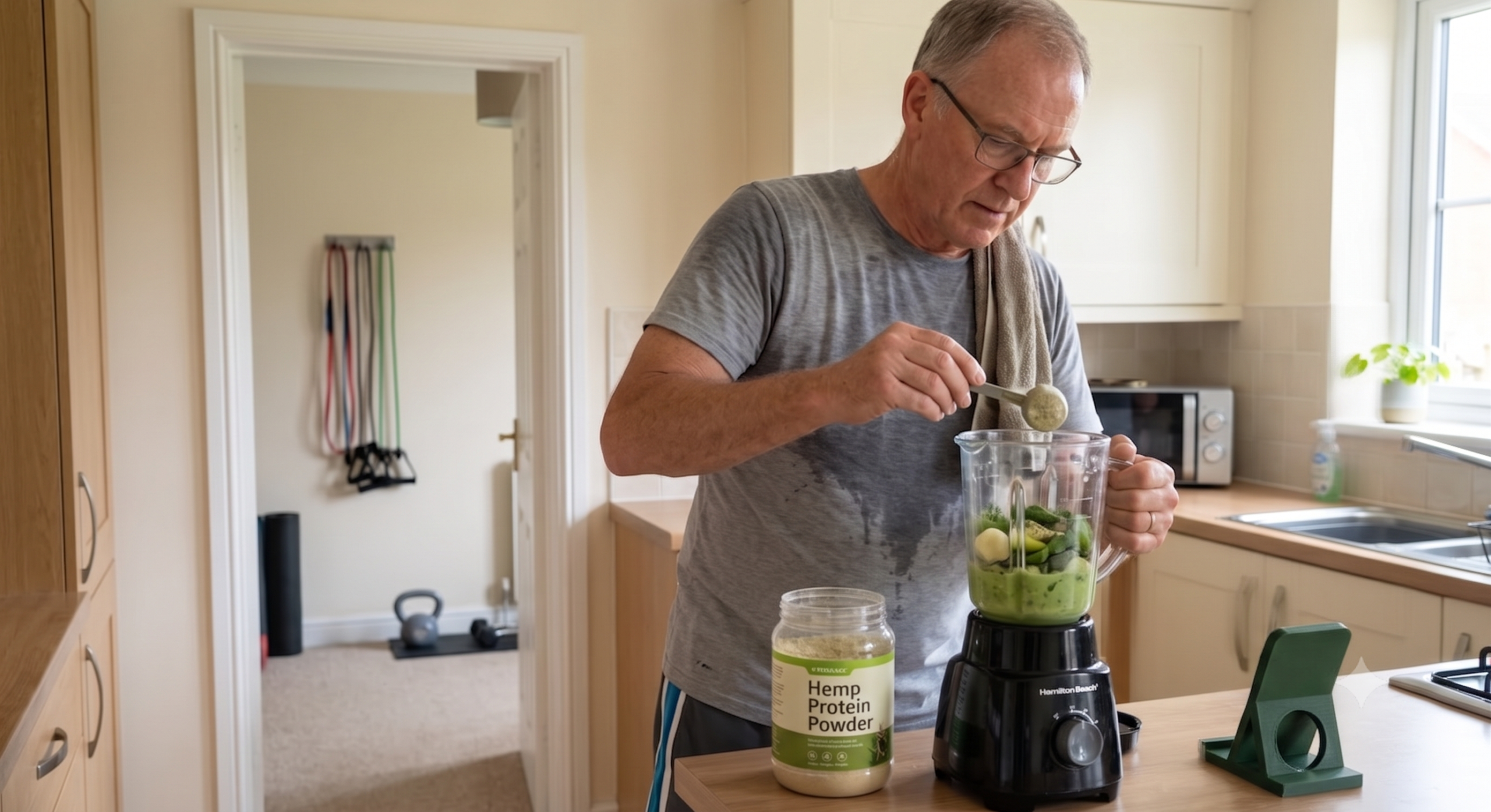
Quick answer: Can hemp protein help build muscle?
Yes—as one source of dietary protein in a plan that includes progressive resistance training and enough total food. Hemp protein contains all nine essential amino acids, including leucine, but many hemp powders provide less protein per scoop than more concentrated isolates, and lysine is commonly the limiting essential amino acid in hemp-protein research.
Do not judge the powder by the word complete or by the color of the bag. Check the labeled protein grams, serving weight, ingredient list, and how that serving fits your whole day. There is no strong basis for claiming that a typical retail hemp powder builds more muscle than another protein source gram for gram.
The scoop supplies material; training supplies the reason to adapt
Resistance exercise and dietary protein work together. Exercise provides the stimulus. Dietary protein provides amino acids the body can use during repair and remodeling. Consistently eating powder without challenging the muscles does not reproduce the effect of a resistance-training program.
The International Society of Sports Nutrition position stand explains that resistance exercise and protein ingestion both stimulate muscle protein synthesis and can work synergistically. Its general range of 1.4–2.0 grams of protein per kilogram of body weight per day applies to most healthy exercising people—not to everyone, and not specifically to hemp.
New 2026 guidance from the American College of Sports Medicine reinforces the less glamorous but more useful point: regularly training the major muscle groups matters more than chasing a needlessly complex “perfect” routine.
What matters inside a serving of hemp protein?
1. Protein grams—not merely scoop size
Two scoops that look alike may deliver very different amounts of protein. One powder may be roughly half protein by weight while a more concentrated product may supply more protein in less powder.
Use this simple label calculation:
Protein concentration (%) = protein grams ÷ serving weight in grams × 100
If a 30-gram serving supplies 15 grams of protein, the powder is 50% protein by weight. That does not mean your body absorbs only 50%. It simply describes how much of the labeled serving is protein.
For a deeper explanation of this distinction, read Can Your Body Actually Absorb Hemp Protein?
2. Essential amino acids and leucine
Leucine is an essential amino acid involved in signaling muscle protein synthesis. That is why sports-nutrition discussions often focus on leucine-rich protein servings. But a single leucine number is not a complete verdict on a food.
Your muscles need the full set of essential amino acids as building material. Hemp supplies all nine, yet “contains all nine” does not mean they appear in the same proportions as whey, soy, pea, or the reference pattern used in protein-quality scoring. In hemp, lysine is commonly the limiting amino acid.
Most Nutrition Facts panels do not list leucine or every amino acid. Do not invent a precise leucine dose from protein grams alone. If amino-acid content matters to your training plan, look for a credible product-specific amino-acid analysis or ask a sports dietitian. Our guide to whether hemp is a complete protein explains why the nine-amino-acid checklist is only the beginning.
3. Digestibility and the actual product
“Hemp protein” is not one standardized powder. Hulling, oil removal, milling, sifting, protein concentration, and added ingredients can change the final product. A result measured in one research ingredient should not be pasted onto every green powder sold online.
This matters in the kitchen too. A high-fiber powder may require a larger, grittier serving to deliver the same protein as a concentrated isolate. That is not automatically bad; fiber may be one reason you chose hemp. It simply means protein density, digestive comfort, and texture belong in the comparison.
Hemp protein compared with common alternatives
| Question | Hemp protein | Pea protein | Whey protein |
|---|---|---|---|
| Plant based? | Yes | Yes | No; dairy derived |
| Typical protein density | Often moderate; check the label | Often high in isolates | Often high in concentrates and isolates |
| Fiber | Can be meaningful | Often low in isolates | Usually little unless added |
| Best fit | Someone wanting plant protein plus the seed’s fiber profile | Someone wanting concentrated plant protein | Someone comfortable with dairy who values protein density |
These are category-level tendencies, not guarantees. Compare the labels in your hands. For a focused plant-protein comparison, see Hemp Protein vs. Pea Protein. If dairy fits your diet, use Hemp Protein vs. Whey Protein.
What the hemp-specific exercise research can—and cannot—prove
Direct human research on hemp supplementation and muscle gain is limited. A small 2024 resistance-training study compared hemp with soy in 34 trained young adults over eight weeks. The researchers reported some sex-specific differences, but a single small trial cannot establish that every hemp product matches another protein source or predict what will happen for you.
The responsible conclusion is narrower: hemp can contribute protein and essential amino acids to a muscle-building eating pattern. The stronger evidence base supports resistance training plus adequate total protein. It does not support treating hemp powder as a stand-alone muscle builder or promising a particular number of pounds of lean mass.
The P.I.C.K. Muscle-Support Planner
Use this label-first planner before buying a second bag or doubling the scoop.
P — Protein target
Estimate your whole-day need with a qualified professional when appropriate. Count meals first, then find the gap a powder might fill.
I — Inspect the label
Record serving weight, protein, fiber, calories, ingredients, allergens, and any credible amino-acid data.
C — Connect it to training
Pair adequate food with a consistent resistance program. A shake cannot replace progression, recovery, or sleep.
K — Keep the record
Track the measured serving, daily protein pattern, training consistency, comfort, and progress over several weeks—not one workout.
A practical post-workout decision
- Look at the day, not only the workout. If meals already cover your needs, another shake may add expense without solving a protein gap.
- Use the labeled gram weight. Scoops vary, and a heaping scoop is not a standardized serving.
- Count the protein in the whole meal. Soy milk, yogurt, oats, nuts, seeds, and other foods may contribute protein too.
- Keep the first recipe simple. This makes taste and digestive comfort easier to evaluate.
- Do not chase soreness. Soreness is not a required sign of an effective workout or a reason to keep increasing powder.
If daily serving questions are the bigger concern, use How Much Hemp Protein Powder Should You Take Per Day? If a shake causes discomfort, work through the separate hemp protein gas and bloating guide.
When individualized advice matters
A sports dietitian can help if you are training intensely, restricting calories, following a vegan diet with limited variety, recovering from an injury, or unsure how to distribute protein across the day. Ask a clinician before making major protein changes if you have kidney disease, liver disease, a medically directed diet, pregnancy, a history of food allergy, or another condition that changes nutrition needs.
Four-question knowledge check
Choose an answer before opening each explanation.
1. Does hemp protein build muscle without resistance training?
Answer: No. Protein supplies amino acids, but resistance exercise provides the principal muscle-building stimulus. Total diet, energy intake, recovery, and consistency also matter.
2. Does “complete protein” mean hemp is perfectly balanced for every use?
Answer: No. Hemp contains all nine essential amino acids, but their proportions and digestibility still affect protein quality. Lysine is commonly limiting in hemp research.
3. Can scoop size tell you how much protein you are getting?
Answer: Not reliably. Use the labeled serving weight and protein grams. Scoop volumes and product concentrations vary.
4. Does one small hemp study prove every hemp powder matches whey?
Answer: No. One study cannot establish equivalence across products, populations, doses, diets, and training programs.
Frequently asked questions
Is hemp protein good after a workout?
It can be a convenient post-workout protein source, particularly for someone who wants a plant-based option. The more important questions are whether the serving supplies a useful amount of protein, how it fits the rest of the day, and whether you tolerate it. The post-workout period is not a few-minute deadline.
How much hemp protein should I take for muscle gain?
There is no universal hemp-protein scoop for muscle gain. Start with your daily protein needs, count food sources, and use a measured serving only if it fills a real gap. Age, body size, training, energy intake, and health status change the answer.
Is hemp protein better than whey for building muscle?
Current evidence does not justify saying hemp is categorically better. Whey is generally more protein-dense and leucine-rich; hemp is plant based and may provide meaningful fiber. The best choice must fit your diet, tolerance, total protein plan, and preferences.
Can I mix hemp protein with another plant protein?
Yes, foods and protein sources can complement one another across meals. A blend is not automatically superior, however. Check total protein, ingredients, allergens, added sweeteners, serving size, and cost rather than assuming more ingredients mean more muscle.
The bottom line
Hemp protein can support a muscle-building diet. It does not replace resistance training, and the word hemp does not guarantee a particular protein concentration, amino-acid profile, or result.
Start with the training habit. Check the protein gap across your entire day. Read the serving weight and protein grams on the bag. Treat leucine and amino-acid quality as useful context—not marketing magic. Then judge the powder by whether it fits your meals, budget, digestion, and repeatable routine.
What does your label show?
Share the serving weight and protein grams from your hemp powder in the comments. That is enough to calculate its protein concentration and compare it fairly—without posting private medical information.
Authoritative sources and further reading
- PubMed: International Society of Sports Nutrition Position Stand—Protein and Exercise
- American College of Sports Medicine: Updated Resistance Training Guidelines
- PubMed: Evaluating the Quality of Protein from Hemp Seed Products
- PubMed: Effects of Hemp Supplementation During Resistance Training in Trained Young Adults
Nutrition and safety note: This article provides general education. It does not diagnose, treat, prescribe a training diet, or replace advice from a physician, registered dietitian, or qualified exercise professional.