

Hemp nutrition · Kidney-aware label guide · Evidence reviewed September 22, 2026
A green powder and a plant-based label can look reassuring. But if kidney function is reduced, the useful question is not whether hemp is “natural.” It is whether the exact serving fits your protein target, blood-test results, medications, treatment stage, and complete day of food.
By Kevin Meyer · General nutrition education · No product endorsement
Quick answer: Is hemp protein safe for your kidneys?
For an adult without kidney disease or a medically prescribed diet, a normal food serving of hemp protein is not automatically a kidney problem. That does not prove every powder, portion, or daily routine is appropriate.
If you have chronic kidney disease (CKD), receive dialysis, have had a kidney transplant, have abnormal potassium or phosphorus results, or were told to control protein or sodium, do not judge the powder by its front label. Your clinician or renal dietitian may need to compare the product and portion with your individual plan.
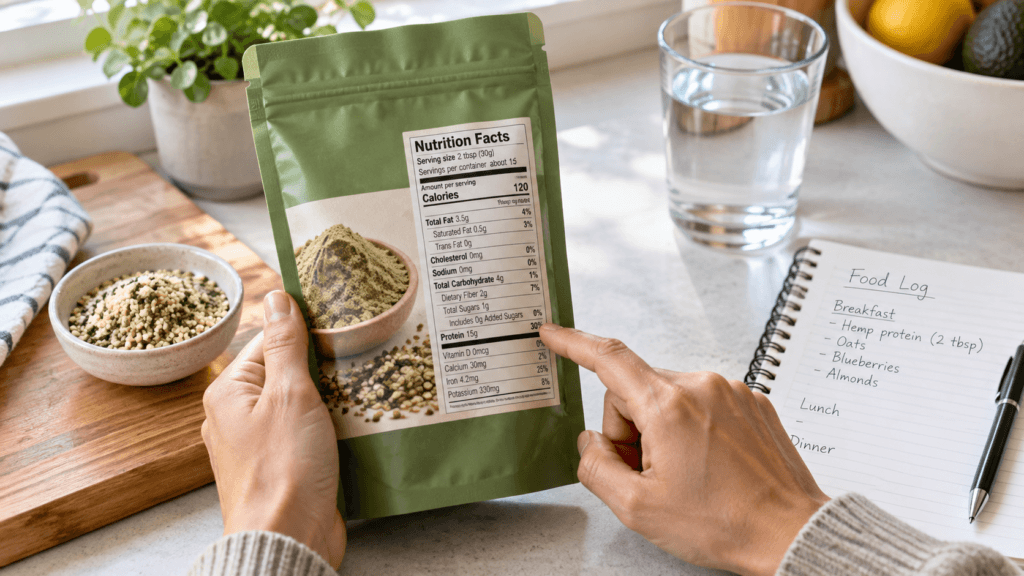
You may have heard two claims that sound equally certain: “Plant protein is easier on the kidneys” and “Protein powder damages the kidneys.” Neither sentence can safely decide what belongs in your glass.
Kidney nutrition changes with kidney function, lab results, treatment, appetite, medications, and total intake. The National Institute of Diabetes and Digestive and Kidney Diseases explains that people with CKD may need to manage protein, sodium, potassium, phosphorus, and fluids. Those needs are not identical for everyone.
Healthy kidneys and diagnosed kidney disease are different questions
Healthy kidneys filter wastes and help balance fluid and minerals. A person with normal kidney function does not automatically need to avoid ordinary protein foods because they contain protein, potassium, or phosphorus.
CKD changes the decision. Damaged kidneys may not filter blood or balance nutrients as effectively. The right amount of protein may also change across stages and treatments. Someone who is not on dialysis may receive different guidance from someone on hemodialysis or peritoneal dialysis.
The five label checks that matter more than the word “hemp”
Count the grams in the portion you will actually use, then place them inside your daily target.
Check the listed amount when present. Your need to limit potassium should come from individualized guidance, not a universal food list.
The label may not provide a number. Scan ingredients for phosphate additives and ask the manufacturer when the amount matters clinically.
Plain powder may be modest in sodium, while flavored blends can add salt, flavor systems, or other ingredients.
Two scoops double every listed nutrient—not just the protein.
Protein: more is not automatically better
Protein supports essential body functions, but its breakdown also creates waste that the kidneys help remove. NIDDK advises people with CKD to work with a dietitian on the right amount and sources of protein. It also notes that protein needs may increase for people on dialysis because treatment removes protein from the blood.
This is why a “high-protein” badge is not a universal benefit. One person may be using a scoop to close a documented intake gap. Another may already meet a prescribed target through meals and unintentionally add more.
If portion size is the issue, use the site’s hemp protein serving guide to calculate what the powder contributes. It is a planning tool—not a substitute for a renal protein prescription.
Potassium: the number matters only in context
Potassium helps nerves and muscles function, including the heart. Blood potassium that is too high or too low can be dangerous. Kidney function, medications, dialysis, and laboratory results can all affect the amount a person needs.
Do not assume every person with CKD must avoid every potassium-containing plant food. The National Kidney Foundation’s CKD nutrition overview emphasizes that restrictions should be based on kidney function, medicines, and blood tests.
Phosphorus: the Nutrition Facts panel may stay silent
Phosphorus occurs naturally in protein-rich foods, including seeds. Manufacturers generally do not have to list phosphorus on a standard Nutrition Facts panel, so a missing number is not the same as zero.
Also inspect the ingredient list for words containing “phos,” which may signal a phosphate additive. NIDDK notes that added phosphorus in processed foods can raise blood phosphorus more readily than naturally occurring phosphorus. A plain, one-ingredient powder and a flavored protein blend therefore deserve separate evaluations.
Sodium: check the complete blend
Too much sodium can contribute to fluid retention and higher blood pressure, issues that can be especially important in kidney disease. Compare sodium per serving and remember to count the liquid, nut butter, yogurt, packaged fruit, or other ingredients in the shake.
Hemp protein does not have one fixed nutrition profile
Hemp protein powders differ because manufacturers remove oil, mill, sift, concentrate, flavor, and blend the seed material in different ways. A product with more retained fiber may not resemble a more concentrated powder. A chocolate multi-protein blend may contain ingredients absent from plain hemp powder.
| What you see | What it can tell you | What it cannot decide |
|---|---|---|
| Protein grams | Contribution per labeled serving | Your personal daily target |
| Potassium amount or % Daily Value | Amount the manufacturer declares | Whether your blood result requires a limit |
| No phosphorus line | Only that it is not declared there | That the product contains no phosphorus |
| “Plant-based” | The marketed protein source | Whether it fits CKD, dialysis, or transplant guidance |
| “Clean” or “natural” | A marketing impression | Protein, mineral, contaminant, or medication safety |
If a company provides batch testing, make sure the report matches the lot you hold and identifies the tested material. The site’s hemp protein heavy-metals guide explains why a certificate of analysis and a Nutrition Facts panel answer different questions.
Quick comparison: when the answer changes
| Situation | Reasonable next step | Avoid assuming |
|---|---|---|
| No known kidney disease; no prescribed protein or mineral limit | Use the label and a normal portion within a varied diet | That multiple daily scoops add benefits |
| CKD, not on dialysis | Ask whether the protein, sodium, potassium, and phosphorus fit the current plan | That all plant powders are automatically kidney-friendly |
| Hemodialysis or peritoneal dialysis | Follow the dialysis team’s protein, fluid, potassium, phosphorus, and sodium guidance | That advice for earlier-stage CKD applies unchanged |
| Kidney transplant or complex medications | Check with the transplant team or pharmacist before adding a routine supplement | That “food-based” means interaction-free |
| Unknown kidney status but meaningful risk factors | Discuss appropriate screening with a clinician | That symptoms alone reveal kidney function |
Use the P.I.C.K. planner before the first scoop
P — Product: Record the exact name, ingredient list, labeled serving weight, and lot number.
I — Intake: Write down how many grams you will use and what the rest of the meal adds.
C — Context: Note kidney diagnosis or treatment, recent lab guidance, medications, fluid guidance, appetite, and the reason you want the powder.
K — Keep or question: Keep the product only if it fits the plan. Write down missing information to ask the manufacturer, clinician, pharmacist, or renal dietitian.
Formula: protein per serving × (grams used ÷ labeled serving grams). This calculates label math only; it does not set a safe kidney-disease target.
When to pause before using the powder
- You were given a daily protein, sodium, potassium, phosphorus, or fluid target.
- Your latest potassium or phosphorus result was outside the range your care team set.
- You receive dialysis or have had a kidney transplant.
- The product contains an undisclosed blend, potassium additives, phosphate additives, herbal extracts, CBD, or other active ingredients.
- You are replacing meals, losing weight unintentionally, eating poorly, or recovering from illness or surgery.
- You develop swelling, breathing trouble, marked weakness, confusion, chest symptoms, or another urgent change. Seek prompt medical care rather than trying to solve it by changing powder.
For ordinary digestive symptoms, the hemp protein gas and bloating guide can help you inspect fiber, serving size, and the complete smoothie. Possible allergy symptoms need a different response; use the hemp protein allergy guide and seek appropriate care.
Four-question knowledge check
1. Does “plant-based” prove a protein powder is kidney-friendly?
No. The exact protein, sodium, potassium, phosphorus, ingredients, portion, and individual kidney plan still matter.
2. Does an absent phosphorus line mean zero phosphorus?
No. Phosphorus is not always listed on the Nutrition Facts panel. Check ingredients for phosphate additives and ask for product data when phosphorus matters clinically.
3. Should every person with CKD automatically avoid potassium?
No. Potassium guidance depends on kidney function, blood results, medications, and treatment. Follow individualized advice.
4. Can advice for a person not on dialysis be copied directly to someone receiving dialysis?
No. Dialysis can change protein and other nutrition needs. The dialysis care team’s plan takes priority.
Frequently asked questions
Can hemp protein cause kidney stones?
A single ingredient cannot explain every type of kidney stone. Stone risk and prevention depend on stone composition, urine findings, fluid intake, sodium, calcium, oxalate, animal-protein intake, medical conditions, and other factors. If you have a stone history, use the prevention plan based on your evaluation rather than avoiding hemp protein on a guess.
Is hemp protein better than whey for kidney disease?
Neither powder wins for everyone. Hemp and whey differ in protein density, amino-acid profile, fiber, minerals, allergens, and ingredients. Your renal plan and the actual labels decide the more suitable option. For a general comparison, see hemp protein versus whey.
Is hemp protein high in potassium or phosphorus?
There is no reliable universal number for every retail powder. Processing, concentration, formulation, and serving size differ. Use the package data, contact the manufacturer for missing information, and compare the amount with your individualized targets.
Can I take hemp protein every day if I have healthy kidneys?
Frequency alone does not establish value or safety. Consider why you are using it, the portion, the rest of your diet, digestive tolerance, allergies, and product quality. The daily hemp protein checklist walks through those questions.
What should I bring to a renal dietitian?
Bring the package or clear photos of the Nutrition Facts and ingredients, the serving weight, how much you use, the complete shake recipe, current medicines and supplements, recent lab guidance, and the reason you want the powder.
The bottom line
Hemp protein is not automatically dangerous to healthy kidneys, and it is not automatically suitable for kidney disease. The useful answer lives in the space between those claims.
Read the exact label. Measure the portion. Count the complete meal. If kidney function, dialysis, transplant care, lab results, or prescribed nutrient limits are part of your life, put that information ahead of the marketing on the pouch.
What would help you most?
Have you found a hemp protein label that lists potassium but leaves phosphorus blank—or one that gives almost no useful detail at all? Share what you are trying to compare in the comments. Do not post private medical information; a label question is enough to start a useful discussion.
Evidence and further reading
- NIDDK: Healthy Eating for Adults with Chronic Kidney Disease
- NIDDK: Eating and Nutrition for Hemodialysis
- NIDDK: Eating Right with Kidney Failure
- National Kidney Foundation: Nutrition and Kidney Disease, Stages 1–5
- CDC: Risk Factors for Chronic Kidney Disease
- FDA: Hemp Seed-Derived Ingredients for Use in Human Food
Medical and nutrition note: This article provides general education. It does not diagnose kidney disease, interpret lab results, prescribe protein or mineral limits, or replace advice from a nephrologist, physician, pharmacist, or registered dietitian.