

Hemp Nutrition · Practical label guide · Evidence checked September 8, 2026
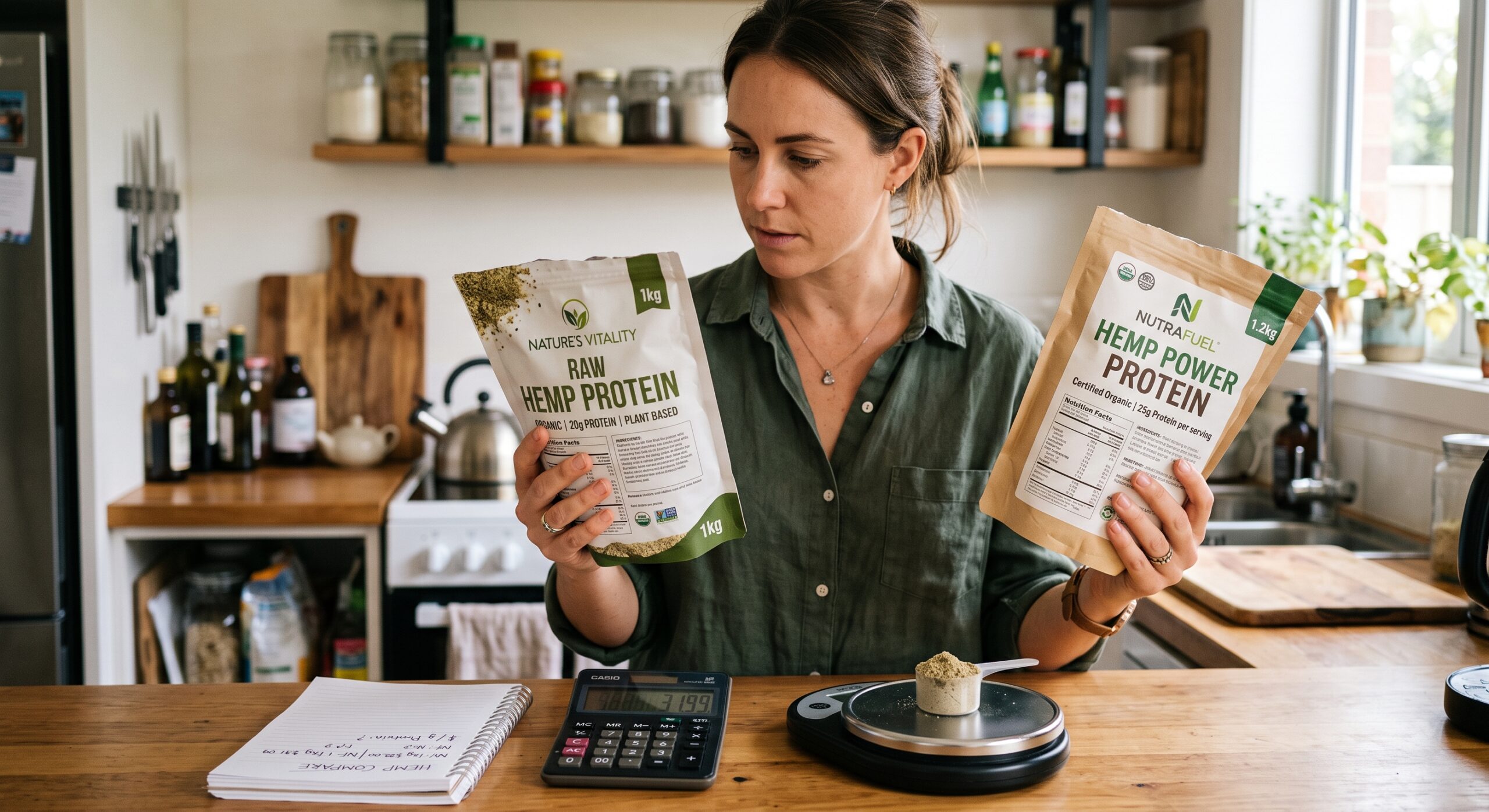
Hemp protein cost looks easy to compare until you turn the bags around. One is cheaper. Another promises more servings. A third puts a bigger protein number on the front—but uses a bigger serving to get there.
That is how a sensible grocery decision turns into a guessing game. The missing question is simple: what does the amount you will actually use deliver for your money?
You do not need a spreadsheet or the most expensive powder. You need four label numbers, a fair comparison, and a little honesty about what belongs in your breakfast.
The quick answer
Compare hemp protein cost in two ways: cost per labeled serving and cost per fixed amount of labeled protein. The first helps you budget for your usual portion. The second prevents different serving sizes and protein concentrations from distorting the comparison.
Then check fiber, ingredients, taste, and how much of the bag you will use. A lower protein cost is one useful result, not a complete nutritional ranking.
The cheaper bag can lose the protein comparison
Imagine two bags on your screen. Bag A costs $18; Bag B costs $24. Both contain 450 grams of powder, so A also looks better by package weight.
Now look at what is inside each 30-gram serving. In this example, A supplies 10 grams of protein and B supplies 20 grams. The more expensive bag contains twice as much labeled protein overall.
| What you compare | Bag A | Bag B |
|---|---|---|
| Total purchase cost | $18 | $24 |
| Net powder weight | 450 g | 450 g |
| Labeled serving | 30 g | 30 g |
| Protein per serving | 10 g | 20 g |
| Calculated servings | 15 | 15 |
| Cost per serving | $1.20 | $1.60 |
| Cost per 10 g protein | $1.20 | $0.80 |
Bag A wins on the price of a 30-gram portion. Bag B wins on the price of 10 grams of protein. Neither calculation is wrong; they answer different questions.
Use this to estimate the cost of your normal recipe.
Use the same protein amount for both products.
Read the grams beside the scoop
The FDA’s Nutrition Facts guide explains that nutrient amounts refer to the stated serving. That serving reflects typical consumption; it is not a personalized recommendation.
A scoop is a measuring tool, not a universal weight. Compare the serving’s gram weight with its protein grams. A 30-gram serving of powder does not automatically supply 30 grams of protein.
This matters even within one brand. At review, the Nutrition Facts panels on Manitoba Harvest’s Max Fiber Unsweetened and Balanced Protein + Fiber pages list different serving weights. These are examples of label variation, not purchase recommendations. Match the flavor, size, and formula to the package you are buying.
Calculate hemp protein cost from your own label
Use the total cost you would pay for that bag, including any shipping or tax you assign to it and any discount actually applied. For multiple bags, enter their combined cost and combined net weight only if they have the same nutrition profile.
Your label calculator
The starting values reproduce hypothetical Bag A. Replace all four with your own numbers. Results are approximate because labels round quantities.
Use one currency throughout. The dollar sign is a display label. The calculation does not adjust for digestibility, amino acid composition, or individual protein needs.
The same calculation by hand
- Servings: net powder weight ÷ serving weight.
- Cost per serving: total bag cost ÷ calculated servings.
- Cost per 10 g protein: cost per serving ÷ protein grams per serving × 10.
For Bag A: 450 ÷ 30 = 15 servings. Then $18 ÷ 15 = $1.20 per serving. Finally, $1.20 ÷ 10 × 10 = $1.20 per 10 grams of protein.
Three things the cheapest-protein number misses
1. You may also want the fiber
If the powder’s job is to add both protein and fiber to oatmeal, ranking it by protein alone leaves out part of what you want. Record fiber per serving alongside the cost, then decide whether the portion fits your meal.
Conversely, do not keep increasing a fiber-rich powder simply to chase a protein number. A larger portion also scales the other labeled nutrients. The FDA’s serving-size examples show how that arithmetic works.
2. The comparison does not measure protein quality
This calculator compares dollars with declared protein grams. It does not show how much protein your body will digest or whether two products have identical amino acid profiles.
If you are comparing different protein sources, use the cost result alongside the site’s hemp-versus-pea guide. Price alone cannot settle every nutrition tradeoff.
3. An unfinished bag changes the value
Imagine buying 20 portions for $20, using 10, and discarding the rest because you dislike the powder. You paid $2 per portion actually used, even though the original calculation said $1.
Before choosing a bulk bag, ask whether you already like that exact formula and have a realistic way to finish it. Follow its storage directions; see the hemp protein storage guide for the quality clues to check.
Your P.I.C.K. shopping planner
Use these four steps before your next order. Write the answers in your shopping notes so the comparison stays tied to a real meal.
P — Pick the job
Finish this sentence: “I want this powder to add ______ to my ______.” Protein for a smoothie and protein plus fiber for oatmeal may lead to different choices.
I — Inspect the exact label
Record total cost, net weight, serving grams, protein grams, and fiber grams. Check the complete ingredients and make sure the online label matches the selected product.
C — Compare on equal terms
Calculate both cost per serving and cost per 10 grams of protein for each bag. Keep the two results separate. Note any differences in flavor, ingredients, or testing information that matter to you.
K — Keep what works in your kitchen
Choose a realistic portion and buying quantity. Record how it tastes in your usual recipe and whether you finish the bag before deciding that a larger order offers better value.
One final breakfast check: A low-cost protein portion does not establish that your smoothie is a complete meal. Use the meal-replacement guide to assess the whole recipe.
Do not pay a premium for an unanswered question
A higher price does not, by itself, tell you what a product has been tested for. If a seller emphasizes testing, look for information that identifies the relevant product and batch, the substances tested, and the actual results.
The guide to heavy metals in hemp protein explains why a simple “pass” badge may leave useful questions unanswered. You can keep quality checks separate from price arithmetic while considering both in your decision.
Four-question knowledge check
Choose an answer in your head, then tap to reveal the explanation.
1. A $24 bag provides 20 servings. What does one serving cost? A: $0.83 · B: $1.20 · C: $2.40 · D: $4.00
B: $1.20. Divide $24 by 20. This gives the cost of the labeled portion, not the cost of a fixed protein amount.
2. A serving costs $1.50 and supplies 15 g protein. What is the cost per 10 g protein? A: $0.10 · B: $1.00 · C: $1.50 · D: $2.25
B: $1.00. $1.50 ÷ 15 × 10 = $1.00. Ten grams is just the shared comparison unit.
3. Two powders both say “one scoop.” What should you check next? A: Bag color · B: Scoop handle length · C: Serving grams and protein grams · D: Front-label font size
C: Serving grams and protein grams. A scoop does not establish equal powder weight or equal protein content across products.
4. Which claim can this calculator support? A: Cheapest per 10 g labeled protein · B: Best digestion for everyone · C: Highest product purity · D: Complete meal replacement
A: Cheapest per 10 g labeled protein. The calculation cannot establish personal tolerance, purity, or the nutritional completeness of a meal.
Frequently asked questions
Is hemp protein worth the money?
It can be if its ingredients, portion, flavor, and nutrition fit a meal you actually eat at a cost you accept. Compare your exact labels rather than assuming all hemp powders provide the same value.
Should I compare price per ounce or price per serving?
Price per ounce compares the cost of powder weight. Cost per serving compares labeled portions. Cost per 10 grams of protein compares one declared nutrient. Use the measure that answers your question, and keep the units consistent.
Does using half a serving save money?
It halves the powder cost for that use, but also halves its labeled protein and other nutrients. For the same product, the cost per 10 grams of protein stays the same.
Is a subscription automatically better value?
Only if the price and delivery schedule work for the quantity you will use. Check the recurring price, shipping, renewal timing, and cancellation terms shown at checkout. Unused deliveries can erase the apparent saving.
Before you put the next bag in your cart
Turn it around. Check the serving weight. Run the protein calculation. Then picture the breakfast you will actually make.
The useful deal is a powder that earns its place in that meal—and gets used.
What makes a hemp protein powder worth buying again for you: price, taste, fiber, or protein per serving? Share your biggest label-comparison frustration in the comments.
Educational information, not individualized medical or dietary advice. If you follow a medically prescribed diet, evaluate the full product label with your clinician or registered dietitian. All price-comparison examples here are hypothetical; no product testing or clinical outcomes are claimed.