

Hemp and soy can both put plant protein into the same smoothie, but that does not make them nutritional twins.
One powder may give you more protein in less volume. Another may retain considerably more fiber. Soy carries an important allergen-labeling consideration, while hemp protein can vary substantially depending on how the seed has been processed.
So instead of asking which plant protein is universally “better,” there is a much more useful question:
Which powder better fits the job you actually need it to do?
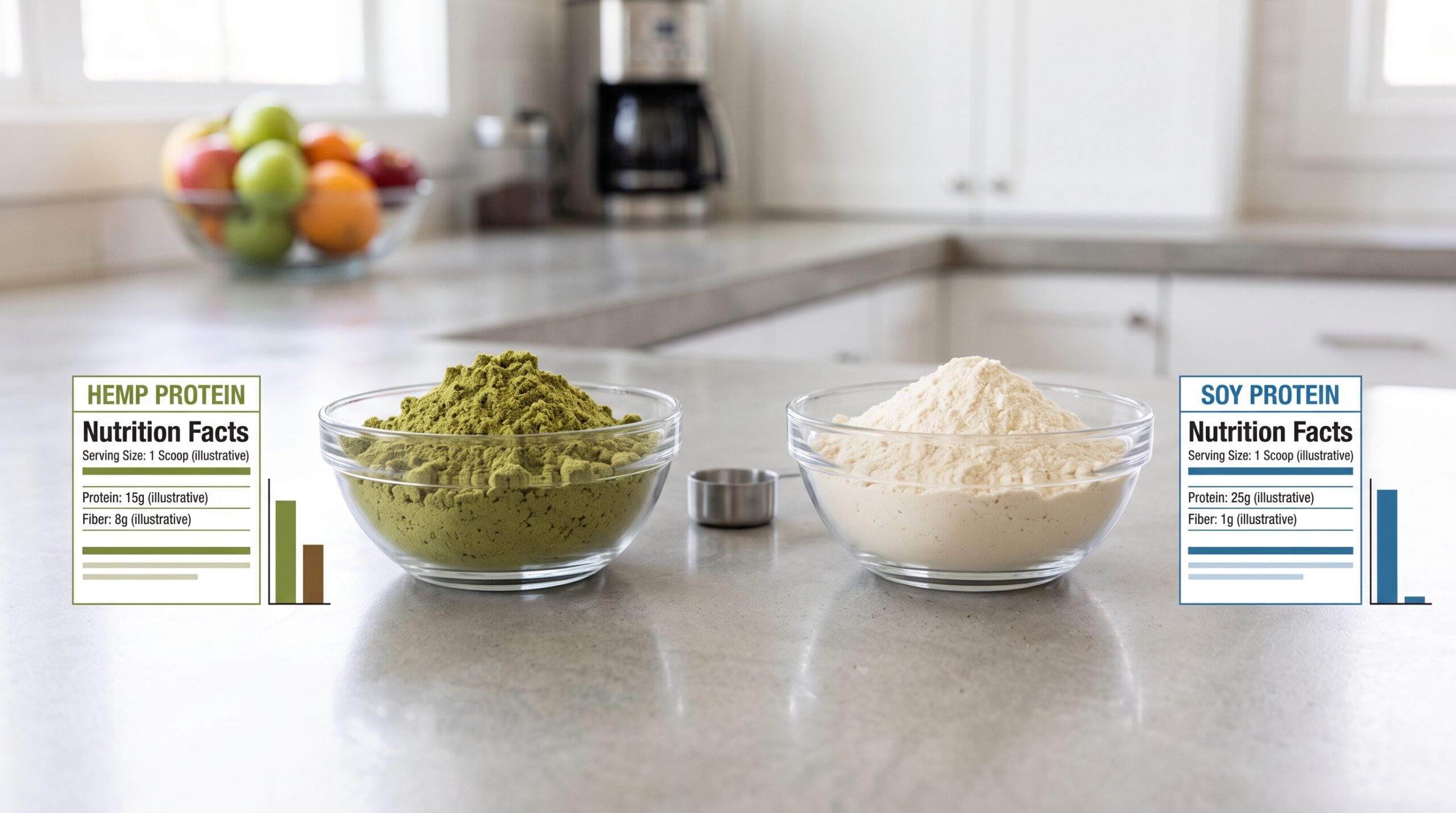
Neither hemp nor soy protein is automatically the better choice.
Soy protein isolate generally provides more concentrated protein and has a strong essential-amino-acid profile. Hemp protein also supplies all nine essential amino acids, but lysine is commonly its limiting amino acid and many hemp powders retain substantially more fiber.
The better choice depends on the job: protein concentration, fiber, allergies, digestion, texture, ingredients, price, and how the powder fits into the rest of your diet.
Hemp Protein vs. Soy Protein at a Glance
| What Matters | Hemp Protein | Soy Protein |
|---|---|---|
| Plant based? | Yes | Yes |
| All nine essential amino acids? | Yes, although lysine is commonly limiting when protein quality is evaluated. | Yes. Soy generally has a well-balanced essential-amino-acid profile. |
| Protein concentration | Often lower when more fiber and other seed components remain. | Soy isolates are typically highly concentrated in protein. |
| Fiber | Can provide meaningful fiber depending on processing. | Usually low in highly refined soy protein isolate unless fiber is added. |
| Major U.S. food allergen? | No, although allergic reactions to hemp can still occur. | Yes. Soybeans are one of the nine major food allergens recognized under U.S. law. |
| Typical texture | Earthy, seed-forward, and sometimes slightly gritty. | Soy isolates can be smoother and more neutral, although products vary. |
| Strongest practical reason to choose it | You want plant protein with more of the fiber and characteristics of the seed. | You want concentrated plant protein in a relatively small portion. |
Those are useful tendencies, not guarantees about every package.
A flavored hemp blend may contain little fiber. A soy formula may include added fiber, sweeteners, gums, flavoring, or other protein sources.
The Nutrition Facts panel gets the final vote.
The First Mistake: Comparing One Scoop With One Scoop
Scoops look wonderfully official.
Unfortunately, they are not standardized.
One manufacturer may call 30 grams a serving. Another may use 40 grams. If the second product shows more protein per scoop, that does not automatically make it more protein-dense.
15 g protein
50% protein by weight
24 g protein
60% protein by weight
Simple formula: Protein grams ÷ serving weight in grams × 100
This calculation does not measure amino-acid quality or digestibility. What it does is prevent a larger scoop from appearing superior simply because it contains more powder.
If you want to understand that distinction more deeply, read Is Hemp Protein a Complete Protein?.
Protein Quality: Soy Has an Advantage Here
Both hemp and soy contain all nine essential amino acids, but their proportions and digestibility are not identical.
Soy protein is generally considered one of the higher-quality plant proteins because its essential-amino-acid profile is relatively strong and processed soy protein can be highly digestible.
Hemp is a little more complicated.
Hemp contains all nine essential amino acids, but lysine is commonly the limiting amino acid. Research has also shown that protein quality and digestibility can differ depending on whether the protein comes from hemp hearts, defatted seed material, or more heavily concentrated protein fractions.
A food can contain all nine essential amino acids while still having different amino-acid proportions, digestibility, protein concentration, and overall nutritional characteristics.
Hemp’s Fiber May Be Its Biggest Practical Difference
This is one of the reasons hemp protein deserves to be evaluated differently from a highly refined protein isolate.
Many hemp powders retain meaningful amounts of fiber from the seed.
That can be an advantage when you intentionally want both protein and fiber. But it can also change how a smoothie feels, how filling it becomes, and how your digestive system responds.
Consider a breakfast that already contains oats, berries, chia seeds, and fruit.
Adding a large serving of fiber-rich hemp protein may turn that smoothie into a substantially higher-fiber meal.
That’s not automatically good or bad. It is something to notice.
If hemp protein seems to cause stomach discomfort, don’t assume the protein itself is automatically the culprit. Serving size, total fiber, sweeteners, gums, milk alternatives, and the rest of the meal can matter.
My guide on hemp protein, gas, and bloating walks through that problem more carefully.
Soy Allergy Can End the Comparison Quickly
Soybeans are one of the nine major food allergens recognized under U.S. federal food-labeling rules.
For someone with a diagnosed soy allergy, that consideration matters far more than whether soy happens to score well in a protein-quality comparison.
Hemp is not one of the nine major U.S. food allergens.
That does not mean allergic reactions to hemp are impossible.
People can develop allergic reactions to foods that are not on the major-allergen list.
If eating a protein powder is followed by hives, swelling, wheezing, difficulty breathing, throat tightness, faintness, or rapidly worsening symptoms, stop using the suspected product and seek appropriate medical help.
Difficulty breathing or throat swelling can be an emergency.
For a deeper look at this distinction, read Can You Be Allergic to Hemp Protein?
Which One Is Easier to Digest?
This question sounds simple but has two different meanings.
Researchers can measure how efficiently dietary protein is digested and absorbed.
You, on the other hand, may be asking whether a particular shake makes your stomach uncomfortable.
Those are related—but they aren’t the same thing.
Your digestive experience can be affected by:
- how much powder you use,
- the amount of fiber in the powder,
- sweeteners or sugar alcohols,
- gums and thickeners,
- milk or plant beverages,
- fruit and other carbohydrates,
- the size of the entire meal, and
- your individual tolerances.
That makes statements such as “hemp is easier to digest” or “soy is easier to digest” far too broad.
Protein digestibility matters.
So does the complete recipe.
Which Protein Makes More Sense for Muscle and Training?
If your main goal is packing a substantial amount of protein into a relatively small amount of powder, soy protein isolate often has the practical advantage.
Its high protein concentration and essential-amino-acid profile make it an efficient plant-protein option.
But that does not make hemp useless for active people.
Hemp protein still contributes amino acids and dietary protein to your daily total. Someone who prefers hemp’s fiber, flavor, ingredient profile, or less-refined character may simply need to think differently about the portion and the rest of the meal.
Does Soy Protein Affect Male Hormones?
This is probably one of the most persistent questions surrounding soy.
Soy contains naturally occurring compounds called isoflavones. Because these compounds are classified as phytoestrogens, they have sometimes been portrayed online as though eating soy automatically raises estrogen or lowers testosterone in men.
That claim is not supported by the overall clinical evidence.
An updated meta-analysis of clinical studies found no significant effect of soy protein or soy isoflavone exposure on measured testosterone or estrogen outcomes in men.
That does not mean every soy food is identical or that everyone needs soy.
It does mean the familiar claim that ordinary soy intake automatically “feminizes” men goes well beyond what clinical research has demonstrated.
Hemp Protein Is Not CBD Protein
The word hemp brings another layer of confusion.
Plain hemp seed protein is a food ingredient produced from hemp seeds.
It should not automatically be treated as though it were CBD oil, THC, or a cannabinoid supplement.
The FDA has explained that hemp seeds themselves do not naturally contain significant amounts of THC or CBD, although trace contamination can occur through contact with other parts of the plant during harvesting and processing.
If a product deliberately contains CBD, hemp extract, THC, or another cannabinoid, that is a different product and deserves a separate evaluation.
Read the entire ingredient list.
Use This 7-Point Label Comparison
Rather than memorizing which protein supposedly wins, compare two real packages.
How many grams of actual powder are in the serving?
How many grams of protein does that amount provide?
Are you deliberately choosing extra fiber, or is it simply along for the ride?
Is this a simple protein powder or a flavored blend containing sweeteners, gums, fibers, and other ingredients?
Check the ingredient list and allergen statement for anything relevant to you.
Compare cost per serving and cost for an equal amount of protein—not just the price of the bag.
What are you actually putting the powder into, and what nutritional job is it supposed to perform?
You can also use my hemp protein cost guide to compare value more realistically.
If you are expecting protein powder to replace breakfast or lunch entirely, read Can Hemp Protein Replace a Meal? before making that jump.
The P.I.C.K. Plant-Protein Planner
P — Pick the Job
I — Inspect the Labels
C — Compare on Equal Terms
Protein concentration: protein grams ÷ serving grams × 100
K — Keep What Works
This planner is designed to help compare food labels and personal preferences. It does not diagnose allergies or prescribe an individualized protein intake.
Four-Question Knowledge Check
Pick your answer before opening the explanation.
1. Hemp and soy both contain all nine essential amino acids. Does that make their protein quality identical?
No. Amino-acid proportions, digestibility, processing, and protein concentration differ. Hemp commonly has lysine as a limiting amino acid, while soy has a particularly strong overall plant-protein profile.
2. A larger scoop automatically means a more concentrated protein powder. True or false?
False. The serving itself may simply be larger. Divide protein grams by serving weight to compare concentration more fairly.
3. Soybeans are one of the nine major U.S. food allergens. True or false?
True. Soy is subject to major-allergen labeling requirements in the United States.
4. Hemp protein powder is basically another form of CBD powder. True or false?
False. Plain hemp protein is a seed-derived food ingredient. CBD and other cannabinoid ingredients are different products.
Frequently Asked Questions
Is hemp protein better than soy protein?
Neither one wins in every situation. Hemp can make sense when you value fiber and the nutritional characteristics retained from the seed. Soy protein isolate often makes more sense when highly concentrated plant protein is the priority.
Is soy protein a complete protein?
Yes. Soy provides all nine essential amino acids and is generally considered a high-quality plant protein.
Is hemp protein a complete protein?
Hemp contains all nine essential amino acids, but lysine is commonly the limiting amino acid. That is why looking beyond the phrase “complete protein” gives you a more useful comparison.
Does hemp protein contain more fiber than soy protein?
Many conventional hemp protein powders contain substantially more fiber than soy protein isolates because more of the original seed material remains. Product labels vary, so always check the exact powder.
Which is easier to digest?
There is no universal answer. Protein digestibility differs between ingredients and processing methods, while digestive comfort is also affected by fiber, serving size, additives, the rest of the meal, and individual tolerance.
Does soy protein increase estrogen in men?
Clinical research and meta-analysis do not support the claim that ordinary soy protein or soy isoflavone intake significantly raises estrogen or lowers testosterone in men.
Can I use hemp or soy protein every day?
Either may fit into a recurring diet when the amount, product, and overall eating pattern make sense for the individual. Protein powder is a food tool—not something everyone must use.
For the hemp side specifically, see Can You Take Hemp Protein Every Day?
Can a soy allergy be serious?
Yes. Food-allergy reactions can be severe. Anyone with a diagnosed soy allergy should follow their medical care plan and avoid assuming that a protein supplement is safe merely because it is marketed as healthy or plant based.
The Bottom Line
Hemp and soy are both legitimate plant-protein choices, but they solve somewhat different problems.
Soy protein isolate usually has the advantage when concentrated protein and strong measured protein quality are the priority.
Hemp becomes more interesting when you want protein together with the fiber and other characteristics retained from the seed.
Neither plant name tells you enough by itself.
Turn the package around.
Compare equal amounts. Check the protein. Look at the fiber. Read the ingredients. Consider allergens. Think about what the powder is actually replacing or adding to your meal.
The best plant protein isn’t the one that wins an internet argument. It’s the one whose nutrition label, ingredients, portion, price, and purpose make sense in your actual diet.
What Would Decide It for You?
If you were choosing between hemp protein and soy protein today, what would matter most?
Protein per serving? Fiber? Ingredients? Taste? Digestion? Allergy concerns? Price?
Share what would make the decision for you in the comment section. Your experience may help another reader know what to compare before buying their next bag.
Evidence and Further Reading
- U.S. Food and Drug Administration — Food Allergies and Major Food Allergens
- U.S. Food and Drug Administration — Hemp Seed-Derived Ingredients for Human Food
- PubMed — Protein Quality of Hemp Protein Sources
- PubMed — Digestibility and Nutritional Value of Soy Protein Isolate
- PubMed — Soy, Isoflavones, and Reproductive Hormones in Men: Updated Meta-Analysis
Nutrition and safety note: This article provides general food and nutrition information. It does not diagnose a food allergy, prescribe an individualized protein intake, or replace advice from a physician or registered dietitian. Individual guidance may be especially important for diagnosed food allergies, medically prescribed diets, kidney disease, pregnancy, childhood nutrition, recovery from illness, or specialized athletic nutrition.