

Hemp nutrition · Gluten-free label guide · Evidence checked September 20, 2026 · No product endorsements
The front of a hemp protein bag may say “plant-based,” “organic,” or “one ingredient.” None of those phrases answers the question a person with celiac disease actually needs answered: Does this finished product meet a dependable gluten-free standard?
Hemp seed is not wheat, barley, or rye. But the seed is only the beginning of the product’s trip through harvesting, transport, milling, blending, and packaging.
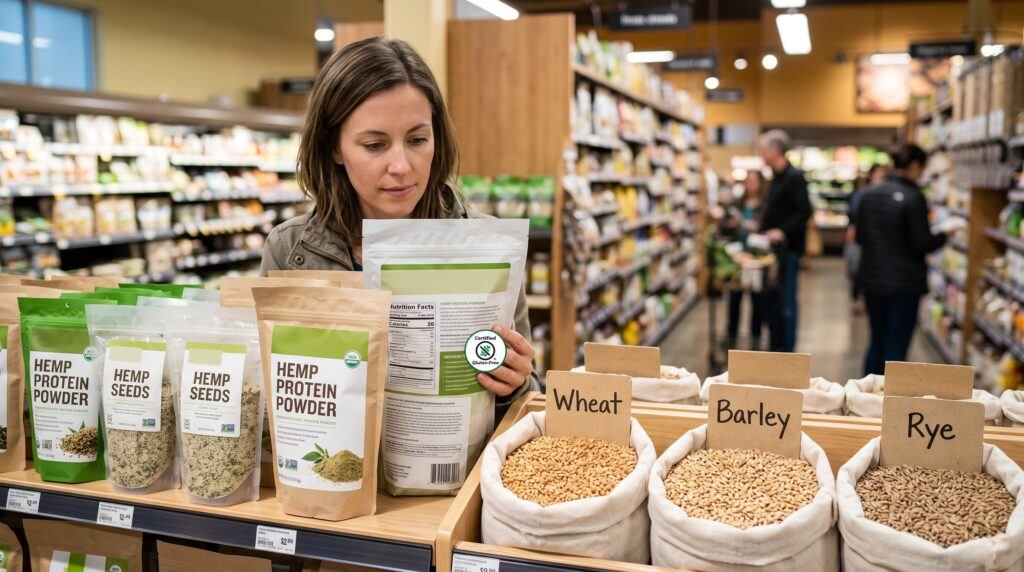
Quick answer: Is hemp protein gluten-free?
Plain hemp seed does not naturally contain the gluten proteins found in wheat, barley, and rye. A retail hemp protein powder is not automatically suitable for a strict gluten-free diet, however. Added ingredients, shared equipment, transport, or processing can change the finished-product question.
For a shopper with celiac disease, the most useful starting point is the exact current package bearing a “gluten-free” claim. Under the U.S. Food and Drug Administration rule, foods using that claim must meet specific ingredient restrictions and contain less than 20 parts per million of gluten. Still read the ingredient list, check the exact flavor, and ask the manufacturer when the package leaves an important question unanswered.
The three places the answer can change
“Hemp is gluten-free” describes the seed. “This hemp protein powder is gluten-free” describes a finished food. Those are related statements, but they are not interchangeable.
The seed
Hemp is not one of the gluten-containing grains identified by FDA: wheat, barley, rye, or their crossbreeds.
The process
Transport, mills, storage bins, and production lines may also handle grain ingredients. Controls and cleaning matter.
The finished pouch
Flavorings, grain-based additions, facility controls, and the final label determine what the product actually claims.
Infographic: Follow the product from seed to process to finished pouch. The final package—not a general statement about hemp—answers the shopping question.
What a U.S. “gluten-free” claim actually means
The FDA says “gluten-free,” “no gluten,” “free of gluten,” and “without gluten” are regulated claims. A food using one of them must contain less than 20 parts per million of gluten and cannot use disallowed wheat, barley, rye, or crossbred-grain ingredients.
The claim is voluntary: a manufacturer is not required to print it. That means a bag without the phrase is not automatically proven to contain gluten. It also means the ingredient list by itself may not provide enough product-specific reassurance for someone who must avoid cross-contact.
The useful distinction
Naturally gluten-free describes what an uncombined food contains by nature. Labeled gluten-free places a defined responsibility on the manufacturer of the finished packaged food.
Gluten-free, certified, wheat-free, or no claim?
These label signals do different jobs. Do not treat them as four ways of saying the same thing.
| What the package says | What it tells you | What it does not tell you | Practical response |
|---|---|---|---|
| Gluten-free | The finished FDA-regulated food must meet the federal gluten-free definition, including the less-than-20-ppm limit. | It does not make the product healthier, more protein-dense, or safe for every separate food allergy. | Use the exact current package; still inspect ingredients and your own medical requirements. |
| Certified gluten-free | A private certification program adds its own review, testing, or audit requirements. | FDA does not endorse or require a particular certification logo; program standards can differ. | Identify the certifier and its current standard instead of trusting an unfamiliar symbol. |
| Wheat-free | The statement addresses wheat in some way. | It does not, by itself, address barley, rye, or every gluten cross-contact route. | Do not substitute it for a regulated gluten-free claim when strict gluten avoidance is required. |
| No gluten-free claim | The manufacturer has not made the regulated claim on that package. | It does not prove the food contains gluten or that it is below the FDA threshold. | Contact the manufacturer or choose a clearly labeled alternative when uncertainty matters medically. |
Why the “Contains” line cannot do the whole job
Wheat is one of the nine major allergens that must receive special U.S. label treatment when intentionally present. Barley and rye are not on that major-allergen list. A “Contains” statement with no wheat therefore does not establish that a product is gluten-free.
Advisory phrases such as “may contain wheat” or “made in a facility that also processes wheat” are voluntary. Their presence deserves attention; their absence is not a manufacturer guarantee that cross-contact is impossible.
Also separate celiac disease from wheat allergy. A gluten-free claim is designed around gluten. A person with wheat allergy may need to avoid other wheat proteins too, so an allergist or other qualified clinician should guide that decision. If your concern began with hives, swelling, wheezing, or another possible food reaction, use the separate hemp protein allergy guide rather than assuming gluten is the cause.
A 60-second hemp protein label check
Read the package in this order. The front design comes last, not first.
1. Find the exact claim
Look for “gluten-free,” “no gluten,” “free of gluten,” or “without gluten” on the current bag. Do not borrow a claim from an online photo of another size or flavor.
2. Read every ingredient
Check for wheat, barley, rye, malt, brewer’s yeast, grain-based flavors, cookie pieces, oats, or other additions that make a blend different from plain hemp protein.
3. Review allergen language
Read the mandatory “Contains” statement and any voluntary “may contain” or shared-facility statement. Neither replaces the complete ingredient list.
4. Match the exact version
Plain, chocolate, vanilla, greens blends, and meal-replacement powders may use different ingredients or production lines. Record the flavor and package size.
5. Check the manufacturer
If the label is unclear, ask whether this finished product carries a gluten-free claim and how cross-contact is controlled. Ask about the exact item, not the brand in general.
6. Recheck each new bag
Formulas, suppliers, labels, and facilities can change. A package you used last year is not the evidence for the bag you are opening today.
Infographic: Claim, ingredients, allergen language, exact version, manufacturer, and recheck. Six short checks turn a vague front-label impression into a product-specific decision.
Which hemp protein format gives you the clearest answer?
A short ingredient list makes the formula easier to understand, but it does not document cross-contact by itself. Compare the complete product, not only the number of ingredients.
| Product format | Likely label complexity | Main gluten question | Best next check |
|---|---|---|---|
| Single-ingredient hemp protein in a sealed bag | Low | Was the finished powder protected from cross-contact? | Look for the regulated gluten-free claim and current manufacturing information. |
| Flavored hemp protein | Moderate | Do flavors, thickeners, inclusions, or sweeteners introduce a grain-derived ingredient? | Read the complete list for that exact flavor. |
| Multi-protein or meal-replacement blend | High | Do oats, cereal ingredients, added proteins, or flavor systems change the answer? | Judge the entire finished blend, not the hemp component. |
| Bulk-bin or repackaged powder | Unclear | What contacted the bin, scoop, transport container, or repacking surface? | Choose sealed, clearly labeled packaging when strict avoidance is required. |
The kitchen can change the answer too
A compliant powder can still meet gluten after the bag is opened. Shared scoops, a blender with residue, a cutting board, an open flour container, or ordinary oats that are not labeled gluten-free can introduce cross-contact at home.
The National Institute of Diabetes and Digestive and Kidney Diseases advises people with celiac disease to store and prepare gluten-free foods separately when needed and to use gluten-free oats because cross-contact with gluten-containing grains is common. Follow the plan created with your clinician or registered dietitian rather than assuming one household rule fits everyone.
A smoothie example
The hemp powder may carry a gluten-free claim, while the oats, flavored plant milk, granola topping, or shared blender do not. Judge the finished smoothie ingredient by ingredient. If digestive discomfort—not diagnosed celiac disease—is the problem, compare serving size and the complete recipe with the site’s hemp protein gas and bloating checklist.
The P.I.C.K. Gluten-Free Planner
Use this four-part planner before buying a new bag or changing a medically necessary diet.
Pin down the requirement
Are you managing diagnosed celiac disease, a wheat allergy, another clinician-identified condition, or a personal preference? Those questions overlap, but they are not medically identical.
Inspect the exact package
Record the gluten-free claim, complete ingredients, allergen statements, flavor, package size, best-by date, and lot information. Do not rely on the brand name alone.
Confirm what the label cannot
When the label is silent or ambiguous, ask the manufacturer about the finished product and cross-contact controls. Bring medical uncertainties to a clinician or registered dietitian.
Keep the evidence current
Save a label photo and recheck each replacement bag. If a product causes a concerning reaction, keep the package and seek appropriate care rather than running a home test.
Infographic: Pin down, Inspect, Confirm, and Keep. The P.I.C.K. planner connects the dietary need to the exact finished product.
If you also want to compare nutrition quality, use the separate guide to hemp protein digestibility. A gluten-free claim answers a food-safety labeling question; it does not measure protein concentration, amino-acid balance, or digestibility. Likewise, “gluten-free” does not replace the batch-specific contaminant checks explained in the heavy-metals and lab-report guide.
Do not use symptoms to diagnose yourself
Bloating, diarrhea, fatigue, abdominal discomfort, and other symptoms can have many causes. They cannot tell you by themselves whether you have celiac disease, a wheat allergy, sensitivity to another ingredient, a large fiber increase, or an unrelated condition.
NIDDK advises talking with a doctor about celiac testing before starting a gluten-free diet. Removing gluten first can make diagnostic test results less accurate. A registered dietitian can also help prevent nutritional gaps when long-term avoidance is necessary.
Seek urgent help for a possible allergic emergency
Trouble breathing, throat or tongue swelling, faintness, loss of consciousness, or rapidly worsening symptoms can be an emergency. Call 911 in the United States—or your local emergency number—and follow any prescribed allergy action plan. Celiac disease and immediate food allergy are different conditions; do not wait for a blog post to sort out urgent symptoms.
Four-question interactive knowledge check
Choose your answer before opening each explanation.
1. Does hemp seed naturally contain the gluten found in wheat, barley, and rye?
Answer: No. Hemp is not one of those gluten grains. The finished powder still requires a product-specific check for added ingredients and cross-contact.
2. Does “wheat-free” mean the same thing as “gluten-free”?
Answer: No. Gluten also occurs in barley, rye, and their crossbreeds. A wheat-free phrase does not substitute for the FDA-regulated gluten-free claim.
3. Does the absence of a “may contain wheat” statement prove there was no cross-contact?
Answer: No. FDA explains that advisory statements are voluntary. Use the gluten-free claim, complete label, manufacturer information, and your professional care plan.
4. If you suspect celiac disease, should you stop gluten before discussing testing with a doctor?
Answer: No. NIDDK advises speaking with a doctor before beginning a gluten-free diet because avoiding gluten can make diagnostic test results inaccurate.
Frequently asked questions
Can someone with celiac disease use hemp protein?
A hemp protein powder may fit a gluten-free diet when the exact finished product meets the applicable gluten-free standard and the rest of the recipe is also protected from cross-contact. Use a current package with a gluten-free claim and follow individualized advice from a clinician or registered dietitian.
Is one-ingredient hemp protein automatically gluten-free?
No. One ingredient simplifies the formula, but it does not describe harvesting, transport, milling, storage, or packaging controls. The finished-product claim remains more useful than ingredient count alone.
Is certified gluten-free better than a gluten-free label?
Certification can add a private program’s testing, audit, or threshold requirements. It is not required by FDA, and FDA does not endorse one certifier. A standard gluten-free claim on an FDA-regulated food must still meet the federal definition.
Is gluten-free hemp protein safe for a wheat allergy?
Not necessarily for every person. Celiac disease concerns gluten, while wheat allergy can involve other wheat proteins. Ask an allergist or qualified clinician which labels, ingredients, and cross-contact precautions fit the diagnosed allergy.
What if the bag lists only hemp protein but has no gluten-free claim?
The ingredient list suggests no gluten grain was intentionally added, but it does not establish the finished product’s gluten level or cross-contact controls. If strict avoidance matters, contact the manufacturer or choose an appropriately labeled product.
Do organic, vegan, or non-GMO labels mean gluten-free?
No. Those claims address different standards. None replaces the regulated gluten-free wording on the exact finished package.
Should I check every new hemp protein bag?
Yes. Formulas, suppliers, facilities, package sizes, and flavors can change. Rechecking the current label is a small habit with more value than relying on an old product photo or memory.
The bottom line
Hemp seed is not wheat, barley, or rye, so plain hemp does not naturally begin with those gluten proteins. But a bag of hemp protein has a longer story than the seed.
For a strict gluten-free diet, start with the exact finished package and a regulated gluten-free claim. Read every ingredient, distinguish gluten-free from wheat-free, treat voluntary advisory statements as only one clue, and check the rest of the smoothie. When a diagnosis, allergy, symptoms, or testing is involved, bring the question to a qualified professional instead of experimenting at home.
What does your bag actually say?
Check your hemp protein label and tell me in the comments: Does it say “gluten-free,” “certified gluten-free,” “wheat-free,” or nothing at all? Share only the wording and ingredient clues—no medical records, personal diagnoses, or full lot numbers. Your label question may help shape the next evidence-first guide.
Authoritative sources and further reading
- U.S. Food and Drug Administration: Gluten and Food Labeling
- U.S. Food and Drug Administration: “Gluten-Free” Means What It Says
- NIDDK: Eating, Diet, and Nutrition for Celiac Disease
- U.S. Food and Drug Administration: Food Allergies and Labeling
Medical and editorial note: This article provides general food-label and nutrition education. It does not diagnose celiac disease, gluten sensitivity, wheat allergy, hemp allergy, or another condition; prescribe an elimination diet; or replace individualized advice from a physician, allergist, gastroenterologist, registered dietitian, or emergency clinician.